• December 2025 Turning Challenge: Single Tree! (click here for details)
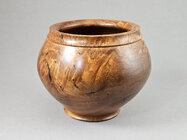
  • Congratulations to Bob Henrickson, People's Choice in the November 2025 Turning Challenge (click here for details)
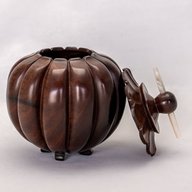
  • Congratulations to Guillaume Fontaine for "Old Tea Pot" being selected as Turning of the Week for December 15, 2025 (click here for details)
  • Welcome new registering member. Your username must be your real First and Last name (for example: John Doe). "Screen names" and "handles" are not allowed and your registration will be deleted if you don't use your real name. Also, do not use all caps nor all lower case.

What now?

Russ Braun

TOTW Team
Joined
Nov 18, 2012
Messages
825
Likes
2,712
Location
Torrance, CA
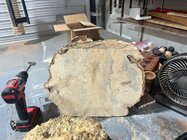
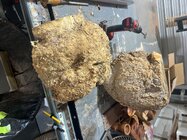
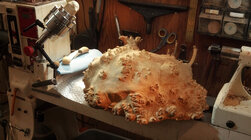
I spent $10 on this piece of wood at our club raffle. It looks to be a trunk with burl wrapping it. I split it in half and likely killed some better options to use it. I am a Segmenter…don’t know any better. Ideas are anticipated and will be greatly appreciated…no cutting it up into segments please, lol!!
 

Attachments

  • IMG_4413.jpeg
    IMG_4413.jpeg
    1.1 MB · Views: 70
  • IMG_4412.jpeg
    IMG_4412.jpeg
    746.7 KB · Views: 70
Do you want two turned items from the two halves, or maybe multiple smaller project pieces? The rather random grain pattern gives you a bit more freedom to continue cutting down into some smaller pieces, if you'd want. Richard Raffan has a few videos on youtube of cutting larger pieces down to yield several turning blanks. If you find the wood has some special appeal to make many finished items, I might think of using one of the two pieces you have to cut down to multiple smaller project blanks. Tea cup size bowls, small plates, boxes, etc. Have fun with it!
 
If you find the wood has some special appeal to make many finished items, I might think of using one of the two pieces you have to cut down to multiple smaller project blanks

When I process any wood, green or dry, I keep the smaller useful pieces, often ending up with a box or three of pieces cut to size for pen blanks - some nicely figured, spalted, good color, some great exotic woods (cocobolo, olive, etc). I don't turn pens so I save them for the club "Pens for Troops" project, drying first if needed, discarding those that warp too much.

Occasionally I'll tape together bundles of a dozen nice pen blanks for our club auctions. I'm always amazed at the prices these bring. These I lay flat in a row and bind with clear packing tape to let them see the sides of the wood in the bundle.

I also know someone who does wonderful inlays so pieces with interesting figure or color go into another box for him to look through.

Other sizes and shapes not otherwise useful go into tubs. I've taken these to high school art teachers for students to glue together, color, and make masterpieces!. Various thin rectangular pieces are great, keeps them out of the burn barrel. Some teachers may like little burl offcuts, even with bark, to hot-glue into sculptures or 3d pictures. (Tip: some schools struggle with funding and some teachers buy supplies with their own money.)

Even small pieces of plywood with one smooth side don't get wasted. After my 3-year-old grandson saw some in my shop and asked if he could draw on one I prepared several boxes of random sizes for pre-school teachers (I sanded edges and corners smooth - 1/2" Radiata pine is perfect for this). Little kids hardly EVER get to draw with markers on anything but paper!

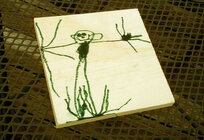
BTW, this is the self portrait the grandson, at age 3, drew on his piece of plywood. He said he had lightning coming from his hands and fire from his feet! I display it along with art from Italy and prized pieces from other turners!

1766150919175.jpeg

JKJ
 
With a big burl, my first thing is to try and figure out how deep the figure goes. If I can see eyes on the cut surface, then I know. Otherwise I will probably make a couple exploratory cuts on the sides - trying not to cut down my options too much.
If the figure is shallow, then I probably will do a flat-edge bowl cut around the perimeter of the burl to capture as much figure as possible.
If the figure is deeper, you get more options like a natural edge bowl (and cores) or a hollow form etc.
Don’t discount cutting it up into smaller pieces. Sometimes getting several small forms, goblets, art pieces, etc is better than just one big bowl.
 
When I process any wood, green or dry, I keep the smaller useful pieces, often ending up with a box or three of pieces cut to size for pen blanks - some nicely figured, spalted, good color, some great exotic woods (cocobolo, olive, etc). I don't turn pens so I save them for the club "Pens for Troops" project, drying first if needed, discarding those that warp too much.

Occasionally I'll tape together bundles of a dozen nice pen blanks for our club auctions. I'm always amazed at the prices these bring. These I lay flat in a row and bind with clear packing tape to let them see the sides of the wood in the bundle.

I also know someone who does wonderful inlays so pieces with interesting figure or color go into another box for him to look through.

Other sizes and shapes not otherwise useful go into tubs. I've taken these to high school art teachers for students to glue together, color, and make masterpieces!. Various thin rectangular pieces are great, keeps them out of the burn barrel. Some teachers may like little burl offcuts, even with bark, to hot-glue into sculptures or 3d pictures. (Tip: some schools struggle with funding and some teachers buy supplies with their own money.)

Even small pieces of plywood with one smooth side don't get wasted. After my 3-year-old grandson saw some in my shop and asked if he could draw on one I prepared several boxes of random sizes for pre-school teachers (I sanded edges and corners smooth - 1/2" Radiata pine is perfect for this). Little kids hardly EVER get to draw with markers on anything but paper!

BTW, this is the self portrait the grandson, at age 3, drew on his piece of plywood. He said he had lightning coming from his hands and fire from his feet! I display it along with art from Italy and prized pieces from other turners!

View attachment 82972

JKJ

He has 'powers'
 
Big burls, I reckon they never really dry out. So you can turn them green then apply any finish after they stopped moving and often I get a crazy leather type finish.
 
Big burls, I reckon they never really dry out.
Hmm, they should all dry given a dry environment and enough time. I have dried a bunch and have more burls and chunks drying. The big maple burl may take years.

1766176151236.jpeg 1766176131687.jpeg

I wonder if I'll ever get around to turning the big one. Maybe I should cut it up into pen blanks.
But it's so nice to look at!

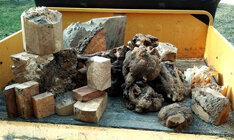
The one at the upper left in the back of the little truck is the sister piece of the one I made this from. (Hard to predict the insides!)

1766177946638.jpeg

I came up with another use for small burl offcuts. Our friend Jake makes ornament hangers from wires cut from whisks from the cooking section in Walmart. He bends the wire and turns a wooden base. I started sticking the wires into holes drilled in small piece of burl. Makes for an interesting base. I made some with one, two, and three wires. Sometime I'll put the spiky part of the burl out and sometimes I'll sand and finish a cut side showing the figure. Doesn't even matter if the piece of burl is dry!

(These are John Lucas ornaments, one on a wire on a small piece of burl.
(He has as article in the AAW mag showing these ornaments but I can't remember the which issue.)

1766178459756.jpeg

JKJ
 
Back
Top