• The forum upgrades have been completed. These were moderate security fixes from our software vendor and it looks like everything is working well. If you see any problems please post in the Forum Technical Support forum or email us at forum_moderator (at) aawforum.org. Thank you
  • March 2026 Turning Challenge: Olla! (click here for details)
  • Congratulations to David Wyke, People's Choice in the February 2026 Turning Challenge (click here for details)
  • Congratulations to Dave Bell for "Torus Teapot" being selected as Turning of the Week for March 9, 2026 (click here for details)
  • Welcome new registering member. Your username must be your real First and Last name (for example: John Doe). "Screen names" and "handles" are not allowed and your registration will be deleted if you don't use your real name. Also, do not use all caps nor all lower case.

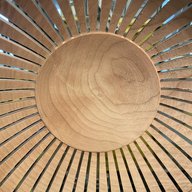
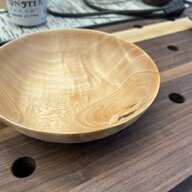
What would you price would you suggest for this turning

Hello Pat!

I learned that platter base technique many years ago from the amazing Frank Penta (incredibly creative woodturner, educator, and wonderfully energetic and generous person!) at one of his platter courses at John C Campbell. (I hope posting this much detail is not inappropriate for this thread. Now that I've written it, I'm wondering if it might have been better in a separate thread in a different sub-forum.)

It’s a multi-axis turning - basically drill four holes in what will be the top of the platter. Each is sized to fit what is often called a “woodworm” screw. One hole is in the exact center to turn the outside diameter, most of the bottom, and the chuck recess for eventually turning the top. The other three are in a circle a short distance (1/2" for this platter) from the center, spaced 120 degrees apart. These three holes will let you turn the multi-axis base.

John,
I appreciate such a detailed answer!
I’ll have to give this a try. And, look up Frank Penta. Such great inspiration in this forum 🙂
Thanks,
Pat
 
Dave Landers touched on the point I wanted to post - Whatever it is, from artwork to utility pieces, they are worth what someone else will pay for it.

The ideal case is where both the buyer and the seller end the transaction feeling like they made an excellent bargain!

I'll often have pieces I don't think much of and did not take much time to make sell for more money than a well thought out design that took a ton of work to make... As well, over the years (3 years now) that I've regularly been vendoring at various local markets I have found that the audience is variable as well as the price they'll pay.

One week, I might sell a bunch of bowls and turned stuff, the next week I sell nothing, but I manage to sell things like the crates I make (they are not even nicely finished or pretty) to carry my wood items into the market, or other flatwork.

As well, One week I might see several people admiring my work and saying "your prices are too low!" (though they don't really buy anything) and the next week, the crowd that comes by thinks I am overpriced! (without even changing my price tags between markets)
That’s why I refuse to sell at craft fairs, I would rather not sell anything to strangers!
I turn for the fun of it and enjoy trying new things as I learn more from my peers!
Most I sell to family!
 
I’ve had this experience several times as well. Donating to a local fund raiser only to see the piece go for far less than I would have been able to sell it for. But I’ve also had the opposite. All depends on the audience.
I went to a two year technical forestry school in upstate New York, The New York State Ranger School. This summer was my class’ 50th reunion. I’ve donated bowls in the past to the reunion auction, and they’ve gone for decent prices, considering the small group and the employment level of most of the alumni. Anticipating my 50th reunion, and wanting to do something a bit more special, I asked the school if they could send me a piece of wood from the school forest to turn. I suggested a block 12”x12”x5 1/2” which would just fit in a USPS flat rate priority mail box. I received a nice piece of cherry in December and turned this bowl. After turning away some defects, it wound up being 10 1/2” x 4”. I was very gratified when it was one of the final pieces auctioned, and went for the high price of the night at $155. Certainly not a fortune by city gallery standards, but enough to make me feel proud of the contribution.
View attachment 66876View attachment 66877
b
 
I can't help with your question on that piece. I understand the difficulty, but my experience is limited since I usually don't try to sell things - mostly give them away to friends or friends of friends. For me, the joy is in the turning (and the teaching) I've never tried to sell a bowl or platter and over the years have seen many threads on pricing things, but mostly paid no attention. I usually rather give things away than sell them. I do sometimes donate pieces for charity auctions. But I do have a tiny bit of experience in what some people are willing to pay for certain things! It seems to me the more unique something is, the more people will pay.

The last time I auctioned off a platter for charity it went for over $300. But maybe it was that high because it was a good cause. (It did take hours to make.)

View attachment 67028

I made a bunch of these crops for a woman who wanted unique presents for her equine Hunter-Jumper competition team. No one had every seen crops like this.
I told her to make an offer so she gave me $100 each for maybe 25 or so.
(The wood is small and cheap, they are quick to make, and the fiberglass/leather part cost me about $3 each.)
I sold another one under pressure for a friend of a relative - he told the woman they were $300 each!
(Hey, to make money, maybe target people with money!)

View attachment 67029

I might sell when someone twists my arm. To price I think of how much I don't want to sell it, the time I have in it, and the material, although I mostly enjoy turning small things so the material cost is generally low.
When someone really wanted some of these wands I had on display at a symposium but didn't want to sell, I just priced them real high. I thought they would just go away but they didn't even blink at the price.

View attachment 67030

I did take things to special events a few times and sold them.

At a Harry Potter book release I set up at a bookstore and turned wands while people watched. Those had to be turned very quickly with no time to be fancy, so I charged $25 each. I had spent a lot of time making a detailed batch at home and my son set up a table - I priced those at maybe $40-$75 each. At one of these events we brought in $1740 in three hours. I think all we bought were sold.
The trick here was make things and sell them to people who REALLY want them!

COMPLETELY OFF TOPIC: When someone asks me to make something, I always tell them $60, whatever it is. But I tell them if they come to the shop, it's free. Help pick out the wood, work on the design, and watch while I make it (maybe even learn to make some shavings, sand a bit, or put on some finish. This method introduces a lot of people to woodturning and at least lets them understand what's involved. Most may never have any interest in turning, some may in the future, but I know few who took up the hobby right away.

After one such introduction, a girl returned repeatedly for lessons - now she has her own lathe and a "following" where she lives! She does it all for fun and gives everything away.
This is one of the things she turned in my shop (with a bit of instruction, made up on the spot since I'd never made one!) - a round frame for a friend who embroidered something personally significant for every day of the year 2020. (The friend divided the cloth circle into 12 sections, one for each month - clever!) It was a tricky turning project to design and hold. The turning part was easy for her.

View attachment 67033

JKJ

So its not like other shop stuff,
80/hr
If you watch its 90
If you talk its 100
If you offer suggestions its double
 
Back
Top