
-
It's time to cast your vote in the March 2026 Turning Challenge. (click here for details) -
Congratulations to Chris Lawrence for "Dragon's Grip" being selected as Turning of the Week for March 30, 2026 (click here for details) -
Welcome new registering member. Your username must be your real First and Last name (for example: John Doe). "Screen names" and "handles" are not allowed and your registration will be deleted if you don't use your real name. Also, do not use all caps nor all lower case.
You are using an out of date browser. It may not display this or other websites correctly.
You should upgrade or use an alternative browser.
You should upgrade or use an alternative browser.
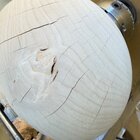
Why do these cracks develop?
- Thread starter Alan Weinberg
- Start date

john lucas
AAW Forum Expert
The outside is trying to dry and is shrinking. The inside isnt drying as fast and not shrinking so the outside cracks. If your fastest hollowing spraying tge outside with water will often stop it. If your slower cover the outside with stretch wrap.

(Sorry, I missed the adjective "dry" 8n the original post. A great example of how unlikely a blank of such size is to be dry throughout)
One of our club board members, who occasionally teaches for our facility, gave me the tip to use a citrus cleaner instead of water (he llikes Zep citrus cleaner). It work great for keeping the wood moist, slowing down unbalanced drying, but does not rust the lathe! I usually spray ostly the end grain since that's where the water comes out fast relative to face grain.
One of our club board members, who occasionally teaches for our facility, gave me the tip to use a citrus cleaner instead of water (he llikes Zep citrus cleaner). It work great for keeping the wood moist, slowing down unbalanced drying, but does not rust the lathe! I usually spray ostly the end grain since that's where the water comes out fast relative to face grain.
Last edited:
Your post lacks much information. Looks like the wood is not fully dry and just doing what comes naturally.Hollowing a dry blank—8.5 inch diameter and these cracks are developing. Am I doing something wrong?
Why did you think it was dry? Did you measure the moisture, and if so, how? Did you turn it round before starting the drying. What is the species! Did you seal the end grain before drying?
If you are hollowing or turning wet wood it will likely crack like that. What some people do is what John Lucas said: periodically spray the outside with water, especially when walking away from the lathe. Some spray then put plastic wrap or a plastic bag over piece if they can't get back to it for a few hours or overnight.
But I usually only turn dry wood. EMC dry. I cut a lot of green wood into blanks and dry before turning. I have very few failures. That one doesn't look nearly dry to me, just from looks and no data. A blank that size from some species may take 5 or more years to dry.
Here's how I work (with solid blanks):
- Cut the blank to size. Write the species and month/year on the outside.
- Coat at least the end grain with thickened Anchor seal
- Put the blank up where air can circulate around it. I dry in a climate controlled shop.
- After a few weeks, examine the blank. If I see any cracks start to develop (almost always in the endgrain) I cut back to good wood and reseal the end. Repeat the examination after a few more weeks.
- When I see no more initial cracks/checks develop I weigh the blank with a good digital kitchen scale. Write the month/year and the weight in grams on the tape and put it back on the drying shelves.
- Every few months, record the current weight.
- Continue until the weight no longer drops are actually goes up a bit with the seasons.
- At that point, the blank is dry. I carefully cut off the end and examine carefully for hidden cracks. The best way to to this is to cut a thin slice and bend it. If it breaks easily it indicates an invisible crack. Keep cutting away to good wood. Then the blank is dry and ready to turn.
Note that I have some large blanks that took over 10 years to air dry. Completely dry. Some were 10"x10"x16" A typical blank for a bowl might be 18"x18"x6" or more thick.
But there are other ways to work. Those who turn hollow forms from wet or not quite dry wood will have good suggestions. Maybe describe in as much detail as possible what you have done so far..
For more information there are a number of good books.
JKJ
Thanks—likely the issue. I’ll start spraying . . .The outside is trying to dry and is shrinking. The inside isnt drying as fast and not shrinking so the outside cracks. If your fastest hollowing spraying tge outside with water will often stop it. If your slower cover the outside with stretch wrap.
Question for the respondents. Spraying with water will postpone cracking by addong moisture to the surface. What happens when the turning is complete and spraying water ends. As the finished hollow vessel dries, why won't the vessel crack? If the wood is thin enough, and dries slowly, the wood will flex like a once turned bowl?
My standard practice is to coat the outside of the piece with medium super glue before hollowing. Been doing this for years to control drying and it works. In Arizona, where the relative humidity is more often less than 10% than not, I turn green log blanks into hollow forms. I do not need to know the moisture content of the blank I put on the lathe, but controlling the drying process is absolutely necessary. A CA-coated rough-turned piece will "live" for a while in a wastebasket plastic liner which is 31 mils (.031") thickness, thin enough to allow moisture to pass through very, very slowly over time. Some may think using CA glue this way is expensive, but it is not compared to the value of the wood itself, and all the work you put into creating a piece.

Question for the respondents. Spraying with water will postpone cracking by addong moisture to the surface. What happens when the turning is complete and spraying water ends. As the finished hollow vessel dries, why won't the vessel crack? If the wood is thin enough, and dries slowly, the wood will flex like a once turned bowl?
Yes, with the hollowing done and a consistent thickness, the wood is free to move and has much less chance of cracking.
When wood dries, it shrinks. If there is still wetter wood in the center, the outside is getting tighter around the inside and building tension. When it builds enough and the weakest point can't take anymore, it lets go, creating even greater stress in the adjacent areas/layers. It becomes a rapid (instant) chain reaction of release built up tension, leaving a crack.
Well, there could be a number of reasons, or a combination of reasons. One is the cracks may have already been there and they didn't come to light until you turned the outside of the bowl. So, was it dry before you started turning it? Also, if the cracks happened after you started turning it, then the wood would not have been as dry as you thought. Any wood over about 3 inches thick never reaches "equilibrium", which means the inside is always a bit damper than the outside which creates stress, and stress in wood is "relieved" by cracking. Did you turn it one day and come back the next day and find it cracked? That would be the equilibrium thing again. A piece that size would be sure to crack if you left it over night. Looks to be maybe 10 inch diameter and 3 to 4 inch thick. Again, that "equilibrium" thing.
robo hippy
robo hippy
Thought it was dry by the shavings while doing interior. Once turned it, outside first—and cracks developed as I finished turning inside, few at first, then more. Likely wasn’t as dry as I surmised. Will spritz exterior in future. 8+ inch diameter.
Thanks for all the comments.
Thanks for all the comments.
Did a hollow form yesterday and spritzed often with water: no cracks.
What about soaking in denatured alcohol for 24 hrs pre-turning? Does that have any value?
What about soaking in denatured alcohol for 24 hrs pre-turning? Does that have any value?
Some swear by the DNA soaking. For my once turned bowls, it makes no difference other than the wood seems to be a bit harder to sand out. To me, rounding over the rim, both inside and outside is a bigger help than the soak. Ideal is to keep the walls a fairly even thickness, and once the walls end, then you round things over must to make it easier to dry without cracking, and the rounded rims keep you from slicing your fingers. Sealing is important as well.
robo hippy
robo hippy

Kevin Jesequel
TOTW Team
Another thing not mentioned is to sharpen your hollowing tools frequently. They may still be cutting, but the duller they get, the more heat they generate and can cause heat checking from the inside. Also stop frequently and blow out the shavings and continue to blow cool air into the piece for a couple seconds. This isn’t necessary for all species, but it’s a good habit to get into.
Are you asking about soaking the blank before any turning?What about soaking in denatured alcohol for 24 hrs pre-turning? Does that have any value?
I’m just asking generally about DNA. Is it useful and at what point?Are you asking about soaking the blank before any turning?