• The forum upgrades have been completed. These were moderate security fixes from our software vendor and it looks like everything is working well. If you see any problems please post in the Forum Technical Support forum or email us at forum_moderator (at) aawforum.org. Thank you
  • March 2026 Turning Challenge: Olla! (click here for details)
  • Congratulations to David Wyke, People's Choice in the February 2026 Turning Challenge (click here for details)
  • Congratulations to Tim Connell for "Black Locust Basket Illusion Series #4" being selected as Turning of the Week for March 16, 2026 (click here for details)
  • Welcome new registering member. Your username must be your real First and Last name (for example: John Doe). "Screen names" and "handles" are not allowed and your registration will be deleted if you don't use your real name. Also, do not use all caps nor all lower case.

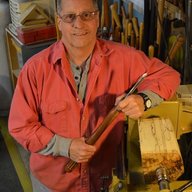
Why wouldn't this work for setting tool rest height?

Joined
Dec 29, 2022
Messages
1,232
Likes
1,572
Location
USA
1773712311062.png
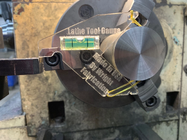
Seems like it would help? Put it on your round stock or tenon and double check tool rest height and where the tool is cutting when rested on the tool rest.

 
Because it’s not that important, and often the rest needs to be other than on-center.

A metal lathe is a different story for different reasoning.

Tim
I was thinking more along line of setting the tool on top of the tool rest and making sure it's cutting on line or slightly above.
 
edit: I didn’t even notice that was for a metal lathe. I think I need more sleep.

——————————————————-

Hmmm....
I've never thought about this much - I just adjust the rest to what "feels right" for the situation. I'll try to pay more attention when I get some lathe time.

I adjust the tool rest height based on the tool and how I hold it, the grind, the distance from the wood, and what gives me the cut I want for a particular turning. I learned long ago that raising or lowering the tool rest up or down by even a tiny bit can make a difference. And the best rest height might be different for a person of different height or arm/body proportions.

I might use a different height when turning long, thin spindles vs larger diameters. If the rest height isn't just right I'm afraid I might compensate with my shoulders or arms which could add tension and fatigue after a while.

BTW, I don't know how others make fine adjustments on the tool rest but what works for me is to hold the post between left thumb and forefinger resting on the top of the banjo, loosen the locking lever, then adjust the height - this way I can feel just how much I'm moving it.

Hard to explain, but for me the rest height is one key to being "in the zone" for spindles.

JKJ
 
Last edited:
When you use a scraper, the burr is doing the job, not the flat of the steel. I was taught to keep the handle higher than the burr to prevent the scraper from self feeding and getting a catch.
 
Completely unnecessary. With time and practice, and honestly, verbally repeating to yourself the laws of cutting tool presentation before you present the tool to the wood, micro-adjustments of the tool rest and the constant fluid movement of the tool on that rest to achieve your cut will become so second nature that you could do them in your sleep.

Just please keep your fingers out of the smashing path of the loose tool rest in case you touch the loose rest to the wood while the wood is spinning. Such adjustment is commonplace among seasoned turners (watch utoob for examples), but it is a dangerous habit. Adjust the rest only when the wood is not spinning.
 
Last edited:
When you use a scraper, the burr is doing the job, not the flat of the steel. I was taught to keep the handle higher than the burr to prevent the scraper from self feeding and getting a catch.

Are you serious? My scrapers cut without a burr. They cut at the joint of two flats and cutting occurs when the sharp end touches the wood in the right position like Steve says above. Wood is different than steel. In over 30 years of machining steel I never had to worry about tool presentation. The only worry was an interrupted cut that was mostly taken care of by grinding off the chip breaker on the carbide insert that usually made it across the 50 plus 1 1/4" holes. For over 90% of my time at GE I turned parts for the motorized wheels, you know those wheels that took those 15 foot tires for deep truck mines.
 
Total waste. Necessary for metal turning. Useless for wood. I cut above center for most cuts. Scraping us different. On a spindle you need to cut at or below center. I am constantly moving my tool rest up or down for the best cut.
 
I have a homemade jig that looks a bit different but does essentially the same thing. I set all my tool rests to 1/2" below center and a punched mark to indicate that specific height using a modified hose clamp. This is the best height for using scrapers that are 1/2" thick, and gouges that are 3/8" to 5/8" tool diameter. For tools that are outside of that perimeter, it's an easy adjustment to lower or raise the hose clamp. When done, it's easy to bring the hose clamp back to the punch mark......I never need the jig again!

Some here think it isn't necessary to get the tool rest height perfect, but I will disagree with that assumption. I guess it all depends on how refined of a cut you are attempting to produce, and with that goal in mind, how fine the starting sandpaper grit you can use.

I consider these things to be critically important... :)

=o=
 
Last edited:
So, forget about tool rest height and imagine you just want a quick way to have the exact centerline of a piece. Still not worth the $7.00 it cost?
 
Are you serious? My scrapers cut without a burr. They cut at the joint of two flats and cutting occurs when the sharp end touches the wood in the right position like Steve says above. Wood is different than steel. In over 30 years of machining steel I never had to worry about tool presentation. The only worry was an interrupted cut that was mostly taken care of by grinding off the chip breaker on the carbide insert that usually made it across the 50 plus 1 1/4" holes. For over 90% of my time at GE I turned parts for the motorized wheels, you know those wheels that took those 15 foot tires for deep truck mines.
Dead serious. I cant believe that you didn’t set up your tool to be somewhat on center cutting steel. You must have never cut threads, or at least eyeballed that the tool was close to center. Never is a very bold statement! I’ve taught way too many classes where someone gets a catch with a scraper. When they get deeper into a bowl, they have no feeling for where center is and a crash results. This usually happens a couple inches up the side. Unless you use a stone to flatten your steel after every time you sharpen, there is a burr there from the grinding process. I am highly aware that wood and steel are different. I worked in a model shop at Caterpillar and turned steel for over a 15 years and have turned wood for over 38 years with personal time turning with John Jordan. I haven’t seen it all, but I’ve seen a hell of a lot over the decades
 
Last edited:
Back
Top