

-
Congratulations to Chris Lawrence for "Dragon's Grip" being selected as Turning of the Week for March 30, 2026 (click here for details) -
Welcome new registering member. Your username must be your real First and Last name (for example: John Doe). "Screen names" and "handles" are not allowed and your registration will be deleted if you don't use your real name. Also, do not use all caps nor all lower case.
You are using an out of date browser. It may not display this or other websites correctly.
You should upgrade or use an alternative browser.
You should upgrade or use an alternative browser.
Wood I’d please
- Thread starter Ted Pelfrey
- Start date
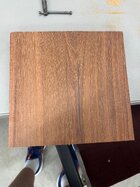
Not very familiar with rosewood. What little I’ve seen, could that be what it is? Is rosewood very heavy, dense ?

Jaramiah Severns
TOTW Team
There are several types of rosewood. Tough to say from one pic, but this looks like it could be of the Yucatán variety.
All of the members of the "rosewood" family will have a very strong aroma to them. Kind of sweet and spicy. Any exposure will weaken your natural resistance to them, so eventually you become allergic. In extreme cases, it can kill. Self defense for the tree against all the bugs that would love to eat it.
robo hippy
robo hippy

Try wood-database.com

where'd you get it? kind of looks like a piece of mesquite I have to make a platter out of.

It looks like rosewood but which species I have no idea.
I do know it’s the only rosewood is the only wood I’ve had allergic reaction too.
I do know it’s the only rosewood is the only wood I’ve had allergic reaction too.
There are many rosewoods. The properties vary widely. The appearance and color varies widely and the species cannot always be identified from the look at the side of a board. Many can guess, few will KNOW without more info.
Scrape a bit and take a sniff - many rosewoods have distinctive smells. That might not identify it for you but might help someone else with experience. Ask other woodturners for opinions. Many have experience with the look. I have dozens of rosewood species and might be able to compare it to one with a name on it. Be aware that many dealers have no clue and write a wood name based on a guess.
To narrow it down, first measure and weigh the piece and compare the density numbers on the Wood Database.
Using a single edge razor blade, shave off a small area of endgrain, enough to show at least two rings. Look at the endgrain through a magnifier - 10x is recommended but I prefer a low-power stereo microscope. Determine if the wood is ring porous, semi diffuse porous, or diffuse porous. Look for rays and note the width of the rays. Note the relative size of the earlywood pores compared to the latewood. Check the large earlywood pores - are they open (hollow like soda straws), filled with sparkly "tyloses", or something else. Those of Cocobolo and some other rosewoods are filled with what looks like a hard or waxy substance, sometimes colored orange.
Read this articles, paying special attention to section 7. Compare what you see in the end grain to the photos of candidate species in the Wood Database. Be aware that it is FAR easier to get a positive ID on domestic species than the many thousands of possible exotics.
If all else fails, look at the last section. You can send a small sample to the gov lab and they will make an ID for no charge.
If interested in learning more, I recommend the book "Identifying Wood" by R. Bruce Hoadley.
JKJ
Scrape a bit and take a sniff - many rosewoods have distinctive smells. That might not identify it for you but might help someone else with experience. Ask other woodturners for opinions. Many have experience with the look. I have dozens of rosewood species and might be able to compare it to one with a name on it. Be aware that many dealers have no clue and write a wood name based on a guess.
To narrow it down, first measure and weigh the piece and compare the density numbers on the Wood Database.
Using a single edge razor blade, shave off a small area of endgrain, enough to show at least two rings. Look at the endgrain through a magnifier - 10x is recommended but I prefer a low-power stereo microscope. Determine if the wood is ring porous, semi diffuse porous, or diffuse porous. Look for rays and note the width of the rays. Note the relative size of the earlywood pores compared to the latewood. Check the large earlywood pores - are they open (hollow like soda straws), filled with sparkly "tyloses", or something else. Those of Cocobolo and some other rosewoods are filled with what looks like a hard or waxy substance, sometimes colored orange.
Read this articles, paying special attention to section 7. Compare what you see in the end grain to the photos of candidate species in the Wood Database. Be aware that it is FAR easier to get a positive ID on domestic species than the many thousands of possible exotics.
If all else fails, look at the last section. You can send a small sample to the gov lab and they will make an ID for no charge.
If interested in learning more, I recommend the book "Identifying Wood" by R. Bruce Hoadley.
JKJ
From a distance it looks a lot like the Jatoba I was turning earlier this week. Also very heavy.
That’s the reason I’m trying to identify . The one time I tried to turn rosewood I had a slight reaction to it. I friend gave this to me to turn him some turkey calls.It looks like rosewood but which species I have no idea.
I do know it’s the only rosewood is the only wood I’ve had allergic reaction too.
A friend and he’s not sure either. I’m familiar with Mesquite. Positive it’s not Mesquite.where'd you get it? kind of looks like a piece of mesquite I have to make a platter out of.
My first reaction was small and didn’t think the wood was the cause. My second reaction was worse and required a shot from the doctor. So be careful!That’s the reason I’m trying to identify . The one time I tried to turn rosewood I had a slight reaction to it. I friend gave this to me to turn him some turkey calls.