• The forum upgrades have been completed. These were moderate security fixes from our software vendor and it looks like everything is working well. If you see any problems please post in the Forum Technical Support forum or email us at forum_moderator (at) aawforum.org. Thank you
  • Congratulations to David Bartell, People's Choice in the March 2026 Turning Challenge (click here for details)
  • Congratulations to Chris Lawrence for "Dragon's Grip" being selected as Turning of the Week for March 30, 2026 (click here for details)
  • Welcome new registering member. Your username must be your real First and Last name (for example: John Doe). "Screen names" and "handles" are not allowed and your registration will be deleted if you don't use your real name. Also, do not use all caps nor all lower case.

Wood Identification using AI

Joined
Sep 4, 2025
Messages
15
Likes
11
Location
Asheville, NC
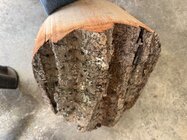
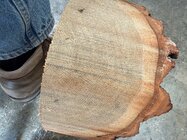
I recently had the opportunity to retrieve some wood from a downed tree. I wasn’t sure what kind of wood it was but it was of decent size and fresh so, good enough for me! Anyway, I took pictures and posted them on ChatGPT. ChatGPT said:

✅ Most likely: Black Cherry
⚠️ Secondary possibility: Red Maple (less likely given bark)

Claude said Sycamore.
Gemini said White Oak
Perplexity said: “Given Asheville’s mountain setting, my guess shifts a bit toward yellow poplar / tulip poplar or red maple, with ash still possible.”
People on Reddit said: White Oak

Since they all saw the same pictures, I thought this interesting so I’m sharing. Oh, I personally have definitely concluded it is wood.
 

Attachments

  • IMG_3099.jpeg
    IMG_3099.jpeg
    780.4 KB · Views: 57
  • IMG_3098.jpeg
    IMG_3098.jpeg
    1.4 MB · Views: 56
  • IMG_3097.jpeg
    IMG_3097.jpeg
    1.2 MB · Views: 57
The pictures are not conducive for even our determination, let alone AI’s faulty performance. Clean up the face and the end grain and then we can tell. From What I see, I lean toward an oak, perhaps white oak, but quite dark.

Tim
Fair enough. Unfortunately, the sides of all 12 blanks are now coated with Anchor Seal. Better pictures will have to wait until I turn them down to about an inch+ a little (first turn). But whatever wood it is, I’m pretty sure it’ll end up round and a Christmas gift for some family or friend in 2027.
 
I have 3 books on wood identification. I recommend them all.
Audubon guide to trees, has good pictures of the bark, leaves etc.
Wood Identification and Use by Terry Porter, has good pictures of the wood itself, not just the tree.
Wood For Woodturners by Mark Baker
Has more detailed info on about 150 species used by turners.
 
Doesn't look like black cherry bark to me. Black cherry and some other fruit trees have bark that looks like burnt potato chips (crisps). Red maple bark doesn't look like that either and the heartwood of all maples I've seen looks very different than that. Not ash either. Sassafras and cottonwood bark in photos looks similar but I've never handled cottonwood or sassafras so couldn't really say. Does it have a distinctive smell?
 
That's Free Wood. Maybe Mystery Wood. I often mixed up the two species, but it helps to identify them if I can chew on some shavings.
 
Isn't there a detailed book for identifying wood species?

I use "Identifying Wood" by R. Bruce Hoadley.
It is usually imperative to see a clean closeup of the end grain, shaved with a single edge razor blade, large enough area to have a few rings - heartwood, away from the pith.
 
Last edited:
I like to examine the bark too, if available. However, due to the wide variability of growing conditions I've seen widely differing bark on the same species, sometimes even on the same tree. Some bark, for example dogwood, persimmon, and cherry, can be very distinctive in mature trees. But even then, the bark can look different in sections of different age, growing in shade or sun, dry hillside or damp bottom.

Give me a leaf! Green, straight from the tree! I can often look that up in a book. Sometimes even in the winter I'll find dead leaves around a tree that can be a clue. But the end grain is the thing - the rings, porosity distribution, tyloses, ray width, and more - fascinating past time! The smell, with experience. And on occasion, UV and chemical tests.

For those interested in wood ID, these two articles might be useful:

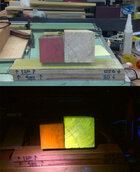
One notable example of ID by fluorescence is locust under UV light - the end grain otherwise can look a lot like mulberry or even osage, but with UV there is no mistaking:

In my shop, with 365nm UV light at the bottom - on the left is redheart, the right, locust
1775435330371.jpeg
More about fluorescence:

Some other woods easily distinguished by end grain.
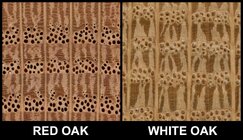
Oak families, tyloses in earlywood pores is a key between red and white. Forget the color, it can differ. Ray width (and length) is another clue.
1775435794349.jpeg

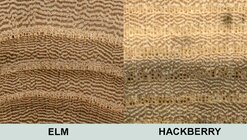
Elm and hackberry both have wavy bands of latewood pores, distinctive but different:
1775435678160.jpeg

I like to check Hoadley's book then look up the excellent end grain pictures in the online Wood Database. Also check the data for weight, density, and the effort Eric puts into the written descriptions. (Keeping mind that individual trees of the same species can vary.) But I have narrowed down a species by cutting a rectangular piece and carefully measuring and weighing to get the density.

Hobbithouse can be good, even if only used to show the wide variation between side grain on the same species:
If identifying by the color and look of side grain of a board or blank, look up a candidate and hold onto your hat!

JKJ
 
I recently had the opportunity to retrieve some wood from a downed tree. I wasn’t sure what kind of wood it was but it was of decent size and fresh so, good enough for me! Anyway, I took pictures and posted them on ChatGPT. ChatGPT said:

✅ Most likely: Black Cherry
⚠️ Secondary possibility: Red Maple (less likely given bark)

Claude said Sycamore.
Gemini said White Oak
Perplexity said: “Given Asheville’s mountain setting, my guess shifts a bit toward yellow poplar / tulip poplar or red maple, with ash still possible.”
People on Reddit said: White Oak

Since they all saw the same pictures, I thought this interesting so I’m sharing. Oh, I personally have definitely concluded it is wood.
I recently had the opportunity to retrieve some wood from a downed tree. I wasn’t sure what kind of wood it was but it was of decent size and fresh so, good enough for me! Anyway, I took pictures and posted them on ChatGPT. ChatGPT said:

✅ Most likely: Black Cherry
⚠️ Secondary possibility: Red Maple (less likely given bark)

Claude said Sycamore.
Gemini said White Oak
Perplexity said: “Given Asheville’s mountain setting, my guess shifts a bit toward yellow poplar / tulip poplar or red maple, with ash still possible.”
People on Reddit said: White Oak

Since they all saw the same pictures, I thought this interesting so I’m sharing. Oh, I personally have definitely concluded it is wood.
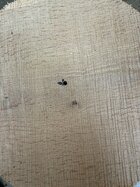
Using the picture with the bark and the iPhone App, Picture This, it identifies it as Chestnut Oak, AKA Mountain Chestnut Oak, Rock Oak, Basket Oak, Rock Chestnut Oak, or Tanbark Oak. Hope this helps. I find that App pretty accurate.
 
I have a few books on wood identification but the best of the best is The Wood Book by Romeyn Beck Hough. The original volumes had actual wood slices for each wood. For the current issues those slices were painstakingly reproduced from an actual set of the original publication with 800 pages. Available on Amazon and other book sellers. A couple of books I have do have some actual wood slices.
 
I am wondering if it is butternut/white walnut. That bark is pretty distinctive, and the branches on butternut look similar, and have a distinct scalloping to the growth rings. Only had some once. It did smell like vinegar when I was turning it. The medullary ray pattern does look like oak though. Both oak and butter do smell kind of like vinegar when turning.

robo hippy
 
I use the Picture This app …. If you can get a good picture of the bark it is usually right on… I always verify descriptions by looking at the Wood Database on the internet…
 
I have a few books on wood identification but the best of the best is The Wood Book by Romeyn Beck Hough. The original volumes had actual wood slices for each wood. For the current issues those slices were painstakingly reproduced from an actual set of the original publication with 800 pages. Available on Amazon and other book sellers. A couple of books I have do have some actual wood slices.

I have that book! (the one with the pictures). A little dated, but excellent, although a bit outdated now.

I have a several other similar books, one has 40 samples of thin real wood slices. I meant to post pics and info on some of the books but something didn't transfer correctly - try again maybe tomorrow.
 
Some time back, I looked into developing an AI-powered wood identification app. While I do think it is possible, based on my research, the challenge is getting enough training data to train the model that the AI operates on, with enough well-identified wood images that it has a very high positive hit rate, and a very low negative hit rate. That was going to be a TREMENDOUS task to do alone, so I shelved the idea.

This kind of thing is not well suited to the general purpose LLMs that we are all mostly familiar with. It is a specialized task requiring very specialized training with specialized model tuning. John demonstrated an aspect of why the training has to be done so carefully...there are many wood characteristics, within the grain, within bark, for different wood cuts, etc. So to build a model that could accurately identify wood species from ANY images that might be supplied, the model would have to know how the wood looks in a wide variety of circumstances. That is dozens of images per wood species, at the very least. However you would likely need more than that, covering different resolutions, lighting circumstances, etc. to make sure your bases are covered, so you could be looking at 50-100 images per wood species...for accurate, high positivity identification.

Its possible, but its a MONSTROUSLY HUGE task. If I had help, I might be able to do it. The trick is getting enough wood images, probably of varying degrees of quality and lighting and all that, which would require a fairly massive community effort, or even starting a company and hiring employees (which when you have no income yet and a limited income model, isn't a particularly effective way to do something.) I had considered creating a site that would just allow woodworkers to upload photos of woods they had positive identifications for and the reasons why, which might over time allow me to accumulate enough data to perform the necessary model training. Probably a many-years effort, though, to acquire enough wood images that the model could be trained properly....and there would again be long term costs (storage of that much image data alone might be non-trivial.)
 
John, outdated? Are they making new trees I don't know about? That is tongue in cheek not disparaging. 🤣
I meant some of the text was a bit outdated, not the wood! First published in 1888, some of the text hasn't been updated.

For example, one page indicates "some of the giant forms of some species ... hardly exist anymore, some of the cultivated species (e.g. the introduced Eucalyptus) had not yet reached maturity...so we still lack information ..."

Some of the uses describe some dated info: for example Black Gum "is particularly suitable for hubs of wheels, rollers and wooden cylinders, clogs, etc.", things often not made of wood now; one species described as "widely used for heavy agricultural equipment (plows, mowing and threshing machines, poles for grubbing up tree stumps...)", also thinks now probably now made from steel.
In the latest edition, many of the pages of text are copied from the original and unfortunately some are so smeared from the copy process they are unreadable. But the wood pictures are great! Lots of species also have hand-drawn sketches of leaves, flowers, fruit. I see 349 species. Some may not apply to many of us, such as Manilkara jaimiqui, WIld Dilly, apparently mostly found in Cuba, Jamaca, Dominican Republic, Haiti.

But certainly a book worth having.

I have lots of books about wood with pictures and such, but I do have one with 40 real wood samples:
"What Wood is That?" by Herbert L. Edlin.
1775603403309.jpeg
Also includes good descriptions of the wood and trees and an introduction to identifying wood.

JKJ (certified card-carrying book freak)
 
Back
Top