• The forum upgrades have been completed. These were moderate security fixes from our software vendor and it looks like everything is working well. If you see any problems please post in the Forum Technical Support forum or email us at forum_moderator (at) aawforum.org. Thank you
  • It's time to cast your vote in the April 2026 Turning Challenge. (click here for details)
  • Congratulations to Ted Pelfrey for "Cherry Blossoms on Cherry" being selected as Turning of the Week for April 27, 2026 (click here for details)
  • Welcome new registering member. Your username must be your real First and Last name (for example: John Doe). "Screen names" and "handles" are not allowed and your registration will be deleted if you don't use your real name. Also, do not use all caps nor all lower case.

Woodfast M Series Tailstock jammed

Joined
Oct 30, 2025
Messages
7
Likes
2
Location
Wynnewood, PA
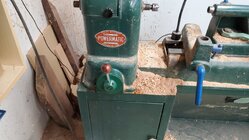
Is there anyone out there who had or still has this vintage lathe on which David Elsworth taught me woodturning?

My tailstock jammed, and I got an email back from Australia with a Utube video for Powermatic and Jet, but not Woodfast (discontinued).

I cannot get the handwheel removed even after removing the mostly hidden set screw.

I have sprayed WD 40 thoroughly.

I surmise from the very small slot in shaft at the working side that I should stick the same Allen wrench in there to hold it and then unturn the handle?

This did not work.

I suspect my gross negligence in not cleaning the tailstock for too many years to admit has put an end to this machine that has special meaning to me.

Thanks for any reply.

Brad Whitman
PA
 
If it’s rust that’s the culprit, use a 50/50 mix of automatic transmission fluid and acetone. It penetrates better than anything on the market. Next is the product Kroil. Both better than Liquid Wrench. WD40 is way down on the penetrating scale.

And if threadloc was used on a set screw, it takes heat.
 
Last edited:
I have one, it's a good machine. It is not discontinued, they are still being made in Asia for Woodfast. What exactly happened to the tailstock that you need to remove the handwheel? Can you post a few pictures?
 
No pure solution from me but two thoughts: (1) Kroil is an excellent penetrant. WD40 is a pretender; (2) No reason to give up, be patient waiting for the best advice. If the lathe were in my shop, I'd apply Kroil repeatedly and strongly "jiggle/pull" the hand wheel (in the past I've been tempted to whack with a deadblow hammer, but resisted the urge). These darn things can get firmly stuck with absolutely no rust - as you surmise, it's due to lack of cleaning. Our Powermatics are particularly susceptible, probably because they are the most heavily used especially for wet bowls of size. Once it's out, clean screw thoroughly, remove any burrs from locking slot and lube appropriately.

PS: if you do give up, I'll pay the freight to Washington State. :-)
 
If it has you stumped, visit a local machine shop, they'll take care of it for you. And if parts are worn, they can make replacements.

(Edit- Like Vicmarc lathes, those Aussie-built M-series Woodfast lathes should last about 200 years. Or so. Well, you may need some new bearings at some point... In other words, those lathes are absolutely machines that should be maintained to encourage an indefinite lifespan. They aren't throw-away machines! Even @Odie couldn't wear his out!)

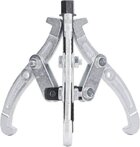
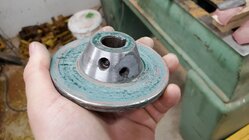
Does the shape contribute to the use of a gear puller tool, such as this generic version? These are usually pretty inexpensive, Harbor Freight and Amazon have them in various shapes and sizes. Auto parts stores and some hardware stores stock them, too.
1777669724881.jpeg
 
Last edited:
Does the shape contribute to the use of a gear puller tool, such as this generic version? These are usually pretty inexpensive, Harbor Freight and Amazon have them in various shapes and sizes. Auto parts stores and some hardware stores stock them, too.
And some auto parts stores will loan them out. I borrowed one from our local NAPA when I was redoing the wheels on a bandsaw
 
I had a problem with my first lathe, a Powermatic 45. It had been out on the weather before I got it, so it was a bit rusty. I tried to get the belt tension lever to move and instead broke it off. So I borrowed a pulley puller from an auto mechanic and removed it. Then took it to a machinist/mechanic and he was able to extract the broken handle. This machine is a 1970. I think it can very well last 100 years.
 

Attachments

  • 20250831_172528.jpg
    20250831_172528.jpg
    270.9 KB · Views: 10
  • 20250910_195150.jpg
    20250910_195150.jpg
    233.1 KB · Views: 10
  • 20250912_192833.jpg
    20250912_192833.jpg
    375.7 KB · Views: 10
This is great--I needed to be told exactly what I always believed and is obvious--that the Australian Woodfast is built for the ages--how rare today!
I will try a serious solvent on the shaft and hope I can get it out and clean the big screw. I have turned almost entirely scavenged wet wood on the first pass. Thank you all.
 
I surmise from the very small slot in shaft at the working side that I should stick the same Allen wrench in there to hold it and then unturn the handle?

I haven't seen that lathe.

A few pictures of your tailstock might be helpful. Also, an internet search of your lathe with model number might turn up a parts diagram which should show what should be there. If you happen to have a manual, it may have a parts diagram.

Tailstocks usually have four main parts - 1) the steel or cast iron body, 2) the steel quill with the slots and a morse taper on the end which slides in and out, 3) the steel left-hand threaded lead screw, and 4) has the handwheel fastened securely to the unthreaded end end of the lead screw. Plus various levers and screws. The handwheel turns the lead screw and the threads on the left end of the lead screw drive the quill in and out.

***First of all, does the handle turn and will the quill slide in and out properly? Does the handwheel turn at all, even a little bit? If so, can you see anything else happening?

Note that the hand wheel often has two, sometimes three set screws holding it on the shaft. If only one is visible, look behind and under to see if there is another.

Most quills have one square-bottomed slot down the length of the back side. Some have a second slot on the front side.
I have never seen a tailstock with an empty hole that allows something like an allen wrench to be inserted until it touches the slot.

One of these grooves usually has a guide setscrew, short threaded rod with a locking nut, or the quill locking lever riding in the slot to keep the quill from turning when adjusted. The tailstock casting usually has a threaded hole to hold one of these. If the quill doesn't advance in and out check to see if whatever is there to keep it from rotating is not too tight. Larger lathes often have a separate lever to lock the tailstock. All should be adjusted so the tailstock slides freely.

If the hand wheel turns and the quill doesn't move in and out, loosen and remove all locking/guide screws. If the handwheel still doesn't turn and advance the quill something may be rusted, bent, or locked up inside. If you do get the handwheel off and everything else loosened, the guide screw and quill can often be gently/carefully driven out of the tailstock from the rear. A brass hammer is good for this since iit won't deform the machined end of the guide screw. If stuck, soak in something first.

I've adjusted and repaired several tailstocks for others. Some had rusted or got gummed up inside and the quill wouldn't slide. One had been abused and the quill was bent and stuck. I fixed them all. I've never had any problem removing the handwheel. If the set screws are remove and the wheel still doesn't slide off the end, I'd try dousing the end with penetrating lubricant, and after waiting a bit lock the quill and try to either twist the handwheel or use a thin wedge like a putty knife encourage it to slide backwards. If the set screws in the handwheel have been overtightend, they may have deformed the metal and the wheel may need extra encouragement.

Are you a member of a woodturning club or have experienced turners nearby? Often having someone else look at the problem can immediately see the problem while others have to make long-distance guesses and assumptions.

JKJ

 
I doubt it makes a difference for this situation, more just FYI for the viewers at home, but I am almost entirely certain that those Woodfast lathes do not have a self-ejecting tailstock feature to eject centers. A knockout bar is required to remove morse taper fittings from the tailstock spindle.

@Bradford Whitman, be sure to let us know the conclusion to your predicament.
 
Back
Top