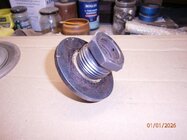
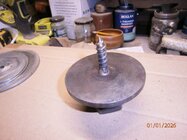
I did a search on the forums and couldn't find any info, so here's my question. How does one decide to use a worm screw or a face plate?

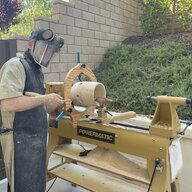
Thank you. That's a lot of info, and staying safe is good practice.Hi @David A Morris, here are a few Richard Raffan videos (amongst many he's posted) that should help you. But, I've never seen him use a multi-screw faceplate before, only single-screw screw chucks and faceplates converted to screw chucks. I agree with Alan, "really big" pieces, multi-screw faceplate. If you are on a 12-14" lathe, the single screw method should be just fine. (I don't turn big stuff anymore, a single screw works for me for everything.) Listen to what Raffan explains about the size of the bearing face of the screw chuck, that face is where the real work of cutting support occurs. He has a lot of videos, watch enough of them and you will pick up his work method patterns- you'll know what he's going to do next. 50+ years as a production turner, he knows his stuff!
Holding with the chuck with no jaw marks-
View: https://youtu.be/DV2T6oJgCi4?si=ahlRB066RHl2IWyP
Explains screw chuck options-
View: https://youtu.be/Vg79ogftGiQ?si=CSCu4WPEiDAp8ruX
"Throwing" a bowl blank onto a screw chuck (not a fan of the method myself, but you see him do it in just about every video so here is the method. I mount it with the motor off and spindle lock locked. I'm a chicken.)
View: https://youtu.be/cNAXwQZNMzE?si=d_wC42Jbg050B3xi
Making a wood collar for a chuck screw (worm screw) to use as a screw chuck-
View: https://youtu.be/3-P6qGkob34?si=HPuhLzIiUzJdyf7Y
Here's Tomaslav Tomasic (Raffan protoge') making a faceplate into a screw chuck-
View: https://youtu.be/ebcqT49xCNs?si=zzI2kiBruMseqIzt
Have fun with it, but be safe.
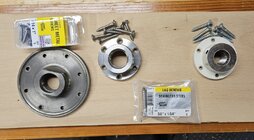

I completely agree with this opinion. It's certainly more fiddly to install, but it holds very firmly. I've assembled a set of faceplates of various sizes, from 75 to 150 mm. As they say, there's something for every occasion.By what you are comfortable with, have equipment for. I think for real big pieces, a large faceplate is safer.


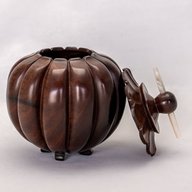
I do the same although I do own a couple of screw chucks and several faceplate rings, rarely use either.Well, I turn a LOT of bowls. I don't use either. I thought I learned it from Richard Raffen, but asked him and he couldn't remember. He now does his bowls with a tenon on the bottom which is sized to exactly fit his chuck jaws. For mounting my bowl blanks, I drill a recess on the drill press, and expand my chuck jaws into that recess. Most of the time, I will drill it deep enough so the bowl blank sits against the flange on the bottom of the chuck jaws. Since I do batches of bowls, I drill them all at the same time, and this is a lot faster than drilling for the screw chuck, or drilling the screws into a face plate, and unscrewing them later, and then threading the chuck back on. Same with the work screw. With the work screw, most who use it will have the lathe spinning and start to screw it on while running. I guess I could get used to it.... I would still have to open the chuck up and remove the screw or there are some that screw directly on to the lathe. Oh, my big chuck uses a 2 5/8 diameter forstner bit. I do use a recess on the bottom of my bowls.
robo hippy

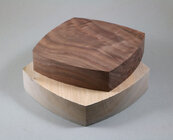
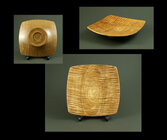
Gotcha!I quit using faceplates years ago except for special projects. This, frame, for example, was tricky to turn because of the need to exactly cover the embroidery frame and no more (they didn't leave quite enough white space) so we made plywood disks for holding, fastened to a faceplate.
View attachment 83654
A friend of mine, however, uses a faceplate for every bowl.
I don't like the wormwood screws and only use them when there is no other choice.
However, the Glaser screw chuck is amazing - I think the precision machined screw is better than the typical wormwood screw. The multiple bearing diameters make it flexible for large and small things.
I've used the screw chuck with blanks up to the capacity of my lathe (20") and on bowl blanks up to maybe 6" thick. The only requirement is the surface must be flat. (When cutting blanks from slabs I like to flatten both top and bottom on the drum sander. For several reasons.) Obviously, the lathe can't be too wimpy for the weight and balance of the blank.
The screw chuck is great for these, blanks usually 8" to 11" across, 2-3" thick.
View attachment 83655 View attachment 83656
Just drill a 1/4" hole (in the top) with the drill press and thread the blank onto the screw chuck by hand. I like the Glaser chuck so much I got one for a friend and keep two at my lathe, the spare is for "just in case."
JKJ

Yes. The screw's job is to pull the wood against the chuck face, not support the work. If the wood isn't flat, the screw may be flexing. It is likely to fail eventually. As you say, the tailstock gives a lot of support. It prevents sideways movement, so there is less leverage on the screw. Even so, it might be prudent to pension off that ancient worm and give the next generation a turn. But I prefer to swivel the headstock when possible.it wasn't very long that the screw broke.

No hurry at all. The temperature has been in the 10 below range for the past couple of weeks and my shop is uninsulated and unheated.Wood worm screw is faster. Faceplate is more secure and maybe a little safer for new turners. How big a hurry are you in? I'm in the group that feels faceplates are wise on bigger blanks (>13").



Same here. 99% of my stuff is started between centers.Almost all of my pieces start between a cup and point drive center and a cup and point live center. If you keep the tail stock tight, the drive center won’t slip. This gives you the option of reorienting the wood as you begin to turn. Once you drill a hole, you’ve decided which side is going to be the top. Sometimes you’ll discover things as you turn (hidden figure, defects, interesting coloration, ring shake) that will make you rethink your approach. Good to keep your options open for as long as possible.
Worth noting that this approach only works for small to medium pieces. Once the diameter gets larger than ~10” and / or the height gets taller than ~8”, I’ll go to a large (1”) four-prong drive center or, if it’s an exceptionally large piece, an 8” face plate.
Me, too, but it was only after about 2 years of turning that I was able to do it—screw chucks and face plates prior to that. Training wheels are off. (Kidding—still a role for both screw chucks and face plates)Same here. 99% of my stuff is started between centers.
Glad you're kidding. A good Glaser screw chuck is still the most efficient way for me to turn a variety of bowls and platters. I teach the method and I know others turning this way....screw chucks.. (Kidding—still a role for both screw chucks and face plates)
While on the topic of good screw chucks, I quite like my Vicmarc 3-in-1 screw chuck (the one Raffan uses), which has an excellent screw and three sizes of backing plate built into the single unit. It is usually about $150, which I think is very good value.A good Glaser screw chuck is still the most efficient way for me to turn a variety of bowls and platters.
That looks nearly identical to the Glaser screw chuck, with removable/reversible cone collar. Even the machined screw with the very sharp threads looks the same and the Glaser. Looks like it's $181 USD from Alan Lacer.I quite like my Vicmarc 3-in-1 screw chuck
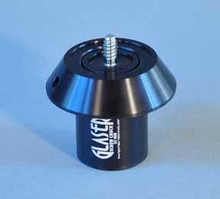
 stores.alanswoodturningstore.com
I don't know, John. Maybe you just like chucks!That looks nearly identical to the Glaser screw chuck, with removable/reversible cone collar. Even the machined screw with the very sharp threads looks the same and the Glaser. Looks like it's $181 USD from Alan Lacer.
Glaser Screw Chuck BACK IN STOCK
No other screw chuck on the market allows such versatility as this chuck. The three different configurations allow for these different base diameters: 1 1/2", 2 1/2" and 31/2". The bases are made with a narrow
Also available for the Jerry Glaser designed screw chuck is a screw-on 5.5" support plate.
I mentioned recently I bought a spare Glaser for "just in case". Yesterday I found a demo piece mounted on another Glaser screw chuck. So I have three. What's wrong with me?!

John, could you speak to the failures? What caused the failure, and what failed (wood, or hardware)?In my life I've had three failures with worm screws while never having had one with a faceplate...that's my answer.
The folks at Lee Valley have grown used to me returning an item with the sheepish explanation that when I went to put it with my tools, I realized I already had one. Or two.I mentioned recently I bought a spare Glaser for "just in case". Yesterday I found a demo piece mounted on another Glaser screw chuck. So I have three. What's wrong with me?!
In my life I've had three failures with worm screws while never having had one with a faceplate...that's my answer.
) Reading John's post above as I'm typing. I usually don't need to have a flat spot as against the chuck jaws works fine. If I do I'll make a flat. I now always use the tailstock probably why the Oneway screws broke but the Nova still going strong. I use two different size drills, one for wet wood and one for dry wood. I have never used the scews that came with the Vicmarcs or the Axminsters because they looked to thin. I have actually broke two Oneway screws but again I believe it was not using the tailstock ( I believe I still have those broken screws.) One last thing is when I am going to make a platter out of say 3/4" board I use spacers on the woodworm screw to get 1/4"hold in the platter, works just fine. I guess this is my dissertation on a woodworm screw.
Quite a speech!As stated I have used the same Nova screw for over 23 years. I use it with the Supernova, the Supernova II and the Nova G3. I most often have to take the piece off the chuck with the screw attached and unscrew the screw with a pair of waterpump pliers. Then it gets turned around and goes right back on the chuck. That has been the feature of it all these years, not having to remove the chuck. Do I have a screw chuck? I do, brand new never used sitting in a drawer. It's things like this that being on this forum for almost 20 years sometimes help and sometimes don't help (for me reading that I need a screw chuck over 20 years ago

When I started turning, 4-jaw chucks had not appeared on the scene so I used a screw. That experience soured me and now I never use them.Well, I turn a LOT of bowls. I don't use either. I thought I learned it from Richard Raffen, but asked him and he couldn't remember. He now does his bowls with a tenon on the bottom which is sized to exactly fit his chuck jaws. For mounting my bowl blanks, I drill a recess on the drill press, and expand my chuck jaws into that recess. Most of the time, I will drill it deep enough so the bowl blank sits against the flange on the bottom of the chuck jaws. Since I do batches of bowls, I drill them all at the same time, and this is a lot faster than drilling for the screw chuck, or drilling the screws into a face plate, and unscrewing them later, and then threading the chuck back on. Same with the work screw. With the work screw, most who use it will have the lathe spinning and start to screw it on while running. I guess I could get used to it.... I would still have to open the chuck up and remove the screw or there are some that screw directly on to the lathe. Oh, my big chuck uses a 2 5/8 diameter forstner bit. I do use a recess on the bottom of my bowls.
robo hippy
I've just started and can't afford a proper woodturners chuck right now so am using an old metalturners 3 jaw chuck. And that's what prompted this thread. I have a faceplate and a spur drive center. I don't have a worm screw. I start mostly between centers but am trying to enhance my own safety as well as develop a variety of techniques. As I learn, the type of material that I turn is growing also. I want to be able to turn anything that I find and from what I'm hearing, a screw is not really a necessity. At some point I hope to have enough to buy a good 4 jaw chuck, but for now, I need to maximize what I already have.When I started turning, 4-jaw chucks had not appeared on the scene so I used a screw. That experience soured me and now I never use them.
I use your method of drilling a 50mm hole with a forstner bit to mount the piece on a chuck.
@Bill Blasic has what appears to be a good value for the $ chuck made by BMWood. Bill, I know you have not had the chance to be in the shop much. Have you had a chance to use the chuck?At some point I hope to have enough to buy a good 4 jaw chuck, but for now, I need to maximize what I already have.