
-
April 2026 Turning Challenge: Salad Bowl! (click here for details) -
Congratulations to David Bartell, People's Choice in the March 2026 Turning Challenge (click here for details) -
Congratulations to Ted Pelfrey for "Cherry Blossoms on Cherry" being selected as Turning of the Week for April 27, 2026 (click here for details) -
Welcome new registering member. Your username must be your real First and Last name (for example: John Doe). "Screen names" and "handles" are not allowed and your registration will be deleted if you don't use your real name. Also, do not use all caps nor all lower case.
You are using an out of date browser. It may not display this or other websites correctly.
You should upgrade or use an alternative browser.
You should upgrade or use an alternative browser.
WTB Sphere jig
- Thread starter Steve Nix
- Start date
- Status
- Not open for further replies.
Anyone have a good used sphere Jig laying around collecting dust, I’m interested. I need to make a few ball for a school project.
Do they all need to be identical? Do you have diameter specifications? (Hope you're not juggling Lignum Vitae.
 )
)You might state the lathe you have. I am very familiar with just one jig, the Vermec (the best, IMO), and it is ordered depending on the lathe size and bed gap.. You can order parts to change to a different size lathe but they come from Australia and might not be cheap. If someone has a Vermec, for example, "laying around gathering dust", it might save some back and forth communication if they know what lathe you have.
But I've also turned a number of spheres without the jig using the "Soren Berger" method, using only a spindle gouge. They were not difficult. Turning "a few" wouldn't take long, maybe make one first for practice.

Typically, after turning by this "sub-division" method, I'll part off the sphere and remount it between wooden (or Rubber Chucky or similar) cones to refine the shape if needed. Do this on several axes.
Pro turer Mark StLeger starts as others do with a cylinder the exact length as the diameter and draws a pencil line around the exact center. His advice when turning: approach but never cut away the line! He uses a clever aid: moves a short piece of squared-off PVC small pipe over the surface to test the curvature. He demos making four spheres of identical size, makes a little base, with a groove, stacks the spheres - if made well twisting the top one makes them all spin. Clever! I have this onw in my collection:

More on turning by hand in this thread.

There seems to be considerable interest lately in a certain structured procedure for turning spheres by hand. Apparently, Sören Berger and Al Hockenbery independently discovered the basic concept and both have popularized it for several years. The procedure involves first turning a cylinder with a length and diameter equal to the diameter of the desired sphere. The outline of this cylinder will appear as a square. The corners of this square then are sliced off in a straight line to produce an 8-sided outline that approximates a sphere. Optionally, one can continue the process by turning...
- Dennis J Gooding
- Replies: 17
- Forum: Tutorials and Tips


A forum or web search might show more.
If really interested in a jig, John Lucas tested several. I think some weren't so good, not so sturdy. I loaned him the Vermec and I think he liked it best, very heavy, solid, built like a tank. I don't know the situation now but when I ordered mine from Australia I had it in hand in two days.
If you saw how the Vermec was made you could probably make a similar one given the right tools and cutter. (The Hunter #4 carbide cutter is perfect.)
JKJ

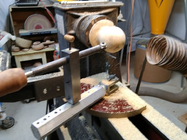
there is a Chefsware sphere jig in the for sale forum
I think they closed that thread,there is a Chefsware sphere jig in the for sale forum

Log into Facebook
Log into Facebook to start sharing and connecting with your friends, family, and people you know.
 www.facebook.com

Hello @Steve Nix,
We are closing this post as it has been inactive for 30 days. Thank you from the AAW Forum Bot!
We are closing this post as it has been inactive for 30 days. Thank you from the AAW Forum Bot!
- Status
- Not open for further replies.