I use it, wheel stays rust freeTormek does make a solution specifically for their diamond wheels which will prevent the rusting of the metal dust on their diamond wheels My bottle of it just says "anti corrosion concentrate".
robo hippy

-
March 2026 Turning Challenge: Olla! (click here for details) -
Congratulations to David Wyke, People's Choice in the February 2026 Turning Challenge (click here for details) -
Congratulations to Gabriel Hoff for "Highly Figured Masur Birch Round Bottom Box" being selected as Turning of the Week for March 2, 2026 (click here for details) -
Welcome new registering member. Your username must be your real First and Last name (for example: John Doe). "Screen names" and "handles" are not allowed and your registration will be deleted if you don't use your real name. Also, do not use all caps nor all lower case.
You are using an out of date browser. It may not display this or other websites correctly.
You should upgrade or use an alternative browser.
You should upgrade or use an alternative browser.
Yet... another CBN question...
- Thread starter Manny Yabar
- Start date
JKJ
How in the world do you keep those conductor batons steady to turn them?
Im sure you posted it before but damn bud, those are slim, pretty cool stuff there.
Most of my "secrets" are in my document posted on this forum: Turning Thin Spindles. I developed these techniques to turn wands for Harry Potter fans. Biggest trick is to start with one end of the wood VERY securely in the headstock using one of several methods.
The technique that makes a successful thin spindle is steadying the wood with one hand while turning with a sharp skew with the other. Skew is held in one hand, handle supported against my forearm, cutting tip sometimes supported by the thumb of the hand steadying the spindle. For those not comfortable with the skew it's really not that hard to learn, especially the way I teach it. The skew is the FIRST tool I put in a beginner's hand even if they've never seen a lathe before. I've never had one get a catch.
If skew expertise seems insurmountable, a sharp spindle roughing can work. (Except for detail I avoid the spindle gouge due to a reason I can explain lather if anyone cares.)

This document shows the tools and methods I use to hold, shape, and successfully finish a thin spindle. I wrote this update for a recent club demo.
As spindles get long and thin, there are challenges to turn them successfully. My demos use “magic” wands to show the techniques but they apply to many types of thin spindles. I always take some long examples, a couple of tapered shafts that go from about 1/2” diameter down to 1/16” diameter in more than 24” - one I turned from a piece of shelving pine board from Home Depot.
Some things covered here are about the wood itself and how to...
As spindles get long and thin, there are challenges to turn them successfully. My demos use “magic” wands to show the techniques but they apply to many types of thin spindles. I always take some long examples, a couple of tapered shafts that go from about 1/2” diameter down to 1/16” diameter in more than 24” - one I turned from a piece of shelving pine board from Home Depot.
Some things covered here are about the wood itself and how to...
- John K Jordan
- Replies: 9
- Forum: Tutorials and Tips

It seems like a challenging problem at first (some have reportedly resorted to shaping with coarse sandpaper!), but as my piano instructor liked to say "Everything's easy once you know how!" (Hey, completely OT - I stopped at the hospital today for some info and on the way out I noticed the piano in the lobby - it usually sits unused. In a couple of minutes I had an audience! No one threw tips...
 )
)I've made an uncountable number of thin spindles using the methods described way, most of them "magic" wands but many other things as well. Good practice for finials.
There I describe the "left hand steady rest", the key for the way I turn almost all thin spindles. (I don't have nor have I ever used an actual steady rest - it's not needed would just get in the way for these types of projects.)
For the conductor batons, I use a bit of a different method - USUALLY turned in two parts, handle from heavier wood like Ebony or Cocobolo and the shaft from lighter color and lighter-weight wood using the methods of steadying described in the doc. The balance of a baton is important.
Some sellers of conductors batons use a wooden, plastic, or other handle and a fiberglass rod for the shaft - where is the fun in that?
I've made a bunch - most have been given away without photos but here are a few:
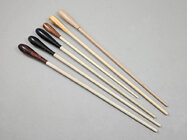
I like to taper the end of the shaft so the joint at the handle is smooth. The one at the top is dogwood - made from a single piece of wood.
One hint - if making one for someone be sure to ask them for their preferences. Some like them about 10-12" long, some longer. Those who work often in dark orchestra pits want a little larger more visible shaft. The small one above is a "finger" baton. I've made sturdy "tap" batons for Jr High band directors to tap on the music stand to keep time. Made several for choral directors.
I never took the time to write a document but this my rough page of "notes to self".
The 1/2" MT collet is great for turning the handle but a chuck would do as well. The collet does give a bit of extra room for turning the end where chuck jaws might be more in the way. Other advantages of the collet is the work can be removed and remounted with perfect precision AND for the baton, it provides excellent support while finish turning the thin shaft.
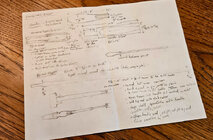
At the bottom you might see I'm holding the shaft in pin jaws to shape, keep a "button" on the end for tailstock support with a 1/2" steb center, cut a tenon on the end sized exactly for the hole in the handle, cut off the holding button and reverse and glue the shaft into the handle, then turn taper and shape the shaft using the steadying techniques shown in the thin spindle document. I use a 1/2" skew to shape and taper the shaft.
Turn and saw off both ends, finish sanding and finishing by hand, and check the balance point!
One guy chose a different handle shape which turned out to be a little too heavy so we had to rig up something to adjust the handle while the baton was in one piece. Good clean fun!
JKJ
JKJMost of my "secrets" are in my document posted on this forum: Turning Thin Spindles. I developed these techniques to turn wands for Harry Potter fans. Biggest trick is to start with one end of the wood VERY securely in the headstock using one of several methods.
The technique that makes a successful thin spindle is steadying the wood with one hand while turning with a sharp skew with the other. Skew is held in one hand, handle supported against my forearm, cutting tip sometimes supported by the thumb of the hand steadying the spindle. For those not comfortable with the skew it's really not that hard to learn, especially the way I teach it. The skew is the FIRST tool I put in a beginner's hand even if they've never seen a lathe before. I've never had one get a catch.
If skew expertise seems insurmountable, a sharp spindle roughing can work. (Except for detail I avoid the spindle gouge due to a reason I can explain lather if anyone cares.)
This document shows the tools and methods I use to hold, shape, and successfully finish a thin spindle. I wrote this update for a recent club demo.
As spindles get long and thin, there are challenges to turn them successfully. My demos use “magic” wands to show the techniques but they apply to many types of thin spindles. I always take some long examples, a couple of tapered shafts that go from about 1/2” diameter down to 1/16” diameter in more than 24” - one I turned from a piece of shelving pine board from Home Depot.
Some things covered here are about the wood itself and how to...
- John K Jordan
- Replies: 9
- Forum: Tutorials and Tips
It seems like a challenging problem at first (some have reportedly resorted to shaping with coarse sandpaper!), but as my piano instructor liked to say "Everything's easy once you know how!" (Hey, completely OT - I stopped at the hospital today for some info and on the way out I noticed the piano in the lobby - it usually sits unused. In a couple of minutes I had an audience! No one threw tips...
I've made an uncountable number of thin spindles using the methods described way, most of them "magic" wands but many other things as well. Good practice for finials.
There I describe the "left hand steady rest", the key for the way I turn almost all thin spindles. (I don't have nor have I ever used an actual steady rest - it's not needed would just get in the way for these types of projects.)
For the conductor batons, I use a bit of a different method - USUALLY turned in two parts, handle from heavier wood like Ebony or Cocobolo and the shaft from lighter color and lighter-weight wood using the methods of steadying described in the doc. The balance of a baton is important.
Some sellers of conductors batons use a wooden, plastic, or other handle and a fiberglass rod for the shaft - where is the fun in that?
I've made a bunch - most have been given away without photos but here are a few:
View attachment 85994
I like to taper the end of the shaft so the joint at the handle is smooth. The one at the top is dogwood - made from a single piece of wood.
One hint - if making one for someone be sure to ask them for their preferences. Some like them about 10-12" long, some longer. Those who work often in dark orchestra pits want a little larger more visible shaft. The small one above is a "finger" baton. I've made sturdy "tap" batons for Jr High band directors to tap on the music stand to keep time. Made several for choral directors.
I never took the time to write a document but this my rough page of "notes to self".
The 1/2" MT collet is great for turning the handle but a chuck would do as well. The collet does give a bit of extra room for turning the end where chuck jaws might be more in the way. Other advantages of the collet is the work can be removed and remounted with perfect precision AND for the baton, it provides excellent support while finish turning the thin shaft.
View attachment 85995
At the bottom you might see I'm holding the shaft in pin jaws to shape, keep a "button" on the end for tailstock support with a 1/2" steb center, cut a tenon on the end sized exactly for the hole in the handle, cut off the holding button and reverse and glue the shaft into the handle, then turn taper and shape the shaft using the steadying techniques shown in the thin spindle document. I use a 1/2" skew to shape and taper the shaft.
Turn and saw off both ends, finish sanding and finishing by hand, and check the balance point!
One guy chose a different handle shape which turned out to be a little too heavy so we had to rig up something to adjust the handle while the baton was in one piece. Good clean fun!
JKJ
Thank you for the info, i knew you had it all organized, this is definitely one of the skills to master relating to spindle turning, and really tool control, think you were the one who said spindle turning is a good way to build technique for bowl turning, there is definitely more refined tool handling. Watching Matt Monaco turn finials with a skew shows the versatility and the delicate control possible, im sure you have the same skillset judging from your turnings, definitely a goal to learn now, heck, soon, i will have all the time in the world to do it. God willing.
So again Thank you for all the info, downloaded that file and will be my morning reading today on this very rainy morning.
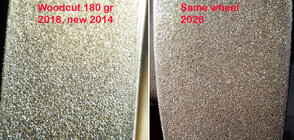
I am just a hobby turner, but I bought this Woodcut True Grind 180 gr 2014. 150 mm diam on bench grinder 2850 rpm. Loosing some aggressiveness quickly, but then stays constant. Picture from 2018 resp 2026, far from worn out.