• The forum upgrades have been completed. These were moderate security fixes from our software vendor and it looks like everything is working well. If you see any problems please post in the Forum Technical Support forum or email us at forum_moderator (at) aawforum.org. Thank you
  • Congratulations to Bernie Hyrtzak, People's Choice in the January 2026 Turning Challenge (click here for details)
  • Congratulations to Matt Carvalho for "Red Mallee Folded Form" being selected as Turning of the Week for February 9, 2026 (click here for details)
  • AAW Symposium demonstrators announced - If the 2026 AAW International Woodturning Symposium is not on your calendar, now is the time to register. And there are discounts available if you sign up early, by Feb. 28. Early Bird pricing gives you the best rate for our 40th Anniversary Symposium in Raleigh, North Carolina, June 4–7, 2026. (There are discounts for AAW chapter members too) For more information vist the discussion thread here or the AAW registration page
  • Welcome new registering member. Your username must be your real First and Last name (for example: John Doe). "Screen names" and "handles" are not allowed and your registration will be deleted if you don't use your real name. Also, do not use all caps nor all lower case.

2nd turn/Final turn/Finish turn HF

Joined
Dec 29, 2022
Messages
1,204
Likes
1,524
Location
USA
Whatever you want to call it.

Are the steps the same as green turned bowls? 3/4 inch or so thick depending on size and coat the outside with anchor seal? Anchor seal on the inside too?

Or is the second time on the lathe more for just sanding? And you should have it almost to your final wall thickness?
 
First turning green is rough shaping with walls ~10% thickness of the diameter. Then paint with Anchor Seal (especially on end grain both inside and out) or use other preferred method of slowing drying process for ~6mon -1yr depending on your area conditions (or multiple years if you have more drying inventory than you need like some of us :)

After dry (measured by no longer losing weight if you care to measure instead of just waiting a long time) then you final turn. Provided you’ve left sufficient thickness you can get a circle of the wall thickness you want circumscribed within the now warped ~10% thickness you left.
 
Wall thickness depends on a few things. If your opening is on face grain with wood that likes to move you want a little thicker walls. Nothing is worse then spending the time to turn it then dry it only to have it warp so bad you don't have enough wall thickness to make it round again. If its end grain you can make the walls with the 10% rule. End grain usually does not warp much when they dry. I only seal the outside unless the opening is large enough to get my hand in. For storage to dry I put them upside down on wire shelves.
 
Wall thickness depends on a few things. If your opening is on face grain with wood that likes to move you want a little thicker walls. Nothing is worse then spending the time to turn it then dry it only to have it warp so bad you don't have enough wall thickness to make it round again. If its end grain you can make the walls with the 10% rule. End grain usually does not warp much when they dry. I only seal the outside unless the opening is large enough to get my hand in. For storage to dry I put them upside down on wire shelves.
Does the pith cause problems in end grain when you figure the thickness then you have the tenon on top of that?
 
I turn 99% of my HFs end grain so I can roughly follow the 10% rule. I never leave the pith in, just asking for trouble. Weigh on day one, place in an old refrigerator with multiple other turnings . Holes drilled in fridge with a tiny fan slowly pulling off moisture. I can feel and smell the moisture when I open door, which I only open when necessary. I don’t want light or any air/ breeze on them. I never seal unless it’s a block I haven’t had time to rough turn. I’d say I have a 95% plus success rate. I mostly turn cherry and maple. Can dry a 8” by 6” in less then say 3 months. Weigh starting about third week and then every week or two weeks there after. When equilibrium is met I let sit in shop on shelf for a few days before returning.
 
I live in Arizona, home of high heat and low or non-existent humidity. Coming from a temperate climate many years ago, where the above advice/suggestions are valid, I had to relearn a few things when turning unseasoned wood here in the desert. I'll start off by saying that turning is always a collaboration between the maker and the material. What you do to the material when turning, and how the material responds is, one might say, the joy of woodturning. Except for native Mesquite, all of my wood is exotic, in the form of unseasoned logs from the Phoenix area urban forest, mainly comprised of introduced species from other parts of the world that do well here. These include D. Sissoo (East Indian Rosewood), Acacia, Eucalyptus, African Sumac, Chinese elm, Chilean and Argentine Mesquite, and a whole host of unknowns from semi-tropic areas that add mystery and challenges to the collaboration. Some facts: 1. Sealants like Anchorseal to not work well. 2. I can turn some species successfully through the pith, which may show very minor checking but no cracks. This helps when the logs are small and the pith is in the center of the log. 3. Candlewax melted on the log end grain blank plus keeping the blanks sealed in a thin (30mil) wastebasket liner before and after rough turning the form is my standard procedure. The liner is thin enough to slowly allow moisture to pass through, which helps immensely in controlling the drying process.
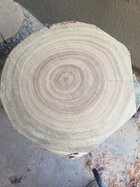
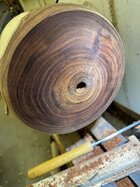
The first image is of a salvaged unknown species buried for years in landscape debris. The second is a recently cut down acacia log being turned through the pith. Some very minor checking controlled with super glue.

 

Attachments

  • woodlot no checks.JPG
    woodlot no checks.JPG
    662.4 KB · Views: 11
  • Acacia pith.jpg
    Acacia pith.jpg
    175.5 KB · Views: 11
FWIW I rarely twice-turn hollow forms. I do both end- and side-grain forms. I turn to final thickness and let the thing dry. If I get them to final thickness (for me that's usually around 3/16" / 5mm give or take) they'll dry usually without cracking (mostly). That depends on the wood and a lot of other factors including climate in the shop etc.

This does require that you can turn your form "promptly". Not rushing it (that's dangerous). But getting the outside form right and getting the hollowing done before the wood moves too much. Break for lunch (or worse, overnight) and you risk loosing the piece (either it will have cracked or will no longer be round enough to finish hollowing).

The end-grain forms (the axis of the tree is parallel to the lathe axis) don't move a lot, so they mostly end up looking round-enough when done. Mostly avoid the pith, as it's likely to check.
If turned around the pith, a piece will usually dry quite round. However, that requires the wood to allow you to do that - you have to ask nicely and respect its answer. I've had good luck with aspen from around here and sometimes walnut.

Side-grain forms will generally move significantly and are usually obviously oval when they dry. I feel this often adds to the character of the piece.

Depending on the wood, sometimes it will dry with ripples as different regions of growth rings will shrink differently. Especially happens in places like crotch figure etc. That can add interest to the feel of the piece.

Just another option/opinion....
 
I'm like Dave. I turn all of my hollow forms, side grain or end grain, to final thickness whether they are green or dry. My preferred thickness is about 1/4". This is where I am different than Dave. If they were turned from green wood, I will soak them in DNA for 24 to 36 hours. After that I will pull them out of the DNA and let the surface evaporate dry. Once that is done I will place it in a brown paper bag, seal it, and then weight it. (I weigh using grams.) I will weight it daily and record the weight. Depending on how wet the wood was, It will stop losing weight in about 3 to 4 weeks. Depending on the wood, and the grain orientation, I will have some pieces that wrap and some that have minor cracks that can be filled. Once sanded, I can then put my finish on them. This process has allowed me to produce turnings that I can sell in a much shorter period of time.
 
Back
Top