John. Could you provide a link to the thread in which you describe how to clean the band saw blade? TIA
Easier to write again than find the thread! And I probably didn't think through the steps the last time.
After several hours of cutting up a short logs and doing a lot of trimming, I needed to clean and sharpen my current blade so I did both a little while ago, sharening first. The sharpening took a while (426 teeth on this 3tpi blade) but the cleaning only took seconds!
There was some gunk built up near the front of the blade, at and just behind the gullets. The gunk is dry and quite hard, stuck firmly to the sides of the blade.
Scraping it off by hand would work but be very time consuming and tedious. Scraping the gunk off with the saw running is so quick, easy, and perfectly safe. Much quicker to do than to think about and type the steps!
---------------------------------------------------------------------------------------------------------------------
CLEANING GUNK FROM THE SIDE OF A BANDSAW BLADE
My secret weapon, er tool, is a piece of thin-wall brass tubing from a hardware or hobby store. Seems like pieces of these might be 10-12" long and come in various cross-sections and sizes. I didn't see the old one so I grabbed a piece of 1/8" square brass tubing from my stash but the size doesn't matter much - I've used larger.
- Start with the saw turned off and properly tensioned.
- I like to raise the guides a few inches for visibility. The blade should be properly tensioned as for cutting.
- As with any bandsaw use, eliminate distractions - no visitors, pets. I turn off the radio and lock the door.
- I stand to one side of the blade and set the tubing flat against the bandsaw table, perpendicular to a flat side of the blade. Position one end of the tubing close to the side of the blade but not touching. (Could stand either in the front or back of the table if equally accessible.) Wear safety glasses - just because.
- Feet flat on the floor, good stance, good balance, good lighting.
- Hold the tubing against the table with both hands, still away from the blade.
- Position the end of the tubing just behind where the dried gunk is. For this case most of the blade was clean but there was a narrow buildup just behind the gullets.
- Turn on the saw. As in all bandsaw operations, be hyper-aware of where the hands are.
- Push the square end of the tubing into the flat side of the blade. It will instantly scrape off any gunk.
- Slide the tubing towards the gullets and continue scraping until that side of the blade is clean.
- Repeat on the other side of the blade if needed.
- Turn the saw off.
Note that almost no pressure against the blade is needed. There is no need to let the tubing touch the teeth but if they do no harm is done. The thin brass will not damage the teeth if accidentally touched. The teeth will not grab the tubing - it's like the tubing and blade don't realize the other is there. The only thing affected is the gunk! But like many things, if it doesn't feel comfortably safe don't do it!
The tubing works better than using a wire brush. Far quicker, easier, and less messy than removing the blade, coiling, and soaking it in something.
---------------------------------------------------------------------------------------------------------------------
I have been cleaning the sides of bandsaw blades this way for many years starting a few minutes after I first thought of it..
If one wanted something larger to grip, it would be easy to solder something else from brass to the tubing. Non-square rectangular tubing is also available, such as 1/4"x1/8", which might be even better to set flat against the table and probably work as well. I haven't tried that.
I drill a small hole across one end of the tubing for a loop of thin steel wire. This lets me hang the tubing from a magnet on the vertical post on the saw or from a nail or screw in the wall.
JKJ.




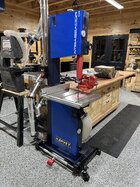

 And - Nova-Teknatool as well.....nice looking machines - but customer service that was considered poor. Now - with them in Chapter 11...well....would not be my choice.