• January 2026 Turning Challenge: Turned and Bent! (click here for details)
  • Congratulations to Phil Hamel, People's Choice in the December 2025 Turning Challenge (click here for details)
  • Congratulations to Larry Copas for "Magnetic Yarn Spinner" being selected as Turning of the Week for January 12, 2026 (click here for details)
  • Welcome new registering member. Your username must be your real First and Last name (for example: John Doe). "Screen names" and "handles" are not allowed and your registration will be deleted if you don't use your real name. Also, do not use all caps nor all lower case.

Bandsaw choice

It's only a curiosity, but could you elaborate on this?
Many Rikon bandsaws feature a toolless, spring-loaded push-button blade guide adjustment system that is intended to be user-friendly and efficient. Based on my experience overseeing the maintenance of woodworking equipment at a well-resourced Habitat for Humanity workshop in North Carolina, I found the actual push-button adjustment process to be challenging.

Adjusting the push-button blade guides requires two hands: one to loosen the threaded locking knob and another to manage the stiff spring-loaded push-button that changes the bearing’s position. Sustaining the desired position while simultaneously securing it with the lock knob can often require multiple attempts. This is, of course, further complicated by multiple adjustment points at both the upper and lower blade guide assemblies.

Admittedly though, such adjustments tend to be less frequent in a personal workshop—reducing frustration. A community shop with multiple users who elect to twist a knob here and a knob there without good reason tends to make frequent and comprehensive adjustments necessary. Nonetheless, I found that the push-button feature did not deliver the practical benefit expected. However, market acceptance of Rikon bandsaws featuring these guides suggests positive user experiences that may differ from my own.

For reference, I favor the straightforwardness of ball-bearing guides over guide blocks, whether ceramic or otherwise. Replacement of ball-bearing guides is both simple and cost-effective.

If any aspect of this explanation requires clarification, please feel free to reach out for additional information.
 
Last edited:
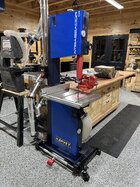
I’m looking to upgrade my bandsaw. I have a rikon 10”. It works for very small stuff. I need something larger for general use purposes. I’m trying to decide between the 14” Rikon 10-326 deluxe and the 17” grizzly G0513.
The Rikon costs about $1600.
The grizzly is $1300.
Does anyone have any experience with either of these.
I have a rikon lathe and it is excellent quality. If the bandsaw is the same I would go for the rikon
 
Many Rikon bandsaws feature a toolless, spring-loaded push-button blade guide adjustment system that is intended to be user-friendly and efficient. Based on my experience overseeing the maintenance of woodworking equipment at a well-resourced Habitat for Humanity workshop in North Carolina, I found the actual push-button adjustment process to be challenging.

Adjusting the push-button blade guides requires two hands: one to loosen the threaded locking knob and another to manage the stiff spring-loaded push-button that changes the bearing’s position. Sustaining the desired position while simultaneously securing it with the lock knob can often require multiple attempts. This is, of course, further complicated by multiple adjustment points at both the upper and lower blade guide assemblies.

Admittedly though, such adjustments tend to be less frequent in a personal workshop—reducing frustration. A community shop with multiple users who elect to twist a knob here and a knob there without good reason tends to make frequent and comprehensive adjustments necessary. Nonetheless, I found that the push-button feature did not deliver the practical benefit expected. However, market acceptance of Rikon bandsaws featuring these guides suggests positive user experiences that may differ from my own.

For reference, I favor the straightforwardness of ball-bearing guides over guide blocks, whether ceramic or otherwise. Replacement of ball-bearing guides is both simple and cost-effective.

If any aspect of this explanation requires clarification, please feel free to reach out for additional information.
I don't have experience with other guide systems, but I find the Rikon push button guides easy enough to use.
 
...I found that the push-button feature did not deliver the practical benefit expected....For reference, I favor the straightforwardness of ball-bearing guides over guide blocks, whether ceramic or otherwise. Replacement of ball-bearing guides is both simple and cost-effective.

@Edward Fasano
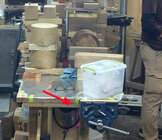
I agree about the guides. My 18" Rikon has the ball-bearing guides and I'm happy with them. Easy to adjust if needed, especially after I put a long hex key for that one screw under the table!

Hey, I notice your location is Kernersville. My wife and I lived in Kernersville for a few years in the early 70's when the area was far more rural than today, Driving through the area now I don't recognize anything! Our oldest son was born in the area. I worked at the Grinell facility west of town doing NDT on piping for nuclear power plants. My biggest "hobby" at the time was riding, racing, destroying, and rebuilding insane dirt bike motorcycles. Woodturning is far less likely to break bones!

JKJ
 
I went thru the same dilemma a couple of years ago.
So - I asked for opinions. The surprising responses I got were about Laguna. While they make a pretty product...their customer service has a really bad reputation. I verified this by searching online for customer experience. As well - several local club members that bought Laguna products - and now spit when they say the name brand...:oops: And - Nova-Teknatool as well.....nice looking machines - but customer service that was considered poor. Now - with them in Chapter 11...well....would not be my choice.

So - I called Laguna - and Nova, asked questions that would require someone in customer service/tech support .Left a message. Days went by, no responses. Called agin, same thing. E-mailed....<crickets>......nothing. Trie this several times. Really thought I wanted a Laguna because they used to be "the" brand. So I was told.

Then - another club member recommended I look at a Rikon. It had more horsepower, good features - not "fancy" as the Laguna or Nova saws. But - a better warranty. So - I went thru the same test as I did with Laguna and Nova. Every time - a real person answered the phone. And - if I had to leave a message for a specific person in the customer/tech support dept....I got a phone call - that day.

There are many good brands - depending how you evaluate "good"....😉

I feel like when we spend our money for "durable goods" - these machines in our shops - we are not just buying a tools. We are investing our money AND our faith in these companies. Nothing is perfect - and that is o.k. - maybe even expected. So - I value the attitude of the company towards the customer AFTER the sale more important than maybe anything else. YMMV...

Just a note about bearings vs ceramic blocks: What are you cutting mostly? If it is green wood - the bearing will build up pitch and gunk on them - causing readjustment and wear more often. The cooling blocks ( www.spaceageceramics.com ) are MADE for green wood cutting. So - if you plan on doing more green than dry wood,,,consider trying ceramics. If you are doing more dry wood - bearings are a better choice for tuning the saw IMO.
 
Just a note about bearings vs ceramic blocks: What are you cutting mostly? If it is green wood - the bearing will build up pitch and gunk on them - causing readjustment and wear more often.

Just to add: for a bunch of years I've been cutting up green wood into blanks for air drying - many, many 100s (probably 1000s) from a variety of wood species local to the SE. I've used two different bandsaws, a previous Delta with riser, tried and used various blocks - ceramic, steel, composite. My current shop bandsaw 18" Rikon with bearing guides.

I've never had buildup on the Rikon guide bearings.

The sides of the blades on the Rikon (1/2" 2tpi) can on occasion get gunk buildup, the same as my Woodmizer sawmill, especially if I'm cutting pine. I always clean any gunk off the blades using an easy method. If I didn't clean sides of the blades, I suspect gunk there might be transferred to and pressed into the bearings.

I think several things might help prevent buildup on my guide bearings, either upper or lower:
  • The Rikon has excellent dust collection with two ports but I devised additional collection for below the lower guides, before the blade enters the lower cabinet - I think this may pick up much of the wet sawdust that would otherwise be carried down and might be compacted between the lower wheel and the side of the blade. I never see any sawdust in the bottom of the lower cabinet. The dust collection is by a powerful cyclone.
  • Made a bracket and added an extra brush to help remove any sawdust that might get packed on the upper wheel. I did this on the older Delta as well.
  • If it makes any difference the bandsaws are adjusted to keep the flat of the blade centered on the crowns of the wheels, where I want it. I set the tension with a tension gauge unstead of a guess.
  • The guides are adjusted with the recommended clearance from the blade. I think it's important they are not too tight.
  • I use sharp blades, resharpen when they get dull. I think a sharp blade cuts cleaner sawdust that is easier to control with the DC; sawdust from a dull blade seems "fuzzier", grain probably torn.
  • Clean the sides of the blades as needed. As mentioned, I do this both on the Rikon and the Woodmizer.
I never get any buildup on the blade with most green species. In the last week I processed a bunch of freshly-felled cherry and walnut, although these species usually don't have sticky sap. I sharpened the blade once, about needs it again.

I've written several times about how I clean the sides of the blades (while the saw is running) but I can describe it again if someone wants.

BTW, I think Mark Duginske's and Lonnie Bird's bandsaw books have good advice about setting up and maintaing a bandsaw. I've seen

JKJ
 
That is what is usually recommended John to center the flat of the blade on the crown of the wheel. However in this demo by Carter products, he recommended adjusting the blade so that the deepest part of the gullets are in the center of the blade. This was recommended to me recently, I don't think I have ever seen better information on setting up a bandsaw.
View: https://youtu.be/wGbZqWac0jU
 
John. Could you provide a link to the thread in which you describe how to clean the band saw blade? TIA

Easier to write again than find the thread! And I probably didn't think through the steps the last time.

After several hours of cutting up a short logs and doing a lot of trimming, I needed to clean and sharpen my current blade so I did both a little while ago, sharening first. The sharpening took a while (426 teeth on this 3tpi blade) but the cleaning only took seconds!

There was some gunk built up near the front of the blade, at and just behind the gullets. The gunk is dry and quite hard, stuck firmly to the sides of the blade.

Scraping it off by hand would work but be very time consuming and tedious. Scraping the gunk off with the saw running is so quick, easy, and perfectly safe. Much quicker to do than to think about and type the steps!

---------------------------------------------------------------------------------------------------------------------
CLEANING GUNK FROM THE SIDE OF A BANDSAW BLADE


My secret weapon, er tool, is a piece of thin-wall brass tubing from a hardware or hobby store. Seems like pieces of these might be 10-12" long and come in various crosssections and sizes. I didn't see the old one so I grabbed a piece of 1/8" square brass tubing from my stash but the size doesn't matter much - I've used larger.
  • Start with the saw turned off and properly tensioned.
  • I stand to one side of the blade and set the tubing flat against the bandsaw table, perpendicular to a flat side of the blade. Position one end of the tubing close to the side of the blade but not touching. (Could stand either in the front or back of the table if equally accessible.) Wear safety glasses - just because.
  • I like to raise the guides a few inches for visibility. The blade should be properly tensioned as for cutting.
  • As with any bandsaw use, eliminate distractions - no visitors, pets. I turn off the radio and lock the door.
  • Feet flat on the floor, good stance, good balance, good lighting.
  • Hold the tubing against the table with both hands, still away from the blade.
  • Position the end of the tubing just behind where the dried gunk is. For this case most of the blade was clean but there was a narrow buildup just behind the gullets.
  • Turn on the saw. As in all bandsaw operations, be hyper-aware of where the hands are.
  • Push the square end of the tubing into the flat side of the blade. It will instantly scrape off any gunk.
  • Slide the tubing towards the gullets and continue scraping until that side of the blade is clean.
  • Repeat on the other side of the blade if needed.
  • Turn the saw off.
Note that almost no pressure against the blade is needed. There is no need to let the tubing touch the teeth but if they do no harm is done. The thin brass will not damage the teeth if accidentally touched. The teeth will not grab the tubing - it's like the tubing and blade don't realize the other is there. The only thing affected is the gunk! But like many things, if it doesn't feel comfortably safe don't do it!

The tubing works better than using a wire brush. Far quicker, easier, and less messy than removing the blade, coiling, and soaking it in something.
---------------------------------------------------------------------------------------------------------------------

I have been cleaning the sides of bandsaw blades this way for many years starting a few minutes after I first thought of it..
If one wanted something larger to grip it would be easy to solder something else from brass to the tubing. Non-square rectangular tubing is also available, such as 1/4"x1/8", which might be even better to set flat against the table and probably work as well. I haven't tried that.

I drill a small hole across one end of the tubing for a loop of thin steel wire. This lets me hang the tubing from a magnet on the vertical post on the saw or from a nail or screw in the wall.

JKJ.

 
Back
Top