• The forum upgrades have been completed. These were moderate security fixes from our software vendor and it looks like everything is working well. If you see any problems please post in the Forum Technical Support forum or email us at forum_moderator (at) aawforum.org. Thank you
  • February 2026 Turning Challenge: Cookie Jar! (click here for details)
  • Congratulations to Chad Eames for "Red Tines" being selected as Turning of the Week for February 23, 2026 (click here for details)
  • AAW Symposium demonstrators announced - If the 2026 AAW International Woodturning Symposium is not on your calendar, now is the time to register. And there are discounts available if you sign up early, by Feb. 28. Early Bird pricing gives you the best rate for our 40th Anniversary Symposium in Raleigh, North Carolina, June 4–7, 2026. (There are discounts for AAW chapter members too) For more information vist the discussion thread here or the AAW registration page
  • Welcome new registering member. Your username must be your real First and Last name (for example: John Doe). "Screen names" and "handles" are not allowed and your registration will be deleted if you don't use your real name. Also, do not use all caps nor all lower case.

Best way to ebonize wood, and best wood to ebonize?

Joined
Jul 30, 2021
Messages
904
Likes
278
Location
Aurora, CO
I've had a project in mind for a while: To turn a bowl (or bowls, rather) that have a black exterior, but their natural color on the interior. I've encountered a few pieces like this, always loved them. One approach, that I figure I'll try at some point but just not yet, is to burn the outside, and that is interesting, but not quite what I'm looking for.

I know that some woods, those containing tannins, can be ebonized in various ways by causing those tannins to blacken. I've done some research on this, and noted that ebonizing with certain solutions on tannin-containing woods, is not really going to give you a "true black" look like the charcoalizing approach does, nor a black that rivals say African Blackwood. I am really looking for a true black. I suspect that dyes may work here, although I am not sure what the best dye might be. Perhaps ink...I thought I came across someone talking in a video about using an ink to ebonize, however for the life of me I cannot find it again.

I'm curious what approach works best, to ebonize to a nice, solid, complete black, and which woods handle it best. I figure, if dye or ink is involved, the wood does not necessarily need to contain any tannins, but I figure some woods are probably better than others to soak up the right amount of dye/ink for the best results. Also curious about application technique, whether any kind of sealing first might be useful, etc.

Thanks!

 
I use India ink - usually on things like finials and goblet stems. You can check my stuff in the gallery - some (not all) of the rockets and goblets have maple parts dyed with India ink (others are African Blackwood). I get a pretty good deep black.

I think the challenge you're going to face with a bowl exterior when using dye or ink (anything liquid-y of any color) is bleed-thru. Depend on the porosity of the wood (or if there's micro-cracks etc), you might get black bleeding thru to the inside. Also around the rim (re-cutting the rim after dying could help). So testing on similarly-thick pieces of side- and end-grain of the same wood is probably called for.

I've had varied results with the iron acetate (vinegar & steel wool). Sometimes I'd get a great deep black, sometimes just blah grey (even with the same solution on a different piece from the same tree). So I don't bother with that anymore.

Seems like to me you'd get the best results with something thicker. Someone is surely going to suggest shoe polish, but I have no experience with that. Paint seems like the safest bet to get the color and maintain control over where it goes.
 
I use India ink - usually on things like finials and goblet stems. You can check my stuff in the gallery - some (not all) of the rockets and goblets have maple parts dyed with India ink (others are African Blackwood). I get a pretty good deep black.

I think the challenge you're going to face with a bowl exterior when using dye or ink (anything liquid-y of any color) is bleed-thru. Depend on the porosity of the wood (or if there's micro-cracks etc), you might get black bleeding thru to the inside. Also around the rim (re-cutting the rim after dying could help). So testing on similarly-thick pieces of side- and end-grain of the same wood is probably called for.

I've had varied results with the iron acetate (vinegar & steel wool). Sometimes I'd get a great deep black, sometimes just blah grey (even with the same solution on a different piece from the same tree). So I don't bother with that anymore.

Seems like to me you'd get the best results with something thicker. Someone is surely going to suggest shoe polish, but I have no experience with that. Paint seems like the safest bet to get the color and maintain control over where it goes.
India Ink! That is what the video was about. Your results look excellent, just what I was looking for.

Good point about bleed through. That's why I asked about sealing... I guess it would depend on the wood and grain orientation. If I do bowls, I wonder if it might be better to do end grain bowls rather than the classic bowl grain orientation to try and prevent that.

The more common forms of ebonizing (iron acetate, is that where you steep steel wool in a solution for a while?) do seem to be hit or miss as far as how dark you get, which is why I posted the thread. I guess it probably depends on the amount of tannins in any given piece of wood, even if its known to have high tannins (i.e. oak). I like the look of the india ink, though. Will give it a try.
 
I like the look of cherry that’s been ebonized with iron acetate (steel wool dissolved in white vinegar). The trick is to apply a coat of black tea to boost the tannins just before you apply the iron acetate.

Here’s a bowl I did a while back that used that technique on the exterior. View attachment 85605
Beautiful. Simple, yet the contrast really does something for it! I had read about using black tea as an initial conditioner. How has your experience been with bleedthrough? Do you do anything to prevent that?
 
With any penetrative finish there will be a little bit of capillary bleed, but when I use this technique I always finish the outside (sanding and ebonizing) before I hollow the interior. That approach leaves a pretty crisp transition at the rim IME.
 
Here's a backwards colored from what you wanted. I did it because I was tired of trying to get the inside smooth. (hides a lot) There's a lot of bug activity visible. I'm calling it "rustic"

Dick Blick India ink.
 

Attachments

  • PXL_20260226_000218161.MP.jpg
    PXL_20260226_000218161.MP.jpg
    331 KB · Views: 21
Last edited:
The best woods for ebonizing, IMHO, are oak and walnut. Cherry will turn, but results in more of a dark gray. At our recent club meeting, where the demo was Ebonizing, the presenter used tannic acid from a wine making supply store, and any wood we tried got very black. I've used wet tea bags for the same purpose, but the wine-making tannic acid produced a very uniform and deep black.

One other choice to consider is Fiebings USMC leather dye. It's a potential disaster if you spill, but it also produces a uniform and dense black, on most woods.

With that in mind, the wood you choose might best be based on the contrast each gives between the natural wood inside and the deep black outside.

One note from experience--the result with ebonizing or leather dye will be a little fuzzy from raised grain, and the color may be blue-black (like Superman's hair is the old DC comics). After a light buffing with fine scotchbrite and applying your favorite film finish, you'll get a true black. (Sorry, no pictures, as the black pieces I make are given away immediately)

PS you might check with Vinnie Luciani on what he uses for the black background on his carved vessels. Maybe he'd even agree to a play date.
 
I'm curious what approach works best, to ebonize to a nice, solid, complete black, and which woods handle it best.

I like Fiebing's Leather Dye - USMC Black. I’ve not found a wood it won’t work with. Easy to work with. I usually apply with a foam brush. Have airbrushed it on a few times.

On HFs. I’ve used it on the inside of a few but have switched to golden airbrush opaque black on the inside.
If I finish the outside first the leather dye doesn’t bleed through but it dulls the colors on the outside a bit.


Camphor Leather dye applied with airbrush
IMG_2814.jpeg

Citrus - leather dye dapplied foam brush
IMG_1095.jpeg

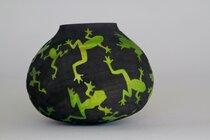
Camphor golden opaque black airbrush background
frogs  night out.jpeg
 
Last edited:
I use the vinegar/steel wool solution on Oak and Ash and like the look that I get, but it is not what you are looking for. I love the appearance of different colors on the same piece of wood from medium brown to dark grey/black without masking the grain.
 
I use the vinegar/steel wool solution on Oak and Ash and like the look that I get, but it is not what you are looking for. I love the appearance of different colors on the same piece of wood from medium brown to dark grey/black without masking the grain.
Yeah. I honestly don't mind that look, and I think it would be great for other pieces. But for the set of pieces I'd like to make, its not quite what I'm looking for.
 
I like Fiebing's Leather Dye - USMC Black. I’ve not found a wood it won’t work with. Easy to work with. I usually apply with a foam brush. Have airbrushed it on a few times.

On HFs. I’ve used it on the inside of a few but have switched to golden airbrush opaque black on the inside.
If I finish the outside first the leather dye doesn’t bleed through but it dulls the colors on the outside a bit.


Camphor Leather dye applied with airbrush
View attachment 85621

Citrus - leather dye dapplied foam brush
View attachment 85616

Camphor golden opaque black airbrush background
View attachment 85625
I'm intrigued by the fact this is applied with an airbrush. Is that to achieve a certain look to the finish, or does the stuff not wipe on well?

Curious how well an airbrushed on finish holds up...well?
 
With any penetrative finish there will be a little bit of capillary bleed, but when I use this technique I always finish the outside (sanding and ebonizing) before I hollow the interior. That approach leaves a pretty crisp transition at the rim IME.

Do you finish to a higher grit? Wonder if closing off the pores a bit that way would help with bleed? I will be doing some experimentation here to see how it goes on a few types of wood. Cherry is probably the main wood I was thinking about using, I just like that warmer tone with the black. But I might also try with some maple as well. I hadn't planned on using any woods with larger more open pores...I do wonder if filling the grain a bit for such woods, though, would help with any bleed? Or would the ink just go right through any grain filler?
 
Do you finish to a higher grit? Wonder if closing off the pores a bit that way would help with bleed? I will be doing some experimentation here to see how it goes on a few types of wood. Cherry is probably the main wood I was thinking about using, I just like that warmer tone with the black. But I might also try with some maple as well. I hadn't planned on using any woods with larger more open pores...I do wonder if filling the grain a bit for such woods, though, would help with any bleed? Or would the ink just go right through any grain filler?
With Cherry, I usually sand to 320, then do the first round of ebonizing. Let dry. Sand 320 -> 400. Ebonize and let dry. Sand 400 -> 600. Ebonize and let dry. Hand sand w/ 600. Then apply your preferred finish.
 
At our recent club meeting, where the demo was Ebonizing, the presenter used tannic acid from a wine making supply store, and any wood we tried got very black.
Can you share any details about how to use the tannic acid? I guess you dissolve it in water (how strong of a solution?) paint it on the surface you want to ebonize, let it dry, then apply the vinegar/steel wool (iron acetate) solution?
 
I'm intrigued by the fact this is applied with an airbrush. Is that to achieve a certain look to the finish, or does the stuff not wipe on well?

Curious how well an airbrushed on finish holds up...well?

You read too quickly🙂
I usually apply the leather dye with a foam brush. The dye is thin spreads easily with a foam brush to get a nice look easily.

With the first hollow form I airbrushed it on with the sandblast resist in place acting like a frisket.
Brushing with the resist in place would create bleeding under the resist.
Removing the resist shows the surface not made black.

I prefer the airbrush paint for doing backgrounds with resist in place. The paint sort of dries when it hits so it leaves a crisper border than the dye. Both work.

Airbrush dye and paint hold up quite well. I would judge equal to brushed on. It can be scratched through intentionally or accidentally.
 
Last edited:
Can you share any details about how to use the tannic acid? I guess you dissolve it in water (how strong of a solution?) paint it on the surface you want to ebonize, let it dry, then apply the vinegar/steel wool (iron acetate) solution?
I like to apply the iron acetate while the tannin solution is still damp. IME that elicits the best reaction.
 
Back
Top