• The forum upgrades have been completed. These were moderate security fixes from our software vendor and it looks like everything is working well. If you see any problems please post in the Forum Technical Support forum or email us at forum_moderator (at) aawforum.org. Thank you
  • February 2026 Turning Challenge: Cookie Jar! (click here for details)
  • Congratulations to Dean Center for "After Life" being selected as Turning of the Week for February 16, 2026 (click here for details)
  • AAW Symposium demonstrators announced - If the 2026 AAW International Woodturning Symposium is not on your calendar, now is the time to register. And there are discounts available if you sign up early, by Feb. 28. Early Bird pricing gives you the best rate for our 40th Anniversary Symposium in Raleigh, North Carolina, June 4–7, 2026. (There are discounts for AAW chapter members too) For more information vist the discussion thread here or the AAW registration page
  • Welcome new registering member. Your username must be your real First and Last name (for example: John Doe). "Screen names" and "handles" are not allowed and your registration will be deleted if you don't use your real name. Also, do not use all caps nor all lower case.

Calling attention to food safe or not food safe?

Joined
Jan 24, 2010
Messages
3,221
Likes
974
Location
Cleveland, Tennessee
Gearing up to display some turnings in addition to custom pens. How do you turners make it known if a turning is food safe or not food safe? I'm concerned in this day of lawsuits that a person buys a bowl and gets sick because they used it for breakfast cereal. I'm thinking to mark this on the bottom of the turning that can be used for food.
 
I dont worry about it. As near as I can tell from research all the finishes we use as turners are food safe once the volatiles have evaporated. I do use mahoneys food safe finish on my baby rattles and that's the only time I might mention it to close a sale.
So let it sit for a while before selling it? Thanks for your help.
 
How would you suggest that anyone can leach, or get a piece of the finish from the wood into their mouth? Cutting board of course, cereal bowl less likely. There is no warning on every plastic utensil, or any piece of plastic anything, that micro plastics are now in 99% of the fish we eat. Micro plastics are found in our rain and the air we breathe. Eating from a finished wood bowl is now healthier than eating from a plastic cereal bowl.
 
I’m going to agree with John Grace that there are too many finishes to chance something. I only use FDA compliant for food contact finishes. There are several. I have no idea if a person may have a reaction to something. The other side is a child might chew anything and if something wasn’t safe it wouldn’t be on the market.
 
I’m going to agree with John Grace that there are too many finishes to chance something. I only use FDA compliant for food contact finishes. There are several. I have no idea if a person may have a reaction to something. The other side is a child might chew anything and if something wasn’t safe it wouldn’t be on the market.
Kids used to chew wood window sills that had lead paint. Then came safer paint.
 
Could you expand on this? It's always been my understanding that the FDA does not test wood finishes for food contact?
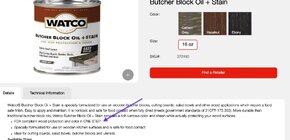
Many manufactures such as Waco Butcher Block will state their product is compliant with FDA guidelines for food contact. (likely FDA 21 CFR 175.300) Compliant doesn’t mean the FDA regulates the manufacture, but the manufacture has followed the guidelines established by the FDA.

This is from Rust-Oleum’s site.

Image 2-20-26 at 8.28 AM.jpeg
 
Last edited:
Saw a wood turning today; label stated- Renewed with mineral oil. BTW, it was a nice walnut bowl with a prominent rim.
 
Allow me to clarify my original post. I try to sell nearly all of my pieces and I won't put it up for sale as 'food safe' unless the manufacturer has done all of their own testing. Again...with so many OEM approved safe finishes I don't understand why someone would choose anything else if the piece is for sale. just my opinion...
 
Allow me to clarify my original post. I try to sell nearly all of my pieces and I won't put it up for sale as 'food safe' unless the manufacturer has done all of their own testing. Again...with so many OEM approved safe finishes I don't understand why someone would choose anything else if the piece is for sale. just my opinion...
I'm with you there, John. I only sell once per year at the holiday bazaar at our facility (11 different studios, 1500 members). A significant percentage of the people who come to the sale are likely to care what kind of finishes are put on bowls especially. Not so much spindle projects, but still.... I used to go with the idea that any finish that is cured is food safe, but then I became more educated about things like "driers" (e.g., in so-called boiled linseed oil - less than a handful are made friendly by heat-treating). And recently, when I wanted to apply a bit of epoxy to a salad bowl, I learned about how not all epoxies are food safe. As an instructor and lathe program coordinator, I feel I must not compromise on any statement about "food safe." Such a hard line isn't for everyone, I know, just sayin'.
 
As a chemist, I can say it is true that nearly all finishes are food safe once fully cured. Also, there are very likely more toxins or allergy causing compounds in the wood than any finish.

That said, many people want to be able to say it is food safe without doubt. (This does generally ignore allergies). Compliance with a certification like FDA does support the safety and that the manufacture backs it, however, as mentioned above that doesn't include testing for toxicity or how the certification/classification is determined. IMO it's better than nothing. In addition one can:

1) Use an edible finish e.g. shellac (used as food coating among other things), mineral oil, vegetable oil...
2) Look at the Safety Data Sheet(SDS) (formally MSDS) required for all products. This shows what chemicals are actually in the substance rather than what the manufacture claims. If this showonly one or two components that are not toxic it is safer than most things. Sectioins 3 ingredients and 11 toxicity are most important. Caveat a) this requires determining what is toxic, and b) "proprietary" compounds are allowed to be excluded.
3) Does the manufacturer provide easy access its food safe criteria and/or its Safety Data Sheet.

Mahoney's does a pretty good job: https://mahoneysfinishes.com/food-grade-safety-info/
However IMO, it demonizes VOC's. Our food, wines, coffee's would taste pretty poor without a lot of VOC's. SDS shows the only ingredient listed on MSDS is walnut oil.

Tried and True says “100% safe for food contact surfaces." “Linseed oil and beeswax” on the can. MSDS ingredients: “Modified Linseed Oils” and “trade secret”. Sooooo, how modified? secret? Their website goes further in its claim on other safety/environmental issues. https://www.triedandtruewoodfinish.com/about/environmental-standards/

Having fun Pushing it too far?? are linseed oil, walnut oil, or tung oil toxic? Warning - google with give many different and wrong answers. See SDS.
Linseed: SDS: Linseed Following ingestion "Rinse mouth with water. Do not induce vomiting. Never give anything by mouth to an unconscious person. Call a doctor or Poison Control Center immediately." ?? Does not sound good! That's likely for drinking it straight. Section 11 No other toxicity data listed

Walnut Oil: SDS: No acute or cronic toxicity. Ok, its a vegtible oil
Tung Oil: SDS: Section 11 toxicity either says not toxic or no data. But for fun see the SDS for Minwax tung oil especially sections 3 & 11 https://web.mit.edu/tsg/sds/minwax_tung_oil.pdf Finishes labled "pure tung oil" are often not.

Sorry for the long post, you decide.
Lary

 
So let it sit for a while before selling it? Thanks for your help.
Two weeks minimum, that's what I learned long ago. If you have a good nose, you can also get a good idea by taking a few deep sniffs inside the bowl.
Yeah let it sit for a while. Not sure I have a “good nose” but the sniff test works for me, based on cutting some pieces apart after no odor was found and inspecting the cut surfaces (blo and poly).

You can speed the curing (and no scent) process up significantly by putting the finished turning in a warm environment 90-100F for a day or 3. I use a cardboard box and 400w personal electric heater when its cold, the deck in summer.
 
Every finish I have used food contact or not the manufacture has provided the time for full cure. I have seen some as long as 90 days, but the most common is 30 days. There are some that have a few days cure time.
 
Tried and True says “100% safe for food contact surfaces." “Linseed oil and beeswax” on the can. MSDS ingredients: “Modified Linseed Oils” and “trade secret”. Sooooo, how modified? secret? Their website goes further in its claim on other safety/environmental issues. https://www.triedandtruewoodfinish.com/about/environmental-standards/

Sorry for the long post, you decide.
Lary

Hi Lary,

I agree with you. Just adding my thoughts here, not debating (particularly since I am not a chemist).
------------
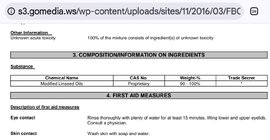
This snip from the Tried & True Danish Oil SDS document (their straight linseed oil product)-
1000017679.jpg
The asterisk under trade secret, since I did not see any footnotes in the report that relate to that asterisk, I am going to interpret it to be equal to "not applicable", or "none". Their 90-100% contents by weight, I'm going to think of that like when a pure metal like silver or gold is represented by stating 99.999% pure, in that there is no practical way to state anything, even this oil, is 100% pure.

Now, could they have made me more comfortable by saying 99-100% rather than 90-100%? Yes, but maybe they can't guarantee 99+% pure linseed oil. Who knows what else gets included in those seeds at any time in the process from the farmer's field until it arrives at my workbench. (Maybe that unknown 10% would include what the farmer did to the plant in his field, or what the processor of the seed did to the previous generation plant before that farmer even planted the seed, such as genetic modification... I'm grasping, those probably are not realistic.) But I have to trust all of their SDS and marketing claims; I don't have a laboratory to test the finished product for purity.

With the "modified" claim, I think that refers to the partial polymerization process of the raw oil. Another article on T&T products from the past, if I recall properly, explains the high heat, oxygen free process of partially polymerizing the oil so it will reach final cure faster for the end user. Otherwise they'd market this as raw linseed oil.

Just my thoughts...
 
THE SKY IS FALLING, THE SKY IS FALLING.

OMG, there is cobalt in my finish....I'M GONNA BE POISONED...........

Did you know that cobalt ingestion happens every day? Necessary ingestion is around 5mcg per day and the body can tolerate up to 1mg/day without ill effects. It's also part of what makes up vitamin B12 (cyanocobalmin) and without it, you get pernicious anemia unless you take those little red shots each month.

Let's get real. The inside of a bowl requires a maybe teaspoon or two of finish. The excess that isn't wiped off is mostly a solvent that gases off and an oil that cures and stays in the wood. So those miniscual amounts of driers are in the wood (where the oil went) and not on the surface just waiting to be licked off. Even if was able to be licked off, the quantity would be insignificant. If the finish is in a pint bottle (473ml), there are ~ 94 teaspoonfuls of finish.

If a person were to drink the bottle, the risk isn't the drying agents. It's the oils/solvents that can cause an aspiration pneumonia. Even notice a lot of products say "Do not induce vomiting if ingested"? So you think mineral oil is a safe product? Did you know there are 2 types? Heavy and light. Heavy is a laxative and safe to ingest. Light is not and can cause, you guessed it, aspiration pneumonia. Care to guess which one is in your butcher block restoration juice.

Heaven forbid the young mother that asked if the finish was food safe had just come from lunch where she ate tuna in a salad which contains mercury. And that morning she took junior in for his boster shots and he got a lovely does of mercury (found in thimersol) equal to the amount of mercury momma ate for lunch in her tuna. Maybe more if he got more that one vacination. I assure you momma isn't worried about the additional mercury when she goes out to dinner with dad and gets sushi. And I guess she isn't worried about those silver fillings she still has from her youth. And I hope that same woman doesn't keep her liquor in those beautiful lead glass decanters that were wedding presents because I would hate for her to poison her guest with lead.

Years ago, when I started practicing, the label on digoxin bottles had a skull and crossbones printed on the label because it was so toxic it was considered to be poison yet we give small quantities and achieve a therapeutic result for heart failure. Even morphine had a skull and crossbones printed on the label and yes, it is considered posionous due to the amount needed to kill you.

Yes, zero ingestion is 100% food safe but also ingestion below acceptable exposure levels is also food safe. Fully cured finishes prevent transfer from the vessel to the person. No transfer equals food safe. Heck, it is food safe if there was transfer due to the extraodinary low quantites of finish in the wood and I truly doubt that all the finish would come out of the wood at one time giving a maximum amount of transfer. Have you ever bothered to read the report from the water company about what is in your water and what's in it? Did you happen to notice what was considered acceptable? Bet most of you didn't know female hormones from contraception medications are present in drinking water since convention means of purification do not remove them.

I guess it all comes down to personal decisions. However your choices should be based on what is real and what is fiction. Not just because you think it is so.

Now, my rant is over and I'm going to enjoy some M&M's that are in my walnut bowl finished with Watco. I sure hope the red dye, presticides in the peanuts, and cadmiun & lead in the chocolate won't hurt me. Now if I could just figure out how to remove the calories from them.............
 
THE SKY IS FALLING, THE SKY IS FALLING.
While I generally agree that there is an over reaction to the concerns about food safety as it comes to wood finishes, I think your post makes light of the fact that from scientific research we have a better understanding about health risks associated with various products. It wasn't that long ago that tobacco products were perfectly safe.
 
While I generally agree that there is an over reaction to the concerns about food safety as it comes to wood finishes, I think your post makes light of the fact that from scientific research we have a better understanding about health risks associated with various products. It wasn't that long ago that tobacco products were perfectly safe.
I do make light of it because to be deleterious, sufficient quantity of the offending substance must be transerred. Just because a substance is present doesn't mean it will transfer much less in sufficient quantities to threaten harm.

For those that are truly worried, proposition 65 must be a nightmare because things like coffee and wood working tools are on the list.

In general, my point is about the drama that we encounter regarding food safety.

As a side note, I was an organic chemist that used to synthesize carcinogenic benzapyrenes for microsomal liver enzyme studies before I became a clinical pharmacist. I'm skeptical about the concerns of cured finishes based on the quantity that would have to be given to lab animals to envoke a clinical response given my experience in the name of scientific research.
 
Last edited:
As a side note, I was an organic chemist that used to synthesize carcinogenic benzapyrenes for microsomal liver enzyme studies before I became a clinical pharmacist. I'm skeptical about the concerns of cured finishes based on the quantity that would have to be given to lab animals to envoke a clinical response given my experience in the name of scientific research.
As a biochemist that spent most of my career working on DNA structure I can tell you exactly why benzo(a)pyrenes are carcinogenic and why I wouldn't mess with it, even at low concentrations (and it is also one of the significant carcinogens in cigarette smoke, which used to be just fine for your health!). Trying to draw a parallel between bowl finishes and animal studies on something completely different might make sense in your head, but it would be very bad science. My point is that scientific exploration is the only way to know what exposure levels can be considered safe, and a change in safety limits as new data are obtained is the right way to do it (see Red food dyes). Again, I agree that most people that make a big deal about cobalt as a drying agent really don't understand the concentrations at use or how that would be related to exposure.
 
Lots of information here Never thought it would develop into on replies. I consider the bumper sticker: Eat right, Stay Fit, Die Anyway.
 
Steve,
I agree with what you said. It’s interesting that the first line of your clip says “Unknown acute toxicity”..The toxicity section is more informative with oral non-toxic. (I should note that not all SDS for a given compound will end up the same partly due to how they are generated, often by AI now). I should note that the SDS refers to the product as sold including solvents not as used or cured.

Your description of the extra percentage is likely correct. It would require significant testing to confirm that “all” cans meet a higher purity. Occasionally, an intentional component can fall below the requirement. “Proprietary” covers anything but we can be sure its not arsenic if they claim non toxic

I think Mahoney’s also uses the high heat method.

Webb,
Sky is Falling,
I agree with your comments about quantity and presence of “undesirable” compounds pretty much everywhere. I think the thread started with essentially “what do we tell them?”. It’s generally not feasible to explain it all. I started looking this up because a friend asked about selling wood utensils, cutting boards, etc. and customers asked. She wanted to have strong evidence for saying yes food safe. After looking at many SDS’s, it looked like Tried and True and Mahoney’s had the most obvious safe SDS,. I did not bring up the glue or toxins in the wood. Personally, I use shellac or Waterlox. Waterlox’s SDS looks a bit scary but I’m sure its safe. I think people should be accurately informed when asking regardless of their lifestyle. It can be very frustrating feeling like I want to go through the comments like you’ve made.

I believe the concern over cobalt, or driers is a carryover from when actual toxic heavy metals were used. I also think there seems to be tendency to catastrophize from those VOC's to weather.
 
ersonally, I use shellac or Waterlox. Waterlox’s SDS looks a bit scary but I’m sure its safe. I think people should be accurately informed when asking regardless of their lifestyle. It can be very frustrating feeling like I want to go through the comments like you’ve made.
Larry, Waterlox provides a statement on their products food safety.

 
Smoking Camels is is preferred by a majority of 113,397 doctors who were surveyed. (See #7.)

Camel mildness for your T-Zone.

History is full of all kinds of things that were acceptable yesterday and not tomorrow. PFAS, anyone? I wore a canvas wide brim hat for over 20 years in every weather condition (ugh, that thing had a life of its own), and every couple years I'd stand out in the yard and spray it down with 3M Scotchguard good and heavy. I appolgize.

In the meantime, until convinced otherwise by facts, I'll keep slathering Tried & True on the goodies I make. And, it's been a long time since I've used good ol' pure tung oil, maybe I'll pick up a bottle sometime.
 
Thanks Tim for the link to 175 indirect food additives and adhesives. Yes, the facts are good to have. The Waterlox example and the 175.300 regulations support the statement above that all modern finishes are food safe. However, details may not be as clear. Some of the substances included under 175.300 only qualify if "applied to any suitable substrate as a continuous film or enamel that serves as a functional barrier between the food and the substrate." Does the wood item qualify?. It also allows use of formaldehyde, ethylene glycol, xylenol, among other toxic compounds in processing. We must trust that the residuals are very small. 175.300b3 provides a nice list of oils that are safe.
 
Back
Top