• The forum upgrades have been completed. These were moderate security fixes from our software vendor and it looks like everything is working well. If you see any problems please post in the Forum Technical Support forum or email us at forum_moderator (at) aawforum.org. Thank you
  • March 2026 Turning Challenge: Olla! (click here for details)
  • Congratulations to David Wyke, People's Choice in the February 2026 Turning Challenge (click here for details)
  • Congratulations to Tim Connell for "Black Locust Basket Illusion Series #4" being selected as Turning of the Week for March 16, 2026 (click here for details)
  • Welcome new registering member. Your username must be your real First and Last name (for example: John Doe). "Screen names" and "handles" are not allowed and your registration will be deleted if you don't use your real name. Also, do not use all caps nor all lower case.

Carbide tools + RPM

Joined
Jan 16, 2025
Messages
13
Likes
10
Location
Minneapolis, MN
Good morning!
I've been turning for just over a year, I use Rockler's 12-24 midi lathe and carbide turning tools. I've had a lot of success and have turned some beautiful pieces.

I mainly turn bowls/platters/boxes etc. usually less than 10" in diameter and 16" in length.

Here's where I want some feedback from the hive mind: When i'm turning, I find myself trying to get to the top rpm (~1,200) as quick as possible so I can turn efficiently and get a smooth finish although, I very often have to start at 80 grit when sanding and usually spend more time sanding than turning. I keep my carbide tools fresh and sharp as much as I can.

Thoughts? Advice?
 
Not sure what type of carbide you use, but most are just scrapers. My advice, 3 years in, is to learn how to turn with traditional tools—gouges. Look at Hunter carbides if you decline to try gouges. And reaching 1200 rpm is not necessarily the goal—depends on wood type, wood shape, blank size. Find a mentor and join a group.
 
Here's where I want some feedback from the hive mind: When i'm turning, I find myself trying to get to the top rpm (~1,200) as quick as possible so I can turn efficiently and get a smooth finish although, I very often have to start at 80 grit when sanding and usually spend more time sanding than turning. I keep my carbide tools fresh and sharp as much as I can.

Are you having problems with certain types of wood, or is it across the board?

What issues are you sanding out? Is it tearout / end grain or are you seeing the same issues across the entire surface? You didn't mention spindle work but do you see the same issues? Understanding where things are going wrong might give you a good clue as to what you need to fix.

I've only been turning a few years myself but one thing that helped me a lot was to use every pass as a practice cut and diagnose what was happening, what worked and what didn't. Make a pass, stop, and evaluate. Don't wait to be at your final form before stopping and seeing how you're doing, cause at that point sandpaper is your only recourse.

I haven't tried carbides, and so my bag of tricks won't be helpful for you. But, things I play with are tool choice, sharpness, angle of presentation, bevel support, how aggressive the cut is. Play around and see if you can make incremental improvements.
 
The main issue seems to be end grain tearout, Some woods have more "damage" than others, but it seems to be a recurring issue that i've been having.

I'll definitely start watching those videos, thank you for posting!

I took a class at WoodCraft and learned on traditional tools, but when it came to getting my own setup up and running, I chose carbide. I am definitely not against traditional tools, and I know they will be in my future, the only barrier is cost at this point.
 
The carbide tools are mostly used as scrapers, and while they do work, you still need gouge and skew skills. With scrapers and experience, you can get excellent results on end grain pieces, but on bowls, they leave a LOT to be desired, which is mostly tear out which requires a lot more sanding time. I don't think I have met any one who actually likes to sand. I sure don't. As for speed, there are all sorts of formulas. Since my first lathes had no rpm read outs on them, I learned to turn by speed. With bowls, I would not go much over about 1000 for a 6 inch diameter bowl, but that may be too fast, especially for a beginner. Spindles are usually done much faster, in the 2000 rpm range, and again, it depends on size. It is a feet/minute thing. Small spindles, as fast as your lathe can go, maybe. Rolling pin about 2 inch diameter, not more than 2000 rpm. Bowls, in the 600 to 1000 range, and all of this depends on the wood. I do not turn crappy wood, though some love the channelge.

robo hippy
 
I took a class at WoodCraft and learned on traditional tools, but when it came to getting my own setup up and running, I chose carbide. I am definitely not against traditional tools, and I know they will be in my future, the only barrier is cost at this point.
This is what I usually told new/prospective woodturners when they were looking at a big display case full of shiny new woodturning tools:

If I had the proverbial one tool to use when I am stuck on that desert island...
3/8" Bowl Gouge for the win.
I think it has the biggest bang for your $.

Second is a 1" Skew. The first one you get I would lean towards one with square shape on the bar stock as opposed to oval.
But man, do I sure enjoy my oval skew when doing my long spindles and finials!

I know many folks here will highly recommend some premium tools with corresponding premium prices...
but a bargain-basement High-Speed Steel (HSS) tool still works and can get you started.
Save your money on the turning tool side if you need to also budget in a grinder for sharpening.
Learning how to sharpen what you have and what sharp can do for you at the lathe is not a bad thing.
The only thing about lower cost tools is they do not generally have a refined shape. But go for it anyway!
 
One thing I’ve noticed is that there seem to be quite a few bowl turners on here that use power sanders, so you’re not alone Jordan, and I’m guessing many if not most are using conventional tools?

Have a look at Glens videos where he uses Cupped Carbide inserts. He seems to achieve a very good finish with them.
 
I find myself trying to get to the top rpm (~1,200) as quick as possible so I can turn efficiently and get a smooth finish although, I very often have to start at 80 grit when sanding and usually spend more time sanding than turning. I keep my carbide tools fresh and sharp as much as I can.

Carbide tools have some advantages, such as when sharpening.

But my advice is to ditch any carbide tools that work like scrapers. Using them on most wood will require significant sanding.

I also recommend the "traditional" tools. But if you don't want to sharpen and use traditional gouges, skews, etc, take a look at the Hunter carbide tools. (he's in Minnapolis too!).

My favorite is the Hercules. Hunter tools have razor-sharp round cutters that work just like a sharp gouge. You don't sharpen them but rotate the cutter a little occasionally to spread the gradual wear around the circumference. They are used just like a spindle or bowl gouge. Can make an extremely clean cut. When the cutter eventually wears out you replace it with a new one. The first cutter on my Hunter Hercules stayed sharp a LONG time - can't remember now, maybe a year?

I often use Hunters on spindles, bowls, platters, almost everywhere except where I need to get into tight "corners" or v-grooves. You CAN use Hunter tools as scrapers, flat on the rest, but that would be such a waste of a clean cut! A bonus advantage when turning a bowl is the cutter throws hot chips to the side while a bowl gouge guides them directly to my hand. And by doing the initial surface smoothing with hand scrapers on bowls and platters I can usually start sanding with 400. (I have one piece I sometimes show at demos that has been touched only by 600 grit.)

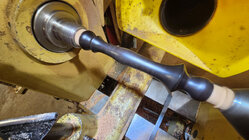
Using Hunters I can often start sanding with 400 grit or finer (with good hard wood). For example, this shows the surface right off the tool from the 1st finishing pass with a Hunter Hercules - I think I started sanding this at 600 grit. (Of course, this is hard, fine-grained African Blackwood. Something softer or turned without a steady hand may require more sanding.) BTW, I quit using power sanding on anything so many years ago I can't remember the last time. I don't like the clouds of dust and what the rotating disks can do to the wood. IMO, there are better ways. (I do have a close-quarters drill in a drawer by the lathe but I only use it for, well, drilling in close quarters. :))

1773960939640.jpeg

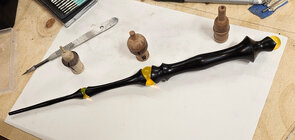
The picture above shows the handle section I made for this, assembled after turning some acrylic pieces and doing a bit of carving on the ends of each section.
1773961273712.jpeg

JKJ
 
Last edited:
Have a look at Glens videos where he uses Cupped Carbide inserts.

Are the carbide inserts actually cupped?

At 37:40+ in the video in message #3, it sounds like Glenn refers to the bits as flat.
In some of the closeups they also appear to have a narrow flat at the circumference. They don't look anything like the cupped Hunter carbide bits.

Of course, I don't have nor have ever seen one of his. It would be a long swim to go visit.

JKJ
 
Last edited:
Are the carbide inserts actually cupped?

At 37:40+ in the video in message #3, it sounds like Glenn refers to the bits as flat.
In some of the closeups they also appear to have a narrow flat at the circumference. They don't look anything like the cupped Hunter carbide bits.

Of course, I don't have nor have ever seen one of his. It would be a long swim to go visit.

JKJ

Glen uses both Cupped and Flat inserts. Maybe it was another video with the cupped inserts. He does though manage to get both types to cut, rather than scrape.
 
I find myself trying to get to the top rpm (~1,200) as quick as possible so I can turn efficiently and get a smooth finish although, I very often have to start at 80 grit when sanding
I think you're going to be the best judge of how fast to go. But if you are still having to sand a lot there may not be a lot of benefit in spinning so fast. You can compare the surface you get at 1200 with lower RPM's.
 
If I had the proverbial one tool to use when I am stuck on that desert island...

Yikes, I just now imagined being stuck on a desert island and wanting to turn some wood. Besides a gouge I might need to built a spring-pole lathe. Could draw a face on it and name it Wilson.

Hey @Jordan Daoust, what a great first name!
Don't you think anyone here named Jordan should send you some spare tools? :)

I didn't see if it was mentioned but IMO the two best things a beginning turner can do are
  • Join a local turning club. Lots of people willing to share advice and resources. Demonstrations by experienced people on ways to do things.
  • Find a mentor/private instructor.
Many clubs have a mentorship program with free help at the mentor's shop. (ours and some other clubs buy insurance policies for this.) Often the mentor will provide tools that you can learn to use effectively. An experienced turner can watch what you are doing, make suggestions on presentation and technique, and might even show you how to get better results from the tools you have. They can also try turning questionable wood with their tools and yours to see how much of the problem is the wood.

Also, I strongly suggest learning spindle turning first with a skew and spindle gouge - that can teach the fine tool control that will let you turn anything with the best possible finish. That still might not help with if using carbides used as scrapers. But as someone pointed out, you DON'T need expensive tools to do good work. I often find and buy older useful tools for cheap or free and keep a box of them in the shop. I use them to practice and teach sharpening, to send home with beginners, and to grind into custom tools.

If looking at inexpensive used tools, the only important things to keep in mind are the type of steel and whether it's properly hardened. If marked HSS, the tool is most likely fine. If not, I use a small triangular file to scratch the corner or side of the steel shaft - if hardened properly, the file will skate on the metal instead of filing a groove. I found that some inexpensive tools are only hardened for the first few inches! Also, non-HHS tools (made from tool steel) can have the hardness at the edge instantly destroyed with too much heat when sharpening with a heavy hand. (Use a light touch and cool them often by dipping into water.) You can sharpen HSS to a glowing red and not hurt anything but simply bluing the edge with sharpening heat can cause a problem with non-HSS.

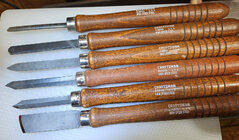
When I started turning I went to Sears and bought a set of HSS turning tools. About 25 years later I have other tools as well but still use the Craftsman tools very often - here are some in the original set with a couple extra added and one missing. They are perfectly respectable and functional tools.
1774192108007.jpeg

A quick check showed these are available on ebay, some at good prices.

JKJ

 
Last edited:
Back
Top