• The forum upgrades have been completed. These were moderate security fixes from our software vendor and it looks like everything is working well. If you see any problems please post in the Forum Technical Support forum or email us at forum_moderator (at) aawforum.org. Thank you
  • Congratulations to Chris Lawrence for "Dragon's Grip" being selected as Turning of the Week for March 30, 2026 (click here for details)
  • Welcome new registering member. Your username must be your real First and Last name (for example: John Doe). "Screen names" and "handles" are not allowed and your registration will be deleted if you don't use your real name. Also, do not use all caps nor all lower case.

Dream shop

Joined
Feb 25, 2025
Messages
723
Likes
912
Location
Jackson, MS
If you had a wish list for your dream shop what would it be?

Reason for asking is I’m doing it now. So far, there will be lots, as in lots of lighting. Plugs out the wazoo (120 and 220). Dust collection and air scrubber. Clean up sink. TV and stereo. Doors to the outside. HVAC. Dust collector and compressor in a closet to reduce noise. Desk area.

My entire life, I’ve made do, cut corners to keep cost down, etc. Now that I’m retired and can afford it, I’m doing it. I’m looking for ideas of goodies you wish you had.
 
About 10 years ago, a friend of mine who was a cabinet maker did some work on making my shop much nicer, All new cabinets, Hardwood countertops, etc. For the cabinets on the floor (not the wall cabinets) he put in drawers instead of cabinets with shelves and doors. Try it....you will love it. he measured some of my equipment that I was keeping in that area and made the drawers to fit that size. Think ...tools in a case, place to put ????? and you do not have to get down on your knees to get to the back of the cabinet.....just pull the drawer out. He had some space and put in some drawers that are about 4' long. Drawers....not cabinets. Yep - the best.
 
Ah, dream shop, so nice to dream,

I think a 30x50, 10’ ceilings on main level, a daylight basement below same size, with a killer loft under the roof with 10/12 pitch roof and 6 dormers, sitting on 4’ knee walls, all timber baloon framed with 2x6 T/G cedar throughout, and open beam floor/ceilings.
Lower level my shop for wrenching and storing my F350 Superduty and my Rubicon and my UTV, with a bay for welding and my forge and knife stuff
Main level my wood shop, all wide plank doug fir wood floors, long sealed flush mount strip lights throughout, opens onto a 30x20 covered deck.
Upper level my office and leather/sewing room and Better half's workout room with a kitchen and bath, that the kitchen opens out onto a deck over covered deck on main level.
All with climate control.

Wheres Publishers clearing house when ya need em!
 
In the for what it's worth category....the closet you're putting your compressor in should have insulated walls, use a solid core wood door, and if possible...sit on a separate slab than the rest of the room/house. A lot of sound is transmitted through a concrete floor.
Dont forget to ventilate it well, they generate a lot of heat
 
I’ve built new shops each time we moved. Each one better than the last. I built my current shop 9yrs ago and it’s the best, I expect it will be the last. The only regret is I didn’t make it larger :)
 
A comfortable chair for when you want to turn off every last piece of electrical gear and sit quietly in the warm sun coming through the window, and maybe take a nap.

And a mini fridge to keep the root beer cold.

And a closed-circuit camera with a monitor back into the house so someone in there can keep an eye on you, just in case. Maybe as simple as a Ring doorbell or something like that.

And a carport-size roof-covered area on the outside of the shop with a door back inside for those times when something needs to be done outside and the sky isn't cooperating. Put it on the typical down-wind side of the building- I'm in Minnesota, so I would not put it on the north side where winter weather would make it useless.

These are the things I dream about. But I do have a mini fridge now. The rest has to wait a few more years.
 
Lumber storage for those 8+ foot boards that just magically seem to show up.
Open shelving for drying turning blanks.
And racks for all the clamps you wish you had.
TV and Stereo in the corner and that Chair Steve just mentioned.
Toilet and wash sink?
A corner for finishing and maybe a small table for taking photos of all your projects.
 
Just moved my workshop to my basement I had an electrician install 220 for my lathe and several new circuits with 16 GFI outlets. The shop, at 14 x 20 is still too small, but when is a shop ever big enough? I do have a large sink, dust collector, JET air filtration unit and a finishing area. I don't do flat work, just turning and embellishment. BR is upstairs, but the exercise is good for me.
 
If a sink of some sort is important to have yet impossible or cost prohibitive to install, one could always cobble together a 5 gallon bucket a couple feet above a sink, with a valve (3/8" outlet) and short length of rubber tubing installed on the bucket side near the bottom, and another bucket below the sink to catch the discharge (no drain trap required), and as long as that drain water doesn't have anything hazardous in it, just toss the waste water out the back door onto the ground. Could skip the sink, too, and just run bucket to bucket.

The upper bucket can be refilled as needed with a garden hose. I'd loose-fit a bucket lid on top of it to control evaporation. And if the water will be sitting between infrequent refills, add a very small amount of chlorine bleach to the water to prevent microbial growth (see 2nd website below). The Clorox website gives ratios of how much can do the job, these ratios show a mix for general cleaning/sanitation of surfaces, these are rubber glove concentrations much high than needed for water storage.

This EPA website for water emergencies lists how to prepare water for drinking with MUCH lower chlorine bleach concentrations. This is more what I was referring to above, not the cleaning concentrations from Clorox.

And post a sign at the sink- no drinking water!
 
I would highly consider quick connect ductwork. It is very expensive (e.g. our 12' x 16' shop was approx. $6,000 installed) but it is so worth it. The ease of assembly and the flexibility is just amazing. Also there are no screws sticking though the pipe, and no duct tape needed. I would go for it now while you are building and not retrofit later.
 
I visited a great shop recently that had the dust collection piping under the floor with the ducts coming up to each machine from below. Worked great, looked great. Agree with separate area for finishing/painting/etc.
 
I visited a great shop recently that had the dust collection piping under the floor with the ducts coming up to each machine from below. Worked great, looked great. Agree with separate area for finishing/painting/etc.
That would be nice, but only with access from underneath. No way you would want to take up the floor to change the layout.
 
What all is the shop for? Just turning, flat ww, anything else? Mine is multi purpose, Turning, flat ww, spray finishing, store and work on motorcycles and anything else. May require separate rooms, etc.

For hvac filtration will need extra work, such as pre-filters. With the fan on it could serve as the shop filter. Over Insulate, especially the ceiling. If all one room, no need to use a lot of ducting - blower fans and or ceiling fans can mix/distribute air well.

Couple of windows, put a 1/2 window in the man door.

My shop is not a “hang out”. I have a home office for that. If it is to be the man cave and shop the size and design changes significantly. TV - not in the shop for me, I use a phone or laptop if I need to review a video on how to do something.

Stereo - yes, I have a very nice one for a shop system. I just upgraded it a few months ago, new set of speakers in a different location and a much upgraded subwoofer. Very much depends on what you want, just background music or an actual music experience - volume level, clarity, soundstage, imaging, etc. I stand most of the time, speakers are mounted with tweeters ear height. Depending on your expectations this is a separate thread.

Prefer sealed concrete floor - I use a lot of nasty chemicals the get spilled occasionally. Due to this, a large door with cross flow from man door and or windows that allows venting the whole shop quickly if needed.

Storage - determine the type of stuff to be stored and where/how to store, then add some to it.

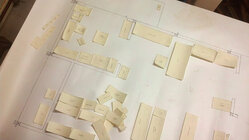
Layout - work on this until you are sick of it. Do a paper scaled drawing, cut out all the machines, cabints, shelves, etc, and move them around. Think through how things will be done, how much room to move wood or other things around.
 
Wherever you install receptacles make them double duplex. The added cost is very small. It would also add a little more cost but have (2) circuits run to each location and then put a duplex on each one.

Have a separate circuit for the lighting in the shop, so when you trip a circuit with some equipment, you don't end up in the dark.
 
What Jim said. I have quad outlets fed by two 20 amp circuits. Separate circuit for lighting.

If I were building new, I would definitely want a grade level shop with at least a partially paved drive leading to a large door. This is to receive all the new equipment I would want for my new shop :).

And to go along with my new equipment purchases, a properly reinforced section of roof/ceiling and an over head hoist to lift heavy equipment for unpacking and assembly.
 
I like my refrigerator. Besides cold drinks, I store CA glue and some finishes in it to extend storage life. Next to the fridge, I put in a standard built in cabinet style microwave for drying bowls and warming up morning coffee. It recently went out, and I replaced it with a much bigger and cheaper countertop microwave. Wish I had built something to keep it off the countertop.
 
First shop was 400 sq. ft. A bit tight.... Second shop was a 24 by 36 pole barn. Not too bad. Current and "forever" shop is almost 2500 feet. This summer I will be building a storage shed for lumber since I do some flat work, and have a large wood stash. It will be 200 sq. ft. since that is a size you can build here without a permit. Things I would do different.... One would be higher ceilings. Mine are currently at 10 feet, but I would opt for 12. In part, with a full sheet of plywood, it is difficult to move the sheet through the shop, and not only because I hung my duct work from the ceiling. With a 10 foot ceiling, you can't rotate the sheet on a diagonal. I would also run the duct work in the attic, which would probably require more insulation. The "lathe" room has a concrete slab. Not sure if I would if I would want to run them under the slab. My walls are a stacked block wall that is 12 inches thick and was made close by. They are wood fiber and concrete, and have HUGE thermal and sound insulation properties. I would keep them. I do have a fridge for beverages, but I would add a small microwave just to allow for reheating my coffee. I do heat with a wood stove, and weather is generally mild so no need for air conditioning or heating, other than the wood stove. I do go through about 3 cords in both the shop and in the house. The shop uses a bit more due to the concrete slab. I would keep that. I do have a full bath with a shower stall. Part of that is due to the idea that some one can convert the shop into a house some where down the line. I am on one acre and on the edge of town. I do have to have a land scape company manage my lawn care. It is more than I can take care of. I ain't no spring chicken any more.... Some one commented before I moved into my forever home and shop, "you will be surprised at how fast it will fill up". I told them that it would be full as soon as I moved in. That was true, but I actually had room to move around in the new spot. Oh, I put grab bars in all the showers and bathrooms. I am getting older....

robo hippy
 
Just built my “dream” shop this past year. Just passed my final inspection and got my certificate of occupancy last week.
Things I did right:
  • 10’ walls with a 10/12 pitch Cathedral ceiling open to a cupola
  • 5 240v outlets on separate circuits
  • 6 120v circuits
  • Lights on 2 separate circuits
  • 8” T&G walls
  • Mostly drawers in benches with just a few cabinets - no open shelves to collect dust!
  • 20’x24’ (also a drawback - see below)
  • Heat with 32K mini split (keeps it at 50 degrees) with wood stove while working in the shop
  • 2 52” ceiling fans
  • 8 windows (plus the 4 in the cupola) and upper windows in the french doors - lots of light!
Things I should have done:
  • Gone bigger. I moved out of 12’x13’ basement shop and thought 20x24 would be huge. Nope.
  • Need more storage for boards and bowl blanks. Totally inadequate right now.
  • Separate room for dust collector (and a stronger collector - I have a Jet 1100 with 6” 26 gauge metal ducts)
I used Sketchup to design the inside layout. Great help. Went thru many different configurations to get to the final layout. Don’t forget that a 20’ wall is actually over a foot less since 20’ is the outside dimension. Need to subtract wall thickness and interior siding thickness to get to the useable dimension. It matters when you have 20’ of tools that now needs to squeeze into less than 19’. 😳

Good luck - building a new shop is a fun project. Share your progress.
 
Potentially big subject.
A few things I thought of just now.

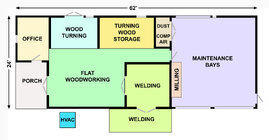
I built my shop 24'x62'; office, main shop, welding room, wood storage, large back room (more wood storage, little machine shop, maintenance.)

Some things I'm sure glad I did: Keep in mind this is a separate building on the farm, near the barn, down the hill from the house.

Note that LONG before I started putting up walls and forming for the concrete I designed all of the space, where the equipment would go, all the walls and storage spaces, and every wire and switch (and every receptacle (both 110v and 220v and the big 50a 220v receptacles for the welders and plasma cutter), both inside and outside power. A thick notebook has drawings for everything. The weeks I spent planning and sketching saved untold hours of frustration, do-overs, wasted materials, and "oops, I sure wish I'd thought of that earlier."

To make sure I had plenty of walking room between machines I made circles to represent the space I needed to carry something and slid them through spaces. Paper cut outs made adjusting things easy - one in progress:
1775422621960.jpeg

CONCRETE
If poring concrete consider heated floors depending on the climate.
If doing your own rebar do NOT use the plastic or even wire "chairs" commonly specified by architects to hold up the rebar. My concrete surfacing friends told me they often feel these "chairs" collapse when they are walking in the concrete while working. This pushes the rebar down towards the ground negating the advantage of having it in the upper third of the concrete. Instead, I broke bricks into chunks and put dozens around to support the rebar at the height I wanted. Rebar is supposed to be wired and NOT welded on industrial/commercial projects due to the chance of corrosion, especially on high rise. I have no problem with welding for a 4" and a 6" slab for a 1-story workshop so that's what I did. I built the footer into the edge of the slab with rebar in place and secured to the rebar in the floor. Tractor, backhoe, auger, and skid steer helped a lot with getting things ready.
SPACE
I built in an 8'x12' office just inside the entrance door. This has desks for instruments like microscopes, computer, a display cabinet, shelves for all the farm equipment manuals, and a small library of woodturning and wood-related books. Spare shotgun, spare varmint rifle, spare bright flashlights at hand. First aid kits, hearing, and eye protection right by the door.

POWER AND INTERNET
Underground power. I didn't want the traditional 3% allowable voltage drop but calculated wire size for a 1% maximum drop, even at the expense of larger gauge copper. The cost of even big copper wire is trivial compared to the total cost of the building the entire shop. DON'T fall for the often-recommended underground aluminum service feeders intended for mobile homes. May be OK in conduit but never in direct burial.
I ran a spare 2" conduit containing nothing but a length of rope. For possible future upgrades.
I ran two ethernet cables in separate conduit. I thinking was if one failed somehow I'd have a spare. An ethernet switch and separate wifi router provides high speed data. Remember that all underground conduit eventually fills with water - use directly burial ethernet cable.

LIGHTING and SWITCHES

I used 3-way and 4-way switches nearly everywhere so lights could be controlled from more than one location.
I like to put lights in "zones" so one switch doesn't light up the shop like a baseball stadium. 6 switches at the entrance door.

One turns on a string of lower level lights from the entrance entrance door/office all the way to that end of the far room. That way I with one switch I can see my way everywhere to fetch or return tools, wood blanks, etc.

One switch turns on the bright overheads in the main shop area.
One switch lights the wood storage area.
One switch controls outside lights at the entrance end of the shop.

Each bright T-5 overhead fixture has a ballast that allows a wire to go to a second switch which disables one of the two bulbs in each fixture. I mount these second switches in boxes above the main switches so if I want more light for a task I just reach up and flip the upper switch.

One switch turns on the overheads over the lathe area. Can turn them off when I use small lights on adjustable arms when turning.
A second wall switch at the lathe enables a number of mostly hidden outlets that power the lathe lights on adjustable arms.
One wall switch at the bandsaw enables a quad outlet and to turn on all the bandsaw lights at once.
A switch at the sharpening station lights that area.
A wall switch outside the welding room lights that before I step inside.

A switch at the wood storage area turns on those lights in the event I don't turn them on at the door but feel a need for wood.
A single switch at the back door lights the back room.
Two double switches on the sides of the back room and next to rollup doors activate outside lights on both sides of the buildings.
A switch in the air compressor/cyclone closet lights that area.

I use some lights outside that come on when it gets dark.

Inside near the entrance door is an emergency EXIT sign with battery-powered lights that will come on automatically in case of power loss.

DOORS
Exterior man doors have electronic keypad locks so I never have to carry a key.
All exterior doors are insulated.
Three double-wide exterior doors are strategically placed to bring equipment and long lumber in and out. The table saw is between the welding room with a set of double doors and one of the exterior double doors. This will let open both and rip long stock if needed.
The back room has two insulated industrial garage doors, one 10 and one 12' wide, plus a 10' on the other side of the room.
A double door in the lathe nook lets me easily move lathes and such in and out. Used it for wheelchair access when a friend visited. Don't forget about wheelchair access!

EQUIPMENT
I planed the placement of every major piece of equipment - lathes, table saw, drum sander, bandsaw, hydraulic press, HVAC unit, ect before I started construction. This let me plan lighting and wiring with no unpleasant surprises later.''
I put the bandsaw across the "aisle" from the primary lathe, withing quick reach and near the entrance door to easily bring it wood chunks for sawing.
To save space, the 22-44 drum sander sits tucked to the side of the walkway to the back room. Since it's on wheels, I can easily roll it out into the walkway when sanding longer pieces.

SECURITY
A set of cameras inside and out record constantly and are viewable over ethernet in the house or anywhere over internet. I had to use one to show a lazy farm sitter that no, she did NOT fill the water tub for the llamas: Here on Tue you dragged the hose to a peacock house. On successive days the hose was never moved. I didn't ask her to come back the next time.
Some external lights are motion activated.
Sensors at the security gate alert me at the house of someone entering, even if walking. Or sometimes if they are a deer...
From the upstairs bedroom window I have a clear view of the shop, barn, security gate, driveway, and both front and back fields. This was by accident but fortunate. Hear some odd noise - a spotlight from the window sees all.

WALLS
Although 2x4 studs are typical I used 2x6 studs (along with 6x6 posts and triple beam construction) for two reasons - extra strength, and space for extra insulation. The attic has multiple diagonal bracing.

HVAC
For me a must. Didn't cost that much more for the year-round temperature and humidity control benefit. Saved bunch by installing the HVAC myself. External + internal unit.

OUTSIDE
Concrete pads outside some doors can be helpful, especially outside the welding shop. On nice days I can cut and weld outside.

COMPRESSED AIR
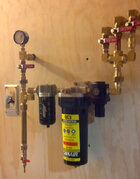
A 5hp 60 gal 2-stage air compress is in the sound-insulated closed with the cyclone dust collector. Put all controls, valves, and filters OUTSIDE the closet for monitoring and switching on and off.
1775422824803.jpeg
The entire shop is plumbed for compressed air with outlets within reach where needed. Two retractable reels, one just inside one of the big powered garage doors reaches outside on that end of the building for tires and impact wrenches and such. Another reel is on the civilized end of the shop.

DUST COLLECTOR
A 5hp Clearvue cyclone in a sound-insulated closet with the air compressor collects dust from multiple places through 6" ducts hidden in the trusses above the ceiling.

WALLS
Not permitted by some codes such as for rooms/garages attached to living spaces: I used 1/2" radiatia pine plywood for on the ceiling and on every wall. Put all sheets up with screws so they could be removed if needed - did that once when I added a 220v line for a new lathe. The plywood allows me to hang anything anywhere with screws - shelves, tool racks, etc. That plywood has two good sides. The outside walls have 1/2" sheathing covered with 4x8 sheets of siding. I discovered that the lumber company would sell sheet goods with dinged corners for $5 each, a fraction of the normal price. Since I was trimming off a few inches in most places I bought every "defect" sheet they had.

EFFORT
I think it took me 5-6 years from clearing and leveling the ground to filpping the circuit breaker on the last wire. I moved the lathe in and took woodturning breaks before all the walls were up. I tell visitors I built the shop with my bare hands but I lie, I used tools...

I hauled and placed all materials with my truck, big trailers, and unloaded with forks on the skid steer and tractor.

A friend with a crane and two friends put up the trusses and the roof. The far left corner needed 4' of fill which could be a problem ("fill always settles") but I did three things: filled and compacted in 3" lifts with a wheeled skids steer with a ton of rock in the bucket; built a rebar-reinforced grade beam for that corner, and strategically buried big 3x4x5' rocks sitting firmly on undisturbed ground and extending a few inches into the 6" slab. Zero settling detected today.

I got help from my son to raise and set two of the interior 6x6 posts into their holes, concrete punch pads already in place. I used big c-clamps extensively to brace the beams and allow fine adjustments until they suited me.

Friends with a concrete finishing company poured and finished the floor. I sloped the entire floor 3" over 62 feet in case of the need for drainage and to make the roof gutters come out nice :) - that slope has no effect on any shop function.

Suggestion: put professional, servicable fire extinquishers within quick reach everywhere. Get them professionally inspected on a schedule. Haven't had to use one yet.

All was good clean fun. Last time I checked I still wasn't an architect but it went together well and is still stout today. If I did it all over I can't think of anything I'd change. Maybe make it 6' wider. A bathroom and kitchen would be nice (and I still might add them) but hey, it's only a 250' walk up the hill to the house.

1775422888008.jpeg

1775422413329.jpeg
All that was so much fun I've prepped the ground and designed a second, simpler building just a bit down from this one. It will be 24x48', gravel floor, open bays on the front to store big equipment and mowers out of the weather. Since I'm getting older and lazier I'll have a company put it up with steel trusses and siding. Should go up in a few weeks once I'm ready. Can't have too many buildings on a farm.

JKJ

 
My flat woodworking area is 33" X 33' and my first lathe started in there. It wasn't long that I knew I was going to need a bigger area just for woodturning. So I planned out a 24' X 36' building with a 14' X 12' room off the side of it. The thing is to this day the flat woodworking area has become a wood holding area there is barely room to walk up and down the aisles and there is wood piled everywhere. (Note: Once I stat woodturning I never touched one of the two table saws until about a year ago I cut something on one of them) After about two years in the woodturning shop I was wishing I had gone to 48 ft. I have one more lathe to sell but the room has filled up again with the homes for the Rose Engine, The CNC Router and the Lasers. The 3D Printer is up in the house in the computer room as I only heat the shop to 70° while I'm down there otherwise the heat comes on at 50°. Will I ever turn all the wood I have - No. I am going to concentrate on the 600lbs of Central American Burl I have though.
 
Wherever you install receptacles make them double duplex. The added cost is very small. It would also add a little more cost but have (2) circuits run to each location and then put a duplex on each one.

Have a separate circuit for the lighting in the shop, so when you trip a circuit with some equipment, you don't end up in the dark.
30-ish years ago I had a small shop in a 10'x13' room in the corner of our basement with one tiny window. Turned on the bandsaw, it tripped a breaker, and everything went dark. That was scary. Found out that the entire basement - lights, outlets, etc was on one 15A breaker. Next thing I did was pull cable for a couple more circuits.
 
Back
Top