Cans would not be my first choice for shop lighting, either.

-
April 2026 Turning Challenge: Salad Bowl! (click here for details) -
Congratulations to David Bartell, People's Choice in the March 2026 Turning Challenge (click here for details) -
Congratulations to Gianni Di Gregorio for "Simple Piercing" being selected as Turning of the Week for April 20, 2026 (click here for details) -
Welcome new registering member. Your username must be your real First and Last name (for example: John Doe). "Screen names" and "handles" are not allowed and your registration will be deleted if you don't use your real name. Also, do not use all caps nor all lower case.
You are using an out of date browser. It may not display this or other websites correctly.
You should upgrade or use an alternative browser.
You should upgrade or use an alternative browser.
Dream shop
- Thread starter Webb Willmott
- Start date

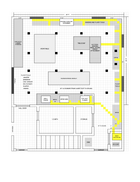
Send your drawing to Oneida, years ago they would provide recommended ducting for free when you’re purchasing from them, I suspect they still will. BTW - your going to love the V3000My dream shop is well underway. Drywall done. Electrical pulled. Here is the plan. Again asking those in the know for suggestions. The black square are led cans for general lighting.
I am installing a V 3000 Oneida dust collector so the drawing is for the engineers to suggest ducting.
Cans are my preference for general lighting. 16 in a 500sf area with brighter bulbs are what I want for general shop lighting since I have 10’ ceilings. With 2 additional over the lathe for a total of 18. I will add more concentrated light after I get things situated and determine what additional is needed. And cans don’t gather dust.Cans would not be my first choice for shop lighting, either.
I suspect every wood worker didn’t start out with all the lights they ever needed and added as need arose.
Hope you are putting doors on the DC and compressor cubby. I used double steel insulated doors on mine - the closet walls and ceiling are insulated as well - can hear a whisper outside the closet when the sound would be deafening inside.
I use a series of can lights down the shop, all powered by one switch. Mine are not for work lights but just to let me see to walk and grab tools and things from the various areas (5 areas, 4 divisions/rooms, depending on how I count). For work lighting I use T5 fluorescent tubes. These are great since each fixture has two bulbs but the ballast is (or can be) wired to turn on just one bulb, both if I flip an extra switch. One is enough for almost anything but higher on the wall I have the second switch for those times I want to be blinded by the light. (Think Manfred Mann's Earth Band ‧ 1976) Plenty of daylight frequency light. One friend visited when I got everything set up and asked for sunglasses...
I also am a true believer of 3-way and 4-way switches so I can control lights from several locations - saves walking back to the main light switch boxes by the entrance doors.
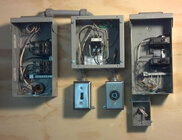
I have a slightly different philosophy for wiring inside the cyclone and air compressor closet, each with 5hp motors- central disconnects and power distribution but remote wireless controls at the major stations (lathe, bandsaw, drum/disk sanders) with a central disconnect near the center of the shop and another in the closet which controls a contactor/relay in the closet. If something goes south I want to be able to shut things down quickly.
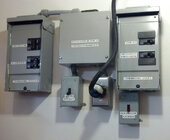
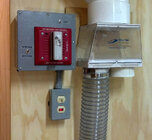
JKJ
I use a series of can lights down the shop, all powered by one switch. Mine are not for work lights but just to let me see to walk and grab tools and things from the various areas (5 areas, 4 divisions/rooms, depending on how I count). For work lighting I use T5 fluorescent tubes. These are great since each fixture has two bulbs but the ballast is (or can be) wired to turn on just one bulb, both if I flip an extra switch. One is enough for almost anything but higher on the wall I have the second switch for those times I want to be blinded by the light. (Think Manfred Mann's Earth Band ‧ 1976) Plenty of daylight frequency light. One friend visited when I got everything set up and asked for sunglasses...
I also am a true believer of 3-way and 4-way switches so I can control lights from several locations - saves walking back to the main light switch boxes by the entrance doors.
I have a slightly different philosophy for wiring inside the cyclone and air compressor closet, each with 5hp motors- central disconnects and power distribution but remote wireless controls at the major stations (lathe, bandsaw, drum/disk sanders) with a central disconnect near the center of the shop and another in the closet which controls a contactor/relay in the closet. If something goes south I want to be able to shut things down quickly.
JKJ
I did send. Yellow is the ductwork I had in mind. Will see what they come up with. My question to the peanut gallery is where would you put the floor tools?Send your drawing to Oneida, years ago they would provide recommended ducting for free when you’re purchasing from them, I suspect they still will. BTW - your going to love the V3000
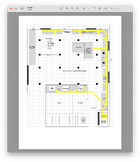

Rough lumber comes into my shop through a garage door. First machine meeting the lumber is the jointer for face jointing. Than the other side goes through the planer and back to the jointer for edge jointing. Finally to the table saw. To work efficiently I grouped those three machines together with as few steps as possible between the garage door and the machines. The infeed side of the machines are alternated to again save steps.
The rest of the machines line the walls with no real thought on work flow or efficiency.
When I first built my shop, I had a long workbench up against one wall. I later added a 4' X 7' assembly table away from the wall. A few years later I built a small workbench about 30" X 40". It sits out in the middle of the shop and I love it. Fast to walk around which really helps when building stools and chairs. It's small enough I can't leave stuff on the top. To reclaim space I got rid of the wall workbench and that was one of my better idea's. It was far too easy to leave stuff (junk) on the top plus it was hard to work off of with access on only one side.
The rest of the machines line the walls with no real thought on work flow or efficiency.
When I first built my shop, I had a long workbench up against one wall. I later added a 4' X 7' assembly table away from the wall. A few years later I built a small workbench about 30" X 40". It sits out in the middle of the shop and I love it. Fast to walk around which really helps when building stools and chairs. It's small enough I can't leave stuff on the top. To reclaim space I got rid of the wall workbench and that was one of my better idea's. It was far too easy to leave stuff (junk) on the top plus it was hard to work off of with access on only one side.

I am finishing my dream shop. 24 X 36 with loft, second floor. The loft is 12' x 36', and there's no head-bump ceiling with a wonderful set of stairs with a railing.
The main floor is three rooms: the shop, the man cave, and the bathroom. Two attached extra buildings, a mechanical room with Dust Collection and Compressed Air. The second 4 x 6 building is a wood drying room.
All the bells and whistles I could think of, many have been listed here already. I would make one change: a wooden floor in the shop. Concrete is faster, but placing dust control, electrical, water/sewer, and others would have been so much easier from a tall crawl space. Over the years, I have only brought one car into the shop for repair, so a concrete floor isn't necessary, in my opinion. Some days, my legs ache from the concrete.
The other thing I wish I had added was an extra 15 feet for my wife's She-Shed. She is running her quilting frame in a small bedroom. She deserves better.
I think I'll work on that.
The main floor is three rooms: the shop, the man cave, and the bathroom. Two attached extra buildings, a mechanical room with Dust Collection and Compressed Air. The second 4 x 6 building is a wood drying room.
All the bells and whistles I could think of, many have been listed here already. I would make one change: a wooden floor in the shop. Concrete is faster, but placing dust control, electrical, water/sewer, and others would have been so much easier from a tall crawl space. Over the years, I have only brought one car into the shop for repair, so a concrete floor isn't necessary, in my opinion. Some days, my legs ache from the concrete.
The other thing I wish I had added was an extra 15 feet for my wife's She-Shed. She is running her quilting frame in a small bedroom. She deserves better.
I think I'll work on that.

I am installing a V 3000 Oneida dust collector so the drawing is for the engineers to suggest ducting.
Hello Webb,
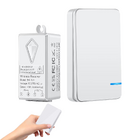
Just thinking of your dust collection system, Instead of hard wiring switches at each point you might want to turn on your dust collector, you might give the switch below a look. This one is by Greencycle.
These are for lighting systems, 1000 to 1200 watts, and 1800 watts for non lighting circuits. They have a 200 ft range indoors, you can place them with a screw or double sided tape wherever you want. The batteries last a long time, I have had mine installed, with 6 transmitters for at least four years and have never changed a battery.
Of course, they will not work directly to start your dust collector, but they will handle the 120 volt start coil on a contactor. 1000 watts on 120 volt equals 8.7 amps. A 120 v coil on a contactor for a five hp motor typically draws .25 to .5 amps to hold the contactor after start, and 3 to 5 amps for the initial engagement.
When I installed mine, I figured up the cost of the copper for six 3 /4 way switches, the contactor and remote switches were 20% less than the copper, and I would still have to buy switches, boxes, conectors, etc. (They have come down in price since I purchesed mine.)
Hope this helps,
WH
I hadn't included an work table yet but with all that floorspace in the middle, it was on my list. Also my woodworking bench wasn't on there. Now is. Exact placement TBD but once I get the cabinet saw and bench located, I'll know the size to build the table. Here is an update with doors labeled as to where they lead. The door directly to the garage is 3' wide. If wider needed, there is a double door out to the back porch that so I got that covered. I thought hard and long about putting a true garage door in but decided not to for several reasons.Rough lumber comes into my shop through a garage door. First machine meeting the lumber is the jointer for face jointing. Than the other side goes through the planer and back to the jointer for edge jointing. Finally to the table saw. To work efficiently I grouped those three machines together with as few steps as possible between the garage door and the machines. The infeed side of the machines are alternated to again save steps.
The rest of the machines line the walls with no real thought on work flow or efficiency.
When I first built my shop, I had a long workbench up against one wall. I later added a 4' X 7' assembly table away from the wall. A few years later I built a small workbench about 30" X 40". It sits out in the middle of the shop and I love it. Fast to walk around which really helps when building stools and chairs. It's small enough I can't leave stuff on the top. To reclaim space I got rid of the wall workbench and that was one of my better idea's. It was far too easy to leave stuff (junk) on the top plus it was hard to work off of with access on only one side.
Thanks for the suggestion WH but the Oneida system uses a keyfob and if needed, extra fobs are $19.95. I'll probably spring for a few extra ones.