• December 2025 Turning Challenge: Single Tree! (click here for details)
  • Congratulations to Bob Henrickson, People's Choice in the November 2025 Turning Challenge (click here for details)
  • Congratulations to Dave Roberts for "Low Rider" being selected as Turning of the Week for December 1, 2025 (click here for details)
  • Welcome new registering member. Your username must be your real First and Last name (for example: John Doe). "Screen names" and "handles" are not allowed and your registration will be deleted if you don't use your real name. Also, do not use all caps nor all lower case.

faceplate-based screw chucks, what diameters?

Joined
Oct 25, 2020
Messages
1,229
Likes
1,100
Location
Minneapolis, MN
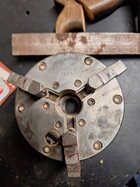
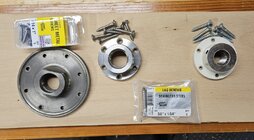
What you see here is the ingredient list to make 3 faceplate-based screw chucks, including the 1-1/8" thick beech board, 8" wide.

On the left are 5" and 3" faceplates, 1-1/4" x 8tpi for my 16" Vicmarc. On the right, a 3" faceplate, 1" x 8tpi for my 12" Oneway.
1000016679.jpg

I don't use faceplates really. But I enjoy watching Raffan more than rerun TV, and three quarters of his projects start with mounting a lump of wood onto a purpose built screw chuck (the Vicmarc 3-in-1 version for him). Since I have everything on hand, I thought I'd go with the faceplate style to begin with before investing in the real thing.

If you were doing this, or if you have done it, what singular diameters of wood would you mount to the faceplates? I don't plan to make a bunch of different diameters, just one diameter per faceplate and be done. Arbitrarily, I thought 1" larger than the faceplate diameters to maintain meat outside of the screws. Thanks for your ideas.

For reference, the Vicmarc 3-in-1 screw chuck has face diameters of 1-5/8", 2-1/2", and 3-3/4", although Raffan always installs a plywood spacer, and generally of diameters larger that those faces of the screw chuck (unless the turning stock is relatively small).

 
This article, by Doc Green, won't directly answer your "what diameters" question, but you might find his discussion of screw chucks helpful.

Good luck and I'd be interested in hearing about any insights you would care to share.

I have a Precision Machine 3-in-1 Screw Chuck that I picked up at an estate sale. I will switch chucks (Vicmarc scoll chuck to Screw Chuck) to use it instead of the woodworm screw.
 
Thanks Jim, that is a very insightful article. It confirmed some thoughts I already had, and gave meaningful forewarning about expectations. I've used the scroll chuck screws (Vicmarc and Oneway) and often times I was realizing what he explained- the relatively small and smooth bearing surface against the chuck jaws puts more of the load on the screw and less on the jaws. A relatively larger bearing surface (slab o' wood with a rough surface) takes more of the cutting torque load than the singular screw with less bearing surface. I've experienced near lock-on of the turned wood on the chuck screws before. And his 4-6 inch wood plates are in harmony of what I thought to build. Seems as good of a starting point as anything else.
 
Gladly done. Additional / alternative insight and perspective is a primary reason I hang out here, plus all the purdy pictures.

One other potential feature to consider adding to your wood screw chuck(s) are tommy bar hole(s). I use them against the tool rest to stop the screw chuck from rotating while you are unscrewing your work in progress from the screw chuck. I can't remember who to give credit for this nifty trick, it isn't originally from me. Obviously there are other means of stopping screw chuck rotation, but this one is my favorite. The Precision Machine 3-in-1 Screw Chuck has a tommy bar hole.
 
Agreed on the tommy bar, or a wrench if the mfr. provides it. My Oneway 1224 has a large spanner to engage onto the headstock spindle that is captured between the bed ways. I never want to bear force against the spindle lock pin for fear of damaging it.
 
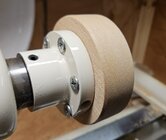
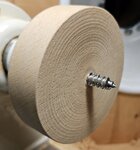
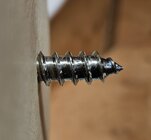
Follow-up. I just spent a little bit of a quiet Saturday evening building a screw chuck. The wood is beech, 1-1/8" thick (for no particular reason than I had it on hand), 4" diameter (1" wider than the faceplate), and the center screw is a stainless steel 3/8" x 2" lag screw. After mounting the block to the faceplate with 1-1/4" x #14 wood screws, I predrilled the lag screw hole at 1/4", and also 11/32" for the unthreaded screw shank that runs about 1/4" below the hex head. The thread that stays in the wood, and the unthreaded shank, got a good coating of epoxy, too, to help resist the screw from spinning in the wood block. 4+ turns of thread, about 11/16" long, are exposed. Perfect. If I don't need that much thread, I'll cut make some 1/8" or 1/4" plywood spacers, ala Mr. Raffan. I also faced the wood block true, then dished it slightly for the inner 3" of diameter and repeatedly bumped a spindle gouge lightly on the face to give it a good friction surface for turning blanks.

I'm glad I used this thick of a block. A 3/4" block would have had at least 2 less threads embedded in the block, making stripping the hole easier over time. And 1-1/8" beech ain't gonna flex, either. The other two faceplates will get the same treatment.


1000016766.jpg
1000016768.jpg
1000016767.jpg
 
Back
Top