• December 2025 Turning Challenge: Single Tree! (click here for details)
  • Congratulations to Bob Henrickson, People's Choice in the November 2025 Turning Challenge (click here for details)
  • Congratulations to Steven Gordon for "Dropped Ice Cream Cone" being selected as Turning of the Week for December 8, 2025 (click here for details)
  • Welcome new registering member. Your username must be your real First and Last name (for example: John Doe). "Screen names" and "handles" are not allowed and your registration will be deleted if you don't use your real name. Also, do not use all caps nor all lower case.

faceplate-based screw chucks, what diameters?

Joined
Oct 25, 2020
Messages
1,252
Likes
1,118
Location
Minneapolis, MN
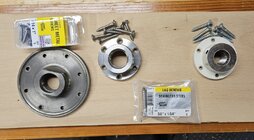
What you see here is the ingredient list to make 3 faceplate-based screw chucks, including the 1-1/8" thick beech board, 8" wide.

On the left are 5" and 3" faceplates, 1-1/4" x 8tpi for my 16" Vicmarc. On the right, a 3" faceplate, 1" x 8tpi for my 12" Oneway.
1000016679.jpg

I don't use faceplates really. But I enjoy watching Raffan more than rerun TV, and three quarters of his projects start with mounting a lump of wood onto a purpose built screw chuck (the Vicmarc 3-in-1 version for him). Since I have everything on hand, I thought I'd go with the faceplate style to begin with before investing in the real thing.

If you were doing this, or if you have done it, what singular diameters of wood would you mount to the faceplates? I don't plan to make a bunch of different diameters, just one diameter per faceplate and be done. Arbitrarily, I thought 1" larger than the faceplate diameters to maintain meat outside of the screws. Thanks for your ideas.

For reference, the Vicmarc 3-in-1 screw chuck has face diameters of 1-5/8", 2-1/2", and 3-3/4", although Raffan always installs a plywood spacer, and generally of diameters larger that those faces of the screw chuck (unless the turning stock is relatively small).

 
This article, by Doc Green, won't directly answer your "what diameters" question, but you might find his discussion of screw chucks helpful.

Good luck and I'd be interested in hearing about any insights you would care to share.

I have a Precision Machine 3-in-1 Screw Chuck that I picked up at an estate sale. I will switch chucks (Vicmarc scoll chuck to Screw Chuck) to use it instead of the woodworm screw.
 
Thanks Jim, that is a very insightful article. It confirmed some thoughts I already had, and gave meaningful forewarning about expectations. I've used the scroll chuck screws (Vicmarc and Oneway) and often times I was realizing what he explained- the relatively small and smooth bearing surface against the chuck jaws puts more of the load on the screw and less on the jaws. A relatively larger bearing surface (slab o' wood with a rough surface) takes more of the cutting torque load than the singular screw with less bearing surface. I've experienced near lock-on of the turned wood on the chuck screws before. And his 4-6 inch wood plates are in harmony of what I thought to build. Seems as good of a starting point as anything else.
 
Gladly done. Additional / alternative insight and perspective is a primary reason I hang out here, plus all the purdy pictures.

One other potential feature to consider adding to your wood screw chuck(s) are tommy bar hole(s). I use them against the tool rest to stop the screw chuck from rotating while you are unscrewing your work in progress from the screw chuck. I can't remember who to give credit for this nifty trick, it isn't originally from me. Obviously there are other means of stopping screw chuck rotation, but this one is my favorite. The Precision Machine 3-in-1 Screw Chuck has a tommy bar hole.
 
Agreed on the tommy bar, or a wrench if the mfr. provides it. My Oneway 1224 has a large spanner to engage onto the headstock spindle that is captured between the bed ways. I never want to bear force against the spindle lock pin for fear of damaging it.
 
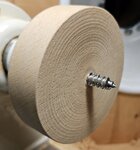
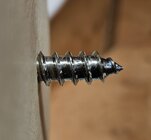
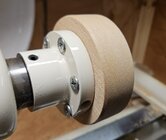
Follow-up. I just spent a little bit of a quiet Saturday evening building a screw chuck. The wood is beech, 1-1/8" thick (for no particular reason than I had it on hand), 4" diameter (1" wider than the faceplate), and the center screw is a stainless steel 3/8" x 2" lag screw. After mounting the block to the faceplate with 1-1/4" x #14 wood screws, I predrilled the lag screw hole at 1/4", and also 11/32" for the unthreaded screw shank that runs about 1/4" below the hex head. The thread that stays in the wood, and the unthreaded shank, got a good coating of epoxy, too, to help resist the screw from spinning in the wood block. 4+ turns of thread, about 11/16" long, are exposed. Perfect. If I don't need that much thread, I'll make some 1/8" or 1/4" plywood spacers, ala Mr. Raffan. I also faced the wood block true, then dished it slightly for the inner 3" of diameter and repeatedly bumped a spindle gouge lightly on the face to give it a good friction surface for turning blanks.

I'm glad I used this thick of a block. A 3/4" block would have had at least 2 less threads embedded in the block, making stripping the hole easier over time. And 1-1/8" beech ain't gonna flex, either. The other two faceplates will get the same treatment.


1000016766.jpg
1000016768.jpg
1000016767.jpg
 
Last edited:
I use a forstner bit, sized to fit whichever chuck I am using and drill a recess so it bottoms out against the face of the blank. Just faster for me. 2 5/8 inch for my bigger Vicmark chuck.

robo hippy
 
Follow-up. I just spent a little bit of a quiet Saturday evening building a screw chuck. The wood is beech, 1-1/8" thick (for no particular reason than I had it on hand), 4" diameter (1" wider than the faceplate), and the center screw is a stainless steel 3/8" x 2" lag screw. After mounting the block to the faceplate with 1-1/4" x #14 wood screws, I predrilled the lag screw hole at 1/4", and also 11/32" for the unthreaded screw shank that runs about 1/4" below the hex head. The thread that stays in the wood, and the unthreaded shank, got a good coating of epoxy, too, to help resist the screw from spinning in the wood block. 4+ turns of thread, about 11/16" long, are exposed. Perfect. If I don't need that much thread, I'll make some 1/8" or 1/4" plywood spacers, ala Mr. Raffan. I also faced the wood block true, then dished it slightly for the inner 3" of diameter and repeatedly bumped a spindle gouge lightly on the face to give it a good friction surface for turning blanks.

I'm glad I used this thick of a block. A 3/4" block would have had at least 2 less threads embedded in the block, making stripping the hole easier over time. And 1-1/8" beech ain't gonna flex, either. The other two faceplates will get the same treatment.


View attachment 82417
View attachment 82418
View attachment 82419
I need to make one of these. Thank you for showing it.
 
I need to make one of these. Thank you for showing it.
You're welcome. See Jim's reply above (post #2) for a link to a good article.

Richard Raffan has a couple youtube videos about screw chucks and mods for chuck screws (for Oneway, Vicmarc, etc.).
 
I don't think I have seen Richard post here. Not sure if he is in the AAW or not. Not sure I would use a screw chuck under any situations. For the bowl styles I do, I found it far faster to drill a recess using the proper sized forstner bit and expand into that. If I was to do a lot of natural edge bowls, I think I would use the forstmer bit to make a level spot for mounting a face plate. I have watched many turners who use them regularly, and am amazed that no one has broken a hand or arm by mounting with the lathe running. I guess you could get used to it.

robo hippy
 
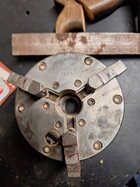
I know what you mean about spinning the piece on. I saw 1 video where the guy said to screw in on by hand, don't use power. My problem right now is my chuck. It's a 3 jaw metal working chuck and the jaws dont hold wood very well. I've been everywhere looking for a set of woodworking jaws that will fit but have been told no. Practical Machinist are the ones who told me about this place. As it sits right now, I have the chuck and a spur drive center and that's it. So I've been looking at alternative methods for securing my work, all on a severe budget. I love to go out and buy all kinds of new parts but can't. So I work with what I have or what I can make.1000001473.jpg
 
I have watched many turners who use them regularly, and am amazed that no one has broken a hand or arm by mounting with the lathe running. I guess you could get used to it.

robo hippy
That is the one "production turner" trick of Raffan's that I would never do. I'd be the one to break a bone.
 
I know what you mean about spinning the piece on. I saw 1 video where the guy said to screw in on by hand, don't use power. My problem right now is my chuck. It's a 3 jaw metal working chuck and the jaws dont hold wood very well. I've been everywhere looking for a set of woodworking jaws that will fit but have been told no. Practical Machinist are the ones who told me about this place. As it sits right now, I have the chuck and a spur drive center and that's it. So I've been looking at alternative methods for securing my work, all on a severe budget. I love to go out and buy all kinds of new parts but can't. So I work with what I have or what I can make.View attachment 82588
Yeah... I would not be using that chuck to hold wood. Wrong application, inferior bite on wood. That chuck will get you hurt.
 
I know what you mean about spinning the piece on. I saw 1 video where the guy said to screw in on by hand, don't use power. My problem right now is my chuck. It's a 3 jaw metal working chuck and the jaws dont hold wood very well. I've been everywhere looking for a set of woodworking jaws that will fit but have been told no. Practical Machinist are the ones who told me about this place. As it sits right now, I have the chuck and a spur drive center and that's it. So I've been looking at alternative methods for securing my work, all on a severe budget. I love to go out and buy all kinds of new parts but can't. So I work with what I have or what I can make.View attachment 82588
The chances of finding a set of wood working jaws is about nil to nothing. But if you look around for a set of reverse jaws they would hold the wood far better
 

Attachments

  • Main.jpg
    Main.jpg
    62.6 KB · Views: 0
What size is the spindle thread on your lathe? Buy a faceplate for it and use a glue block to work on your projects if you're on a tight budget. Small faceplates are not very expensive. Lyle Jamieson has several videos on using faceplate and glue blocks. He doesn't use a chuck for anything. This would get you going safely until you can afford a proper chuck.
 
What size is the spindle thread on your lathe? Buy a faceplate for it and use a glue block to work on your projects if you're on a tight budget. Small faceplates are not very expensive. Lyle Jamieson has several videos on using faceplate and glue blocks. He doesn't use a chuck for anything. This would get you going safely until you can afford a proper chuck.
3/4 x 16tpi. Does glue actually hold? I have ca glue, hot glue and regular yellow glue. A faceplate I think I could swing. Also have been thinking about selling the chuck I have. According to AI mode, I should be able to get 2 or 3 hundred for it. Then I could buy the right chuck. I don't think I want to get a 75 dollar chuck from eBay either.
 
So I've been looking at alternative methods for securing my work, all on a severe budget.

There are many options.

I use a spur drive to start most HFs and bowls between centers. Most lathes come with a spur drive that will work.

For my HFs I almost always use a faceplate
You can also use a glue block on a faceplate.

You can by a whole lot of screws for the price of a chuck

For spindles I usually use a cup center drive. These days it’s a ONEWAY safe drive around $50
But for many years I used a delta dead center

I like to start between centers and the turn the area to mount the faceplate with a concave face to perfectly seat the outer rim of the faceplate. I make the tenon for the faceplate a 1/4” longer than the screws to prevent a screw hole showing up in the bottom of ny piece.
Here is a quick tutorial on mounting a faceplate with a short video from a demo
 
3/4 x 16tpi. Does glue actually hold? I have ca glue, hot glue and regular yellow glue. A faceplate I think I could swing. Also have been thinking about selling the chuck I have. According to AI mode, I should be able to get 2 or 3 hundred for it. Then I could buy the right chuck. I don't think I want to get a 75 dollar chuck from eBay either.
I use medium or thick ca glue on undried (green) wood for glue blocks. Can use regular wood glue on dried wood. As usual when turning stay out of the line of fire as much as possible and wear safety gear. I would buy a chuck from a major manufacturer and get one that takes inserts, that way if you ever change lathes you just change the insert and keep your chuck. The buck chuck you have should bring enough money to buy a good 4 jaw woodturning chuck. Go to you tube and watch Lyle's videos he will walk you through the faceplate/glueblock procedure.
 
I don't think I have seen Richard post here.

I saw a post from Richard Raffan a few months ago. A search tells me it was in September.
I understand he was also awarded an honorary lifetime membership in the AAW.

Doc Green has a good book about holding things on the lathe:

Doc has a great website too. At least check out his Articles section.

JKJ
 
I saw a post from Richard Raffan a few months ago. A search tells me it was in September.
I understand he was also awarded an honorary lifetime membership in the AAW.

Doc Green has a good book about holding things on the lathe:

Doc has a great website too. At least check out his Articles section.

JKJ
I'll do that.
 
3/4 x 16tpi. Does glue actually hold? I have ca glue, hot glue and regular yellow glue. A faceplate I think I could swing. Also have been thinking about selling the chuck I have. According to AI mode, I should be able to get 2 or 3 hundred for it. Then I could buy the right chuck. I don't think I want to get a 75 dollar chuck from eBay either.
By the way, I have a 3 jaw chuck like yours and a 4 jaw independent machinist chucks fitted to my wood lathe. I do use them on occasion for different things. The 4 jaw is very handy for dialing something in to get it to run true. Mostly spindles.
 
By the way, I have a 3 jaw chuck like yours and a 4 jaw independent machinist chucks fitted to my wood lathe. I do use them on occasion for different things. The 4 jaw is very handy for dialing something in to get it to run true. Mostly spindles.
I also have a 4 jaw independent chuck which I haven't had the need to use yet. Just want to be able to hold my work securely without it flying away. I've had a couple of practice pieces do that. It's no fun chasing down a piece in a crowded shop!
 
There are many options.

I use a spur drive to start most HFs and bowls between centers. Most lathes come with a spur drive that will work.

For my HFs I almost always use a faceplate
You can also use a glue block on a faceplate.

You can by a whole lot of screws for the price of a chuck

For spindles I usually use a cup center drive. These days it’s a ONEWAY safe drive around $50
But for many years I used a delta dead center

I like to start between centers and the turn the area to mount the faceplate with a concave face to perfectly seat the outer rim of the faceplate. I make the tenon for the faceplate a 1/4” longer than the screws to prevent a screw hole showing up in the bottom of ny piece.
Here is a quick tutorial on mounting a faceplate with a short video from a demo
I just subscribed to your YouTube channel.
 
What you see here is the ingredient list to make 3 faceplate-based screw chucks, including the 1-1/8" thick beech board, 8" wide.

On the left are 5" and 3" faceplates, 1-1/4" x 8tpi for my 16" Vicmarc. On the right, a 3" faceplate, 1" x 8tpi for my 12" Oneway.
View attachment 82237

I don't use faceplates really. But I enjoy watching Raffan more than rerun TV, and three quarters of his projects start with mounting a lump of wood onto a purpose built screw chuck (the Vicmarc 3-in-1 version for him). Since I have everything on hand, I thought I'd go with the faceplate style to begin with before investing in the real thing.

If you were doing this, or if you have done it, what singular diameters of wood would you mount to the faceplates? I don't plan to make a bunch of different diameters, just one diameter per faceplate and be done. Arbitrarily, I thought 1" larger than the faceplate diameters to maintain meat outside of the screws. Thanks for your ideas.

For reference, the Vicmarc 3-in-1 screw chuck has face diameters of 1-5/8", 2-1/2", and 3-3/4", although Raffan always installs a plywood spacer, and generally of diameters larger that those faces of the screw chuck (unless the turning stock is relatively small).
Hey, didn't mean to monopolize your thread. Sorry about that.
 
In your shoes, I would:
1. Follow John Jordan's advice in post #21 above, Doc Green has lots of work holding information and most of it you can make yourself.
2. Buy a 3/4" X 16tpi tap and start making your own work holding fixtures (glue blocks, face plates, jam chucks, spike plates, ...). A quick check of HD says this will set you back $13. You'll need an appropriate sized drill for the pilot hole my guess would be 5/8". There is a lot of information about threading wood available.

A well executed glue joint is usually stronger than the wood. The wood fails before the glue joint. This is easy enough for you to test this yourself, you don't have to believe me.
 
In your shoes, I would:
1. Follow John Jordan's advice in post #21 above, Doc Green has lots of work holding information and most of it you can make yourself.
2. Buy a 3/4" X 16tpi tap and start making your own work holding fixtures (glue blocks, face plates, jam chucks, spike plates, ...). A quick check of HD says this will set you back $13. You'll need an appropriate sized drill for the pilot hole my guess would be 5/8". There is a lot of information about threading wood available.

A well executed glue joint is usually stronger than the wood. The wood fails before the glue joint. This is easy enough for you to test this yourself, you don't have to believe me.
I'll do that Jim, thank you.
 
... Buy a 3/4" X 16tpi tap and start making your own work holding fixtures (glue blocks, face plates, jam chucks, spike plates, ...). A quick check of HD says this will set you back $13. You'll need an appropriate sized drill for the pilot hole my guess would be 5/8". There is a lot of information about threading wood available.

I like to keep a drill-size chart handy in the shop. Here's one:

But I missed something - what lathe uses a 3/4x16 thread? That's a pretty fine thread!
 
3/4 x 16tpi. Does glue actually hold? I have ca glue, hot glue and regular yellow glue. A faceplate I think I could swing. Also have been thinking about selling the chuck I have. According to AI mode, I should be able to get 2 or 3 hundred for it. Then I could buy the right chuck. I don't think I want to get a 75 dollar chuck from eBay either.
Post #17 above.

The 16 tpi was another reason I suggested the tap and threading route since the selection of 3/4" 16 tpi fixtures is probably more limited.

Thanks for the chart, John.
 
I like to keep a drill-size chart handy in the shop. Here's one:

But I missed something - what lathe uses a 3/4x16 thread? That's a pretty fine thread!
It's a Craftsman 103 lathe. I haven't actually measured it but was told by AI mode that the Buck Chuck is 3/4 x 16. Maybe I ought to measure it to be sure
 
It's a Craftsman 103 lathe. I haven't actually measured it but was told by AI mode that the Buck Chuck is 3/4 x 16. Maybe I ought to measure it to be sure
Is that one of the single tube lathes? Don't remember the exact model but my first lathe was a single-tube, actually the Ridgid clone of the Craftsman.

I bought it from Home Depot to make ONE thing for my son in architect school. I knew nothing about lathes except they could make things round. Bought the set of HSS tools from the local Sears store (still use them). Turned the thing for my son, then a few months later glued-up pieces of red oak board and turned a bowl. Got hooked and ordered a new Jet1642. After that there was no going back.

The very first thing I turned now hangs on the wall in my shop.

JKJ
 
Is that one of the single tube lathes? Don't remember the exact model but my first lathe was a single-tube, actually the Ridgid clone of the Craftsman.

I bought it from Home Depot to make ONE thing for my son in architect school. I knew nothing about lathes except they could make things round. Bought the set of HSS tools from the local Sears store (still use them). Turned the thing for my son, then a few months later glued-up pieces of red oak board and turned a bowl. Got hooked and ordered a new Jet1642. After that there was no going back.

The very first thing I turned now hangs on the wall in my shop.

JKJ
Yup, that's the one! Inherited when my father passed. It's been sitting in the garage for many years doing nothing. When I retired I started going through his stuff. This was buried so I brought it back to life and discovered I have a passion and talent for turning wood.
 
Hey, didn't mean to monopolize your thread. Sorry about that.
Oh, geez, no worries at all. This is the way just about every thread on this board goes. We're all just sitting around a big wood stove in a big electronic garage shootin' the breeze here All of these threads meander organically, often times far away from the opening post, which is great. So much more info and knowledge is shared that way. Don't hold anything back! Keep posting!
 
Last edited:
Back
Top