• The forum upgrades have been completed. These were moderate security fixes from our software vendor and it looks like everything is working well. If you see any problems please post in the Forum Technical Support forum or email us at forum_moderator (at) aawforum.org. Thank you
  • It's time to cast your vote in the April 2026 Turning Challenge. (click here for details)
  • Congratulations to Ted Pelfrey for "Cherry Blossoms on Cherry" being selected as Turning of the Week for April 27, 2026 (click here for details)
  • Welcome new registering member. Your username must be your real First and Last name (for example: John Doe). "Screen names" and "handles" are not allowed and your registration will be deleted if you don't use your real name. Also, do not use all caps nor all lower case.

First box

Joined
Jan 24, 2010
Messages
3,443
Likes
1,091
Location
Cleveland, Tennessee
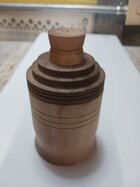
Need to tweak for better details when turning. Outside was good; inside walls were a bit rough. Need to work on the interior including the bump at the bottom. I can take criticism...been married for 54 years.
First box.jpg
 
Outside was good; inside walls were a bit rough. Need to work on the interior including the bump at the bottom.

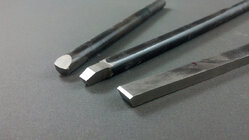
For boxes that have straight walls inside I like to use a box scraper to make them straight after hollowing. Box scrapers often have the long sharp working edge (down the side near the end) ground at a small angle to the axis of the tool and handle which seems easier to handle. Note that the very end is ground at an angle so it's 90-deg to the side cutting edge.

1777591214175.jpeg
I've ground one to have a negative rake edge for easier smoothing. I burnish burrs on all scrapers and negative rake scrapers. These are usually used held flat on the rest, the working edge just above center.

For boxes with either straight or curved insides I usually clean up the inside walls with a spindle gouge or Hunter tool used as a shear scraper. For getting the bottom flat, a square end can help. A bump at the bottom can often be removed with the end square or very gently curved - scraped by hand with the lathe off.

What kind of wood is the darker lid? Are both the lid and body made with dry end-grain blanks? A few species are just plain difficult to smooth so I avoid them.

Maybe it's just the light but from the photo the flat "steps" on the top look like they might be a bit rough. Were they cut from the side with a parting tool? That can leave rough surfaces. With some practice the long point of the skew can make quite smooth "facing" cuts. In general, for me, a surface with some curve to it seems to be easier to turn cleanly and to sand smooth. But I keep a variety of negative rake scrapers to smooth flat surfaces on both end grain and face grain.

A couple of these are helpful when smoothing small flat areas. I ground one from a spare Thompson 3/8" detail gouge. I almost always grind a different profile on the other end - use these without handles. I almost always stick with Thompson steel.
1777593653887.jpeg

JKJ
 
I have a DIY scraper as you show. Need to apply it more for the sides and bottom. I bought a Hunter Viceroy #1 and used it. I also have a beading/parting tool as demonstrated by Mike Peace. As mentioned, this was a learning experience. IMO, the finial overpowers the overall appearance of the box. I was pleased that I get the 'pop' when I remove the lid. Told that is a good fit. As for wood, good question for all three. The lid was from the bargain box at Woodcraft. Showed some tear out but seemed to 'smooth' out with final passes. Love the word, "bargain." Now on to the next turning. JKJ, thanks for your directions.
 
I have been doing a run on boxes. Yours is not the way I would do it, but it does work. For the insides, I use NRSs/negative rake scrapers, and I have maybe 10 of them I use for the insides. One is like an upside down 7 so I can get all the way into the corners since I prefer, most of the time, a square corner. I use them on the sides as well, and the top and the bottom. With a sharp NRS, you can get surfaces clean enough that 400 grit roughs them up. Learning to get that nib out of the center, on all surfaces, is an art. Mostly it is sweeping back and forth as well as up and down. It takes some practice. I seldom go more than about 6 inches high. Beyond that, it is almost like a hollow form, and you need extra tools for that. The corners on your layered walnut top are sharper than I would leave, I ease them all, minimum 120 grit abrasives.

robo hippy
 
The lid was from the bargain box at Woodcraft....IMO, the finial overpowers the overall appearance of the box.
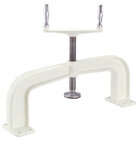
Ah, mystery wood. I wondered if it was Wenge. I HATE Wenge - course, splintery, can present challenges in turning. I've given away all the wenge I have except for one block - I use it for spacing when needed on a "book press" when making glueups - an incredibly useful tool!. (I mounted the legs on blocks so I could clamp much taller things.)

1777650377134.jpeg

I agree about the top piece. I didn't comment on it because design is such a personal decision that what is right for one person may not be the choice for another. Years ago on another a self-appointed member of the Woodturning Police Force gave me grief over my box design - said the junction between the lower and upper part was way too low, against a proportion "rule". My response was a gentle variation of a favorite expression of my brother-in-law: "That's what YOU think". Sure, I'm aware of convention but I made that decision on purpose for a reason.

It was one of these. I've turned lots of variations from cocobolo like these, african blackwood, etc. I like the little ebony finial of the one on the right but like the proportions and shape of the other one (it has an ebony insert on the top.)

1777650844366.jpeg

Hey, if you like wood from a bargain box, come visit - I'll send you home with some real bargains: free wood! All dry.

BTW, Opinion Alert: I've made boxes with the "woodturner's suction pop" as per instruction by some of the experts. While it's great for practicing precision, I think the biggest reason for the suction lid fit is to impress other woodturners! 😮 Real people don't like it on a box made for use. For example, if a lidded box for jewelry needs two hands to open, it can be annoying to the user who wants to lift the lid to get something inside.
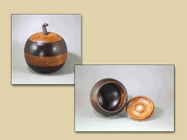
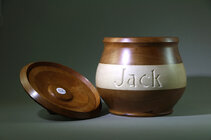
I also think the suction is not a good idea for Beads of Courage boxes. For one thing, it doesn't take much humidity change to make a suction fit lid stick, even if turned end grain.. I once looked at ten BOC boxes turned in at a symposium and five had stuck lids. Our club BOC coordinator told me once he had rework many of the boxes turned in. I imagined frustrated kids, perhaps in the hospital after a cancer treatment, having to deal with a stuck lid.

I started teaching and demonstrating turning a tapered fit lid which is impossible to stick.
Can even use face grain blanks (like the two below) and laugh in humidity's face. :)

This one, maybe 8" in diameter, cherry and walnut, has an internal taper at the top of the box.
1777651680528.gif

This one has an external taper at the top; the lid fits over. Made for a special little boy.
Cherry and basswood (to make the chip carving easy.)
1777651861134.jpeg

I've started making other, smaller boxes with the tapered lid method too - so easy to remove the lid with one hand!

JKJ
 
I started teaching and demonstrating turning a tapered fit lid which is impossible to stick.
Can even use face grain blanks (like the two below) and laugh in humidity's face. :)

JKJ
@John K Jordan I blew the pictures up but still can't see exactly what you did for a tapered fit lid. Can you draw (hand sketch) what you did? Or show close-up pics showing what the taper is?
thanks...
 
Back
Top