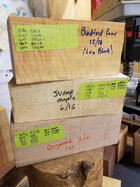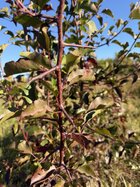
There is the saying that the Lord will provide. My son just bought a house and 4 acres with trees. He wants to take down two Bradford pear trees. Now to find a place to store it. Hmm.

I’m not a fan of the look. Mostly very plain grain and oxidizes very quickly to look even more plain. That oxidized color is hard to sand off to get an even color when it was turned green.I personally like how it looks and turns, but it is definitely split-happy. Smaller branches can make decent ornaments.



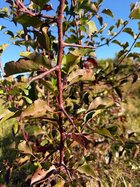
I know here in Colorado, Russian Olive is considered invasive (funny that it also has long super sharp spikes on it) it is on the do not plant list as well. its actually considered a weed tree here. Ash is also on the do not plant list because of ash beetles killing off trees and spreading and all the citys here are actually having the trees removed. Both, are great for turning, although some people dont care to much for turning Russian olive, it does have a beautiful dark brown color with a creamy white sap wood, and it is one of the few trees here that will produce a lot of burl here, although it is mostly root burl.I live in the foothills of NC and Bradford Pears are becoming very invasive. In the spring the hills and roadsides are covered with their distinctive white and stinky blooms like in the pic in the Clemson University article linked here, Invasive Bradford pear banned for sale in SC.
They revert with each generation gradually back to a bush with thick 4 in thorns that chokes out everything else.
Attached is a pic of a Bradford in the large field near my home. Those thorns are no joke
.View attachment 85133
Can you give us the genus and species names on both trees with identical common names?Just to be clear for everyone, there are different species called Bradford Pear that are very different trees. The variety located in the southeast U.S. is a nuisance and the wood splits easily.
There is a totally different Bradford Pear that is common in southeast Texas and probably other areas that is not a nuisance, and it is a wonderful wood for woodturning. It is one of the most common woods used by turners in this area and it does not have a big splitting problem like the other variety has.
Ric, the name Bradford Pear is one of several cultivars of the Callery Pear, a Chinese Bush that grows straight and erect with nasty thorns. Texasinvasives.org says there are no other species of tree that could be confused with the Callery pear (Texas Invasives: Pyrus calleryana). I suspect you are in an area where it has not yet begun to hybridize, but it will. All of the cultivars have been found to eventually start becoming fertile and become quite a nuisance.Just to be clear for everyone, there are different species called Bradford Pear that are very different trees. The variety located in the southeast U.S. is a nuisance and the wood splits easily.
There is a totally different Bradford Pear that is common in southeast Texas and probably other areas that is not a nuisance, and it is a wonderful wood for woodturning. It is one of the most common woods used by turners in this area and it does not have a big splitting problem like the other variety has.
Ric, the name Bradford Pear is one of several cultivars of the Callery Pear, a Chinese Bush that grows straight and erect with nasty thorns. Texasinvasives.org says there are no other species of tree that could be confused with the Callery pear (Texas Invasives: Pyrus calleryana). I suspect you are in an area where it has not yet begun to hybridize, but it will. All of the cultivars have been found to eventually start becoming fertile and become quite a nuisance.
Part of your statement is not clear to me: "the wood splits easily." Do you mean:Just to be clear for everyone, there are different species called Bradford Pear that are very different trees. The variety located in the southeast U.S. is a nuisance and the wood splits easily.