• The forum upgrades have been completed. These were moderate security fixes from our software vendor and it looks like everything is working well. If you see any problems please post in the Forum Technical Support forum or email us at forum_moderator (at) aawforum.org. Thank you
  • Congratulations to Bernie Hyrtzak, People's Choice in the January 2026 Turning Challenge (click here for details)
  • Congratulations to Matt Carvalho for "Red Mallee Folded Form" being selected as Turning of the Week for February 9, 2026 (click here for details)
  • AAW Symposium demonstrators announced - If the 2026 AAW International Woodturning Symposium is not on your calendar, now is the time to register. And there are discounts available if you sign up early, by Feb. 28. Early Bird pricing gives you the best rate for our 40th Anniversary Symposium in Raleigh, North Carolina, June 4–7, 2026. (There are discounts for AAW chapter members too) For more information vist the discussion thread here or the AAW registration page
  • Welcome new registering member. Your username must be your real First and Last name (for example: John Doe). "Screen names" and "handles" are not allowed and your registration will be deleted if you don't use your real name. Also, do not use all caps nor all lower case.

Good source of Bradford pear

There is a subdivision near us that has them along the main road at the edge of the subdivision. High winds have crews trimming or cutting up the trees. I must have passed on tons of wood! Arrrgggh. Blossoms stink, too.
 
It takes dye well and when finished looks a great deal like cherry. Most cuts have a nice curl due to all the strain on the limbs. I have not had any problem with cracking , must be the atmosphere.
 
I live in the foothills of NC and Bradford Pears are becoming very invasive. In the spring the hills and roadsides are covered with their distinctive white and stinky blooms like in the pic in the Clemson University article linked here, Invasive Bradford pear banned for sale in SC.

They revert with each generation gradually back to a bush with thick 4 in thorns that chokes out everything else.

Attached is a pic of a Bradford in the large field near my home. Those thorns are no joke

.Pears.jpg
 

Attachments

  • Pears.jpg
    Pears.jpg
    601 KB · Views: 5
Last edited:
I live in the foothills of NC and Bradford Pears are becoming very invasive. In the spring the hills and roadsides are covered with their distinctive white and stinky blooms like in the pic in the Clemson University article linked here, Invasive Bradford pear banned for sale in SC.

They revert with each generation gradually back to a bush with thick 4 in thorns that chokes out everything else.

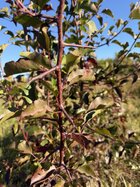
Attached is a pic of a Bradford in the large field near my home. Those thorns are no joke

.View attachment 85133
I know here in Colorado, Russian Olive is considered invasive (funny that it also has long super sharp spikes on it) it is on the do not plant list as well. its actually considered a weed tree here. Ash is also on the do not plant list because of ash beetles killing off trees and spreading and all the citys here are actually having the trees removed. Both, are great for turning, although some people dont care to much for turning Russian olive, it does have a beautiful dark brown color with a creamy white sap wood, and it is one of the few trees here that will produce a lot of burl here, although it is mostly root burl.
 
Lots of cities and towns are removing them. I saw a pile of short logs at a nearby post office yesterday. Wasn’t driving my truck.

Might contact the public works and road depts and they might load up a truck or trailer if you show up at the right time. The county road crew used to bring and dump logs on a spot on my property until I had to tell them to stop.

Tree removal service companies will usually give you more wood than you can ever use - saves them from disposing it.

County/municipal wood dumps can be a good source.
 
Just to be clear for everyone, there are different species called Bradford Pear that are very different trees. The variety located in the southeast U.S. is a nuisance and the wood splits easily.
There is a totally different Bradford Pear that is common in southeast Texas and probably other areas that is not a nuisance, and it is a wonderful wood for woodturning. It is one of the most common woods used by turners in this area and it does not have a big splitting problem like the other variety has.
 
Just to be clear for everyone, there are different species called Bradford Pear that are very different trees. The variety located in the southeast U.S. is a nuisance and the wood splits easily.

There is a totally different Bradford Pear that is common in southeast Texas and probably other areas that is not a nuisance, and it is a wonderful wood for woodturning. It is one of the most common woods used by turners in this area and it does not have a big splitting problem like the other variety has.
Can you give us the genus and species names on both trees with identical common names?
 
Just to be clear for everyone, there are different species called Bradford Pear that are very different trees. The variety located in the southeast U.S. is a nuisance and the wood splits easily.

There is a totally different Bradford Pear that is common in southeast Texas and probably other areas that is not a nuisance, and it is a wonderful wood for woodturning. It is one of the most common woods used by turners in this area and it does not have a big splitting problem like the other variety has.
Ric, the name Bradford Pear is one of several cultivars of the Callery Pear, a Chinese Bush that grows straight and erect with nasty thorns. Texasinvasives.org says there are no other species of tree that could be confused with the Callery pear (Texas Invasives: Pyrus calleryana). I suspect you are in an area where it has not yet begun to hybridize, but it will. All of the cultivars have been found to eventually start becoming fertile and become quite a nuisance.

I had them here in my yard in NC for 20 years before I started seeing seedlings, but when they started producing fertile seed they started popping up everywhere. Half the yards in my neighborhood still have them because people love the shape and spring flowers, but they really all should be destroyed. It has gone from a docile ornamental to a true kudzu like tree here only in the past decade.

There are a couple great Washington Post articles about this history, but they are behind a paywall. This article from the Harvard Arboretum goes into the history of the tree and how it began to revert to it's original form.

It really is a Frankenstein tree: The Rise and Fall of the Ornamental Callery Pear Tree
 
Ric, the name Bradford Pear is one of several cultivars of the Callery Pear, a Chinese Bush that grows straight and erect with nasty thorns. Texasinvasives.org says there are no other species of tree that could be confused with the Callery pear (Texas Invasives: Pyrus calleryana). I suspect you are in an area where it has not yet begun to hybridize, but it will. All of the cultivars have been found to eventually start becoming fertile and become quite a nuisance.

David I understand what you are saying and I am familiar with what is happening with the nuisance version of Bradford Pear in other parts of the country. The fact remains that there are totally different types of trees that are called Bradford Pear, and the type that is in my part of the country right now is not invasive, does not have thorns, does not have a cracking problem and it is a great wood to turn. Turners need to be aware that there is more than one type of tree called Bradford Pear.
 
Last edited:
Just to be clear for everyone, there are different species called Bradford Pear that are very different trees. The variety located in the southeast U.S. is a nuisance and the wood splits easily.
Part of your statement is not clear to me: "the wood splits easily." Do you mean:
  • the green wood in log or blank form checks easily on the end grain (like almost every other species)
  • left in log form it splits down the side easily as it dries (like dogwood)
  • that a piece turned green cracks and splits easily as it dries and shrinks (I have no experience with this)
  • splits easily with an axe when making firewood
  • or something else, like the well-known weakness causing major branches to split off main trunk of the tree?

I've cut and turned a fair amount of Bradford Pear, all of it from the same Southeastern trees that are earning an increasingly bad reputation.

I haven't noticed a propensity for the wood itself to split when drying. For example, I have a bunch of dried blanks I cut from logs for drying. If the a blank does no contain the pith or significant juvenile wood and is properly sealed, Braford Pear dries reasonably, like other hard, dense, fine grained species.

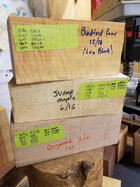
This photo, posted recently to show using the weight method to track drying, has a nice BP blank at the top, cut in 2018, dry now and ready to turn. (as an indication of size, the green tape pieces are 2" and 1.5" wide.)

1770862735186.jpeg

Wonderful wood to turn and carve. Takes fine detail well.

BTW, I've harvested and turned three different types of pear: the Bradford Pear, what I call common fruiting pear (we have Bartlett), and Asian Pear which bears a wonderful nearly spherical fruit. (There are many mature Asain pear trees on our property.) I have no Bradford pear trees.

JKJ
 
Back
Top