• January 2026 Turning Challenge: Turned and Bent! (click here for details)
  • Congratulations to Phil Hamel, People's Choice in the December 2025 Turning Challenge (click here for details)
  • Congratulations to Ric Taylor for "Black Ash Burl" being selected as Turning of the Week for January 26, 2026 (click here for details)
  • Welcome new registering member. Your username must be your real First and Last name (for example: John Doe). "Screen names" and "handles" are not allowed and your registration will be deleted if you don't use your real name. Also, do not use all caps nor all lower case.

How often do you use a Bedan

I have seen and been at Escoulen's demos and he uses a square bedan.


Did he specifically say the tool was Square or were you close enough to see the shape up close?


IMG_5497.jpeg

IMG_5499.jpeg

As always though, it’s quite possible some turners use a square section tool and legitimately call it a Bedan. Over here at least though, a square section tool is normally just called a parting tool, which may have a single or double bevel.
 
Last edited:
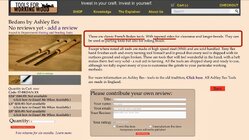
Pascal Oudet says here that the Bedan can be either shape:


I don’t see any advantage to a square shape, apart from ease of manufacture, but as I admitted earlier, I couldn’t get on with my Robert Sorby Bedan.
 
Last edited:
I think you can search You Tube channels by typing in the name of the person, and/or channel after that.

I am curious, Richard has responded to my comments about stropping the skew. He doesn't strop, but I do. It seemed to make a big difference for me. I do try to use a very light touch when I resharpen, and I NEVER hone inbetween sharpenings. With my platform, it is easier to just touch it up on the grinder. Anyone else strop?

robo hippy
 
I am curious, Richard has responded to my comments about stropping the skew. He doesn't strop, but I do. It seemed to make a big difference for me. I do try to use a very light touch when I resharpen, and I NEVER hone inbetween sharpenings. With my platform, it is easier to just touch it up on the grinder. Anyone else strop?
I strop nearly every tool after sharpening. I use the non-profiled leather wheel on the Tormek with a bit of their honing compound. This is after sharpening on 600 or 1200 grit CBN. I realize the grinder burrs for those sharpening grits are small and don't last long, but I do what I do. I strop just enough to knock off the grinder burr and put a barely detectable polish on the edge - I want "shaving sharp", especially on skews and spindle gouges. I test by shaving hairs from my left arm.

I sometimes examine cutting edges under my low-power stereo microscope to help evaluate my technique. I also have a sharpness tester, Edge On Up, that will provide numbers of the absolute sharpness of an edge.

Scrapers and NRS also get the grinder burr removed and a burnished burr added. After trying various burnishers over the years the only one I use now is the French Arno.

For gouges, I use the narrow profiled leather Tormek wheels to remove the burr from inside the flute. All this takes just 3-4 seconds. (Since I'm quite lazy I use a foot switch with the Tormek for instant on/off.) To touch up inside the flute of a gouge before resharpening I use a very fine conical diamond hone.

Since all my tools are sharpened on 8" or 10" wheels they have slight hollow grinds so when the tool gives a hint of losing it's edge, and depending on what I'm doing, I'll touch it up very lightly with an EZE-Lap extra fine (blue) paddle hone and can use it a bit more before sharpening again. I do this with gouges and scrapers and with skews in the past.

However, a few years ago I started using a different way to touch up the edge of skews. I make stropping boards by resawing MDF on the bandsaw, leaving the bandsaw tooth marks. Rub the end or corner of a stick of some kind of honing/polishing compound onto the surface - doesn't seem to matter what kind, color, grit - it's all very fine. Then strop the skew by placing the bevel flat against the board, raise the handle a microscopic amount, and draw the skew back while pressing the cutting edge against the board. I don't raise the handle much so the edge won't be rounded over. It's easy to see that steel is being removed from the black marks on the compound. Replenish the compound occasionally.

stropping-board.jpg

This gives me a shaving sharp edge I like. Everyone has their favorite methods. Don't know if this is the best way but it works for me.

I've given some of these boards to friends and they use them.

JKJ
 
I have a Thompson bedan. I use it turning mortise on the foot of green turning. It's nice to have a fixed angle with a set start to always get the dovetail right. It makes the cut consistent and only takes a moment.
 
I sharpen turning tools up to 800g on a belt grinder but don’t strop, maybe I should, if only for finish cuts.
I do though strop knives, and made this many years ago from Ash and Veg Tan Leather.

IMG_5518.jpeg
 
I think it was in 2010 at the Hartford, CT AAW Symposium that I not only saw Escoulen's bedan I actually held it. It was square. I actually tried many many times to get Doug Thompson to make a bedan, so much so that he really got mad at me. So I started asking customers to ask Doug if he makes a bedan. 🤣
 
Sorry guys but from many of your comments they almost read like you're looking to buy a tool in need of a project. No offense meant...j
 
Sorry guys but from many of your comments they almost read like you're looking to buy a tool in need of a project. No offense meant...j
That sounds like introspection... And most threads for most hobbies. Sometimes we love turning except one step we botch. Come on this forum and ask wtf... And the answer is: a tool made to solve that problem...

All things considered; saying no offense typically makes it worse, not better.
 
I think it was in 2010 at the Hartford, CT AAW Symposium that I not only saw Escoulen's bedan I actually held it. It was square. I actually tried many many times to get Doug Thompson to make a bedan, so much so that he really got mad at me. So I started asking customers to ask Doug if he makes a bedan. 🤣

If you want a Square Bedan just buy some off the shelf square section HSS?

 
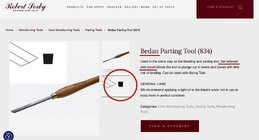
At the Rocky Mountain symposium, I'm pretty sure the French contingent (Yann Marot, Laurent Niclot in 2023, Jean-Francois Escoulen in 2024) said a rectangular cross section is French and a trapezoidal cross section is British. Sorby would appear to agree.
 
At the Rocky Mountain symposium, I'm pretty sure the French contingent (Yann Marot, Laurent Niclot in 2023, Jean-Francois Escoulen in 2024) said a rectangular cross section is French and a trapezoidal cross section is British. Sorby would appear to agree.

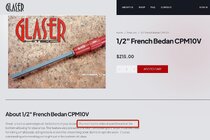
Bedan sounds French to me. The two other manufacturers I linked to both call the tool a “French Bedan”.

Edit: On the page I linked to earlier: “Bedan comes from the French word "bédane" (duck beak, as duck is anas in Latin).”
 
Last edited:
M42, 3/8" bedan from Carter and Son. Available with or without a handle, $99 without. An M42 bedan, ought to last about 200 years...
 
Laurent Niclot

For those who may be interested and don't know, Laurent Niclot is on the schedule for the North Carolina woodturning symposium, Nov 7-9.

I'm planning to attend.
 
There is only one vendor selling M42 tools that has my total trust and that is D-Way tools. And by the way a square 3/8" bedan from Thompson is $75.
 
D-way's bedan is trapezoidal, Thompson's is square stock. I have Thompson's that I sharpened as a skew with a 25 degree bevel on each side. I use it very frequently as a skew on smaller spindles and finials and love it. I'd like to purchase D-way's but from the above comments about trapezoid bedans, I'm skeptical. Does anybody own D-Way's bedan and are willing to share your thoughts?

 
D-way's bedan is trapezoidal, Thompson's is square stock. I have Thompson's that I sharpened as a skew with a 25 degree bevel on each side. I use it very frequently as a skew on smaller spindles and finials and love it. I'd like to purchase D-way's but from the above comments about trapezoid bedans, I'm skeptical. Does anybody own D-Way's bedan and are willing to share your thoughts?
I own and use both the double bevel and the 'French' single bevel types of 'bedans'. I've found them to be very useful in many and varied cases. I've tried trapezoidal bedans (Sorby) when working or teaching in other shops and decided I had no use for them. I think you'd be far better off with some of the D-way box-making tools instead for making the sort of cuts the trapezoid is touted for, such as cutting box mortises.
 
I like the square cross section bedan. I often use the side of the tool to cut, and that is not convenient with the trapezoidal cross section. I can see cuts where the trapezoidal cross section would be nice, but I make do with another tool.
 
I use a bedan a lot, But i also do a lot of spindle turning. I will confess i use it mostly for peeling cuts, it does an excellent job and because of the thickness you can reach out over the tool rest more, this makes it really effective and fast for removing wast wood in spindle work. Laurent Niclot is local to us and uses one quite frequently, he also is french (from France) and has some serious skills with it. every time i see him demo i learn something else to use it for,lol.

 
I use a bedan a lot, But i also do a lot of spindle turning. I will confess i use it mostly for peeling cuts, it does an excellent job and because of the thickness you can reach out over the tool rest more, this makes it really effective and fast for removing wast wood in spindle work. Laurent Niclot is local to us and uses one quite frequently, he also is french (from France) and has some serious skills with it. every time i see him demo i learn something else to use it for,lol.

Same here, use it more for peeling cuts. But I do find a 1/2" un-skew (ground straight across with no angle) usually gave me cleaner/faster cuts, perhaps because of the smaller included angle. But really, I rarely need a clean peeling cut!

Laurent Niclot was my favorite demonstrator at the NC symposium - the first time I've seen him. I enjoyed watching his obvious skill with whatever tool he picked up. I especially liked his off-axis demo and listening to his advice about rotary carving.

JKJ
 
I use a bedan a lot, But i also do a lot of spindle turning. I will confess i use it mostly for peeling cuts, it does an excellent job and because of the thickness you can reach out over the tool rest more, this makes it really effective and fast for removing wast wood in spindle work. Laurent Niclot is local to us and uses one quite frequently, he also is french (from France) and has some serious skills with it. every time i see him demo i learn something else to use it for,lol.
@Richard Findley's custom signature square skew is bedan-like, but it has a bevel on each side. Richard, do you think it's somewhat like a bedan?
 
Well, not positive, but to me a Bedan is tapered on the sides and has a single bevel. The beading and parting tool that Richard Findley uses is a square section, and has 2 bevels. I have one that a friend made for me and he called it a "sizing" tool. I asked Richard about that and he didn't really know. I find it handy for tenons, which I do uxe some times.... I have tried a couple of tapered cuts with it, but not really in to beads and coves, yet....

robo hippy
 
@Richard Findley's custom signature square skew is bedan-like, but it has a bevel on each side. Richard, do you think it's somewhat like a bedan?

Historically, the English and the French are very similar to each other, but we do things just slightly different with the aim of pissing each other off 😂😂. The beading and parting tool is a square tool with 2 bevels, the Bedan has one bevel and is either square or trapezoid, but both tools are used in the same way: as a hybrid skew/parting tool.
Hope that helps

Richard
(You can check out my YouTube channel to see my tool in action and to get lots of skew tips, among other videos)
 
Ray Jones was a professional woodturner based in the UK. Ashley Iles Tools produced what Ray calls a skew tool that was promoted by Ray and engraved with his name.
I have attached an eBay listing for this tool, which includes a number of images showing the tool in detail


Please note the ebay link is only provided for the images

I also have a Spindle turning course DVD which was sold by Ray Jones
 
Last edited:
Well, not positive, but to me a Bedan is tapered on the sides and has a single bevel. The beading and parting tool that Richard Findley uses is a square section, and has 2 bevels. I have one that a friend made for me and he called it a "sizing" tool. I asked Richard about that and he didn't really know. I find it handy for tenons, which I do uxe some times.... I have tried a couple of tapered cuts with it, but not really in to beads and coves, yet....

robo hippy
When I hear 'sizing tool', I think of the Sorby sizing tool used with a beading & parting tool. Some people call it a 'turner's gate'. Sizing Tool
1766144617530.png
 
Historically, the English and the French are very similar to each other, but we do things just slightly different with the aim of pissing each other off 😂😂. The beading and parting tool is a square tool with 2 bevels, the Bedan has one bevel and is either square or trapezoid, but both tools are used in the same way: as a hybrid skew/parting tool.
Hope that helps

Richard
(You can check out my YouTube channel to see my tool in action and to get lots of skew tips, among other videos)

I was watching your skew videos and went to the shop to practice. I was going left to right, emulating what you had done in the video. It felt weird. I thought, "Hold on. Is Richard left-handed?" Went back to the video, and sure enough. :p
 
Adrian, I do have that particular tool, and the cutter is a bedan. I did eventually find out with it that it works fine once the spindle you are turning is pretty close to size, but not a roughing tool. I never use it any more, mostly because I find calipers to be more efficient, at least on the rolling pins I make.

robo hippy
 
Adrian, I do have that particular tool, and the cutter is a bedan. I did eventually find out with it that it works fine once the spindle you are turning is pretty close to size, but not a roughing tool. I never use it any more, mostly because I find calipers to be more efficient, at least on the rolling pins I make.

robo hippy
You can put a bedan or a beading and parting tool in there; that would be much more common. Way more people know what a B&P tool is compared to a bedan. We can't even agree what a bedan IS.
 
You can put a bedan or a beading and parting tool in there; that would be much more common. Way more people know what a B&P tool is compared to a bedan. We can't even agree what a bedan IS.
EXACTLY. That lack of agreement has made this discussion unclear at best, since at least three different things are being called a 'bedan'.

Lewis Carroll (Through the Looking Glass):
“When I use a word,” Humpty Dumpty said in rather a scornful tone, “it means just what I choose it to mean—neither more nor less.”
“The question is,” said Alice, “whether you can make words mean so many different things.”
“The question is,” said Humpty Dumpty, “which is to be master—that's all.”
 
I was watching your skew videos and went to the shop to practice. I was going left to right, emulating what you had done in the video. It felt weird. I thought, "Hold on. Is Richard left-handed?" Went back to the video, and sure enough. :p

Glad to see at least one person is paying attention to my videos!! 😂😂
 
Glad to see at least one person is paying attention to my videos!! 😂😂

@Richard Findley
Mark me down too. A lot of good stuff - I watched them all and I raregly watch youtube videos!.
I noticed the direction and handedness right away - you even mentioned your left-handedness in at least one video, describing your "natural" cut direction.

I like to practice two directional things: switching hands, and switching direction without switching hands. I'm "slightly" ambidextrous (right-handed but can write my name in cursive with my left hand as long as I write backwards, from right to left. Maybe some of that comes from over 60 years of playing the piano.)

I like the way you explain everything, for example the details of body motion.

I like your exercise/challenge in part 3 video - haven't done that yet but plan to, both the straight and the curved variations.

The skews are my favorite tools - the first tool I put in a beginner's hand (after I round the blank into a cylinder). I start the first lesson by turning the lathe by hand so they can learn to feel for the cut - with plenty of feedback and correction. By the end of the first lesson they are all making nice planing cuts so we start on v-grooves then learn coves with the spindle gouge. I'm going to suggest they all watch your videos - especially one guy, even if I have to stand there and MAKE him watch.

Hey, if you don't mind mentioning, what included angle do you grind your bedan/beading&parting signature tool? I want to grind one from a 3/8" bedan and try it. Can just experiment but starting with a suggested angle could be useful. I actually paused the video and traced the profile on the screen to measure but I misplaced my piece of paper. The elderly brain problem. I call skew chisels ground straight across "unskews", perfect for pealing, of course.


BTW, last night I ran into my first problem with the skew in years, something entirely different. I was planing and shaping a spindle (taking a 1" cylinder down to about 1/2"-1/4" in some areas. The seller said the wood was "bloodwood" but it doesn't look like the bloodwood I'm familiar with.

Twice every revolution the skew edge picked up and chipped out chunks all the way down the blank on the side grain (tangential) areas of that particular blank. No problems with the end/radial and near-radial grain areas. I could feel and even hear the clips being torn off andejected. The wood was dry, straight grain. (Too dry?) Reversing the direction of planing didn't make any difference. The skew was sharp/sharp/sharp. I wonder if the wood was just brittle.

I tried planing with other skews with different included angles with the same effect. I ended up using a 5/8" roughing gouge, a 3/8" spindle gouge, and small a Hunter Hercules tool to shape the piece without chipout. Once I got the diameter to about 1/2" the side grain chip-out quit and I could go back to the skew for the finish cuts.
My guess is the rounded tool edges (on the larger diameter wood) and straight skew edge (on the small diameter wood) were doing the same thing - presenting a much smaller edge contact. I didn't try a curved edge skew but will on the next one I turn from the same wood.

Anyway, thanks for all the work you put into those videos! I'm sure more people are benefitting than you might ever know!

JKJ
 
@Richard Findley
Mark me down too. A lot of good stuff - I watched them all and I raregly watch youtube videos!.
I noticed the direction and handedness right away - you even mentioned your left-handedness in at least one video, describing your "natural" cut direction.

I like to practice two directional things: switching hands, and switching direction without switching hands. I'm "slightly" ambidextrous (right-handed but can write my name in cursive with my left hand as long as I write backwards, from right to left. Maybe some of that comes from over 60 years of playing the piano.)

I like the way you explain everything, for example the details of body motion.

I like your exercise/challenge in part 3 video - haven't done that yet but plan to, both the straight and the curved variations.

The skews are my favorite tools - the first tool I put in a beginner's hand (after I round the blank into a cylinder). I start the first lesson by turning the lathe by hand so they can learn to feel for the cut - with plenty of feedback and correction. By the end of the first lesson they are all making nice planing cuts so we start on v-grooves then learn coves with the spindle gouge. I'm going to suggest they all watch your videos - especially one guy, even if I have to stand there and MAKE him watch.

Hey, if you don't mind mentioning, what included angle do you grind your bedan/beading&parting signature tool? I want to grind one from a 3/8" bedan and try it. Can just experiment but starting with a suggested angle could be useful. I actually paused the video and traced the profile on the screen to measure but I misplaced my piece of paper. The elderly brain problem. I call skew chisels ground straight across "unskews", perfect for pealing, of course.


BTW, last night I ran into my first problem with the skew in years, something entirely different. I was planing and shaping a spindle (taking a 1" cylinder down to about 1/2"-1/4" in some areas. The seller said the wood was "bloodwood" but it doesn't look like the bloodwood I'm familiar with.

Twice every revolution the skew edge picked up and chipped out chunks all the way down the blank on the side grain (tangential) areas of that particular blank. No problems with the end/radial and near-radial grain areas. I could feel and even hear the clips being torn off andejected. The wood was dry, straight grain. (Too dry?) Reversing the direction of planing didn't make any difference. The skew was sharp/sharp/sharp. I wonder if the wood was just brittle.

I tried planing with other skews with different included angles with the same effect. I ended up using a 5/8" roughing gouge, a 3/8" spindle gouge, and small a Hunter Hercules tool to shape the piece without chipout. Once I got the diameter to about 1/2" the side grain chip-out quit and I could go back to the skew for the finish cuts.
My guess is the rounded tool edges (on the larger diameter wood) and straight skew edge (on the small diameter wood) were doing the same thing - presenting a much smaller edge contact. I didn't try a curved edge skew but will on the next one I turn from the same wood.

Anyway, thanks for all the work you put into those videos! I'm sure more people are benefitting than you might ever know!

JKJ
Thanks for your kind words, John.

The skew (whatever your preferred flavour) is a fantastic tool but just sometimes it will pick out grain. I usually just go to a roughing gouge in planing mode and that will usually deal with it.

Another option that I have been experimenting with recently and been getting good results is a steeper grind on a skew. My usual angle is 22° on each face and I find that works great for most general work but can pick out occasionally if the wood so decides. There’s a little known theory that a steeper angle (I’ve been using 35° on each face) works a little like a hand plane with a high-angle frog (might be a niche reference but worth looking up). Basically, a hand plane works great with straight-grained timber, working with the grain but as soon as you get a curl or bit of ‘interesting’ grain, the long angle will tear the grain. The high-angle plane doesn’t get under the grain as much so, while being a bit harder to push, deals with interesting grain better. The same principle can work with a skew, a long bevel angle can lift grain but the steeper angle can deal better as it doesn’t lift the fibres so much.

It’s an interesting subject

Richard
 
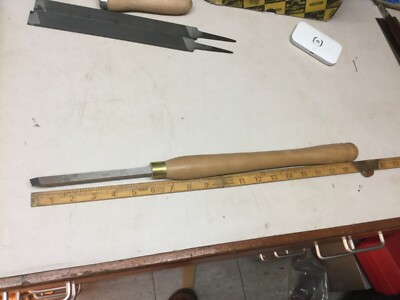
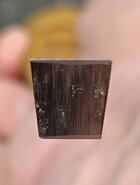
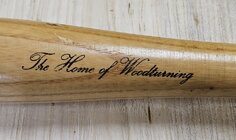
Below is a cross-section view of a Sheffield-made M2 "The Home of Woodturning" brand bedan that I bought in the later 90s. In nearly 30 years, I bet not 1/8" of steel has been turned to grinding dust. Measuring, it seems to have been ground from 3/8" square bar stock (tool height and edge width) but only tapering down to 5/16" on the bottom. It's hollow ground on the bevel, then honed with a hand-held diamond hone.

Separately, it seems that was a house-brand of Craft Supplies UK, per a 2-second web search. I have no idea where I would have bought it from. Other than local Rockler/Woodcraft stores, the two big USA mail order suppliers of the time were Craft Supplies USA and Packard.
1000016950.jpg
1000016951.jpg
 
Back
Top