• The forum upgrades have been completed. These were moderate security fixes from our software vendor and it looks like everything is working well. If you see any problems please post in the Forum Technical Support forum or email us at forum_moderator (at) aawforum.org. Thank you
  • April 2026 Turning Challenge: Salad Bowl! (click here for details)
  • Congratulations to David Bartell, People's Choice in the March 2026 Turning Challenge (click here for details)
  • Congratulations to Ethan Hoff for "Basket Illusion Platter" being selected as Turning of the Week for April 13, 2026 (click here for details)
  • Welcome new registering member. Your username must be your real First and Last name (for example: John Doe). "Screen names" and "handles" are not allowed and your registration will be deleted if you don't use your real name. Also, do not use all caps nor all lower case.

Linear Rail Hollowing Rig

Joined
Apr 9, 2026
Messages
35
Likes
19
Location
Kiev, Ukraine
Hello everyone,

I’d like to start a discussion about a project I’ve been obsessed with lately: a Linear Rail Hollowing Rig. When I first saw Alan Trout’s system, I was blown away by its precision and stability, and I knew I had to try building one myself. I’ll be the first to admit — I’m still gaining both life and technical experience. But I’m a firm believer that if you don’t try and you don’t make mistakes, you’ll never truly learn anything. So, this is the beginning of my journey into precision hollowing. I’m here to learn, so please — criticize my ideas, share your advice, and speak your mind. That’s exactly why I’m starting this thread. I don’t know the exact specs of Alan’s original build, so I’m reverse-engineering it and looking for the best available materials.

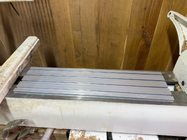
Let’s start with the base for the guide rails. I’ve been weighing three options:
  1. Steel (Heavy and rigid, but requires precision welding and surfacing).
  2. Phenolic/Textolite (Great damping, but can be expensive and tricky to tap).
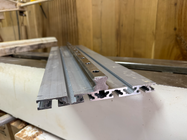
  3. Aluminum T-Slot Plate/Profile (Excellent geometry and ease of mounting).
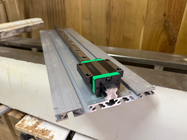
I have made my choice in favor of aluminum, and I will be mounting the guide rail to it.

tempImage6jj1sX.png
tempImageZyY5ev.png
tempImagexQPkSu.png


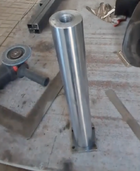
I have started selecting the diameter for the shaft. I was choosing between three options: 40, 50, and 60 mm. The 40mm seems a bit flimsy, while the 60mm, on the contrary, feels heavy — I am concerned that the extra weight will kill the guide bearings, although the sellers say they can withstand a lot. I settled on 50mm, but I am also making one for 60mm in parallel. For the guide rail, I initially took a size 20, but then switched to 25. For the 60mm bar, I will need at least a size 30 rail.
 
Moving on to the shaft setup. There is one key element here: the main carriage (holder), which must allow for up-and-down adjustment and rotation around its own axis. In addition to these movements, it has to support the handle, the blade, and the mounts for a video camera or laser guide.

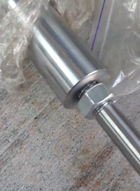
I decided to simplify the carriage by moving the laser/camera mounts directly onto the shaft itself. I’ve commissioned a machinist to cut threads into both my 20mm shaft (for the laser) and my 50mm shaft. I’m a bit concerned that the 20mm shaft might vibrate loose, so I added a jam nut (lock nut) just in case. Better safe than sorry! ;)

Снимок экрана — 2026-04-17 в 18.20.27.png

I couldn't post a video here, so I had to make an image instead.

Until I assemble the entire system, I am keeping the 20mm shaft long. Once everything is installed, I will cut off the excess. I thought for a long time about whether to choose a laser or video. I read so many complaints about laser systems and lasers failing due to vibration that I decided to try a car rearview camera. For now, I bought a simple $40 version because I didn't know which one was optimal. Trent Bosch sells his visualizer for a lot of money; I still don't know what kind of camera and screen he uses—they must be good—so I decided to try a more modest model for now, a 'beginner' version, so to speak. If I need this system, I can just screw it on top; it won't add extra weight to the carriage on the shaft and hopefully won't get in the way. If I don't need it—for example, if I'm just doing roughing down to a thickness of 1 inch—I can simply remove it so it's not in the way on top.
 
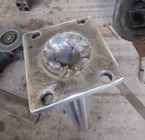
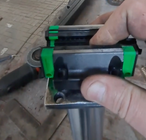
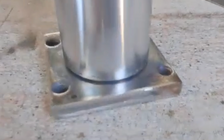
Now we are mounting the shaft to the guide rail via the bearing carriage. We welded a plate to the bar and drilled holes in it, taking great care to weld from the inside so that no seam is visible on the outside. The carriage features M8 threaded holes, and we will be securing it with four socket head cap screws.

Снимок экрана — 2026-04-17 в 18.32.14.pngСнимок экрана — 2026-04-17 в 18.32.46.pngСнимок экрана — 2026-04-17 в 18.33.23.pngСнимок экрана — 2026-04-17 в 18.33.48.png
 
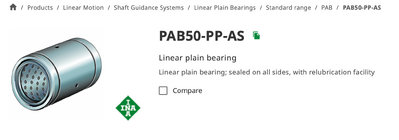
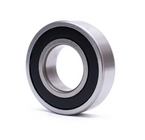
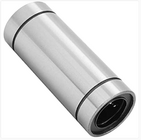
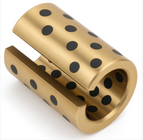
Choosing the main bearing is probably the most critical moment. I listened to many different opinions and read a lot on this subject.
There were several different options under consideration:

Снимок экрана — 2026-04-17 в 18.45.17.pngСнимок экрана — 2026-04-17 в 18.46.20.pngСнимок экрана — 2026-04-17 в 18.45.41.pngСнимок экрана — 2026-04-17 в 18.45.30.png

I am leaning towards the second option: using narrow bearings. My plan is to install two of them—one at the top of the carriage and one at the bottom.
 
Tymur, it would be helpful if you showed a sketch of the proposed unit and a description of what it is intended to do and how it will operate. DJG
Oh Dennis, I’m not really skilled with that kind of software yet — I guess you'd usually draw that in AutoCAD. To be honest, I’m still very 'green' in many ways and I tend to approach things a bit like a kid, just figuring it out as I go. I could try to draw it, of course, but I think that would take too much time. It’ll probably be faster for me to just build it and show you the rig in action!;)
 
I was in the process of typing about how I'm not following where this is going, but then a light came on...

Rather than a captured bar or articulating arm, you're thinking a telescopic tool bar on a sliding track?
 
I was in the process of typing about how I'm not following where this is going, but then a light came on...

Rather than a captured bar or articulating arm, you're thinking a telescopic tool bar on a sliding track?
Exactly! There will be two rails at the bottom, perpendicular to each other. On top of that, there will be a shaft with a swiveling carriage. This setup will allow for movement across 3 axes.
 
have started selecting the diameter for the shaft. I was choosing between three options: 40, 50, and 60 mm. The 40mm seems a bit flimsy, while the 60mm, on the contrary, feels heavy
My thoughts. Some HF's are small with a small opening, so giving the user some choice in tool shaft size is good. Also a round tool bar has better clearance at the opening.
 
Oh Dennis, I’m not really skilled with that kind of software yet — I guess you'd usually draw that in AutoCAD. To be honest, I’m still very 'green' in many ways and I tend to approach things a bit like a kid, just figuring it out as I go. I could try to draw it, of course, but I think that would take too much time. It’ll probably be faster for me to just build it and show you the rig in action!;)
how about a hand sketch
 
Oh Dennis, I’m not really skilled with that kind of software yet — I guess you'd usually draw that in AutoCAD. To be honest, I’m still very 'green' in many ways and I tend to approach things a bit like a kid, just figuring it out as I go. I could try to draw it, of course, but I think that would take too much time. It’ll probably be faster for me to just build it and show you the rig in action!;)
Its interesting, but as mentioned a drawing might help us evauate. But I am very familar with the linear bearings, perhaps wood dust might become an issue. 40,50,60mm shafts wow I use 25mm to a depth of 400mm quite successfully, or is that fo the vertical mounting shaft to the bed? As to bearings , yup second option as they are sealed. Although I have a couple of captured hollowing set ups I generally dont bother rather run free hand. Lasers, I have a multi laser set up, yeah vibration can be a concern. But trying remove all vibration might make far too heavy and cumbersome
 
My thoughts. Some HF's are small with a small opening, so giving the user some choice in tool shaft size is good. Also a round tool bar has better clearance at the opening.
Mark, I think there can be only one shaft. Otherwise, if I had three different shafts, I would have to mount a separate carriage for 30mm rails on each of them. Since the rails are the same 30mm everywhere, it's possible, but I don't think it makes much sense. A 60mm shaft is quite heavy, while 40mm feels a bit flimsy. If you are making HFs up to 14 inches, a 40mm bar is plenty. But if your 'inner artist' wakes up and you decide to create a 30-inch masterpiece — then a 40mm shaft won't be enough. ;)I believe a 50mm shaft is the 'golden mean'.

I hope to have everything assembled within a couple of weeks. Next week, I want to build the carriage for the shaft. If you have any serious thoughts on bearings, you’re more than welcome to share. Now is the time for me to choose and prepare the carriage specifically for the bearing size.:cool:

By the way, Marc, in the video you sent, it looks like a 40mm shaft. In the version I saw before, it seemed like a 50mm shaft at the very least. If you're hollowing very long forms, I’d personally prefer a 60mm shaft for that extra stability.
 
Last edited:
Its interesting, but as mentioned a drawing might help us evauate. But I am very familar with the linear bearings, perhaps wood dust might become an issue. 40,50,60mm shafts wow I use 25mm to a depth of 400mm quite successfully, or is that fo the vertical mounting shaft to the bed? As to bearings , yup second option as they are sealed. Although I have a couple of captured hollowing set ups I generally dont bother rather run free hand. Lasers, I have a multi laser set up, yeah vibration can be a concern. But trying remove all vibration might make far too heavy and cumbersome
Unfortunately, I’m a terrible artist 😟and I’m afraid a drawing might confuse everyone even more. To be clear — I was talking about the vertical shafts. I haven't even mentioned the horizontal ones yet!


Hughie, what do you think about using a camera? Everyone says that once you try a camera setup, you never go back to lasers. What’s your take on that?
 
Tymur,

This seems like an adaptation of the captured-D design. What do you hope to gain from it over that older design?

I am particularly interested in how you will keep all the dust and other detritus out of the linear rail bearings. Are you planning to use accordion style covers?
 
Tymur,

This seems like an adaptation of the captured-D design. What do you hope to gain from it over that older design?

I am particularly interested in how you will keep all the dust and other detritus out of the linear rail bearings. Are you planning to use accordion style covers?
Rich, I believe this system is quite different from the Captured-D. You are likely referring to systems similar to Oneway or Lyle Jamieson, unless you have something else in mind.

Regarding the linear bearings on the rails, I have already purchased specialized dust seals and oiling cartridges that will automatically lubricate them as they move. I’ve taken the debris issue into account.
 
Alan Trout’s system is impressive, and overkill. Hi precision is provided by the hand guiding the tool, along with cutter adj and cutting edge height. Arresting torque from the cutter needn’t be precise, ie Jamieson’s system is not precise but works quite well.

A comment on bearings - if you able to keep dust out, oil will work. An alternative - look into Dupont Chain Saver - it is wax based, solvent evaporates leaving wax on the surface, low debris pickup. Not sure if you can get it, but it would be my choice - best motorcycle chain lube I have found in 55 years of riding.

Good luck on the project, definitely aspiring to a high level for a young man!
 
Unfortunately, I’m a terrible artist 😟and I’m afraid a drawing might confuse everyone even more. To be clear — I was talking about the vertical shafts. I haven't even mentioned the horizontal ones yet!

Hughie, what do you think about using a camera? Everyone says that once you try a camera setup, you never go back to lasers. What’s your take on that?
I think the camera is fine a step forward, although it will probably develop further, for such a set up is quite expensive so I can do with out it.
 
Back
Top