I had a thread a while back about non-yellowing finishes. There are not too many options, and generally speaking its either water-based finishes (which I have tried, and thus far, I have not liked the results with any of them...the high solids content limits the finish penetration into the wood, and that has a marked effect on the final results...you can tell its a film coating the wood, rather than something penetrating the wood, which limits the quality of the chatoyance, etc.), or ultra blond shellac.
I purchased some ultra blond shellac to finish some holly pieces. So far, it is the only finish that did not impart a noticable yellowing, that also still penetrates enough to really bring out the chatoyance. There is a very slight yellowing, even with the ultra blond, but it was not strong enough to impart an actual yellow appearance to the holly. I've sold two of those pieces, and the customers both stated it was the whitest, brightest wood work they had ever seen, and were satisfied with what they bought. One of the guys in particular was a real fan of American Holly, and was fairly emphatic about the fact that the wood was still white (with a little bit of gray here and there.) With the shellac, you can tune the shine by polishing more and with finer sandpapers. One thing to note, the shinier the finish is, the more the slight yellowing it imparts is noticable. I've finished some pieces with more of a matte or barely visible satin sheen, and it seems to preserve the natural color better. That may not be optimal for many...best I've found so far, though, especially for bright/light maples, holly, etc.
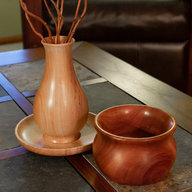
There is one other finish that I've used lately, which while it does impart some warming, it is less than any of the linseed-based finishes that I've used: Tung Oil. It appears more orangish in the can (or stop loss bag, as is usually the case for me), however upon application it has less of a color-changing effect than any poly, oli+wax, pure linseed, or other types of finishes I've used. It DOES have an effect, just not as strong, and I feel more of the natural color of the wood is preserved with Tung than other oils. The key challenge with oils, especially pure, is the time it takes for them to dry and to cure. To get a satin sheen with Tung, it usually takes 4-6 coats, which can require days of application, and then likely 2-3 weeks of time to properly cure. So it is not a fast finish, and water-based finishes have oil fully beat here as they will usually dry very quickly and be fully cured within a day.
Many water-based finishes are very clear and colorless. If you don't have any issues with the way water based finishes look in the end, then they might be an option. I've tried Polycrylic, which I just cannot stand (for a multitude of reasons), and it really looks like a sloppy plastic coating when its fully cured. I've tried some other water-based finishes, some of which start out milky white then cure clear. I have found that these milky-white finishes, often have a SEVERE yellowing problem. I first noticed it on a piece I'd finished with one of these a couple of years ago...it had notably warmed. I then found the bottle, now about two years old, and all the stuff that had gummed up the cap and outsides of the bottle, had turns a brilliant orange. More orange than any oil-based product I've ever used. I also have something called CraftCoat, which is another water-based finish. It does not yellow, however I've used it on some pens...and over time, it did not seem to age well. It is still clear, but the surface has lost the shiny smooth finish I originally gave it, it seems it has started to expose the nature of the wood grain (??) and it very much looks like a surface of plastic over wood. In contrast, pens finished with CA (GluBoost specifically) still look perfect years after they were created, just as crystal clear as they ever were (only plastic finish I actually like

).
Again, there may be application techniques that solve some of the problems I've encountered with water-based finishes...I have never had time to try and figure out on waste pieces or anything like that and I've been unwilling to try on any pieces I hope to sell, if I could get the results I am looking for, which thus far I have only been able to achieve with oil-based finishes. The way oil penetrates the wood fibers, it brings out characteristics that a surface-only film just can't do, and I have yet to find a water-based finish that penetrates to any meaningful degree.