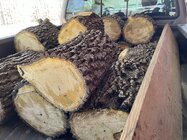
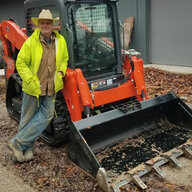
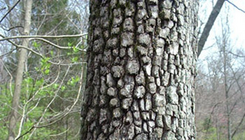
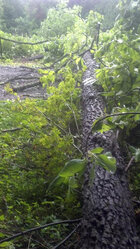
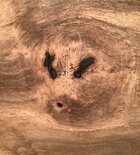
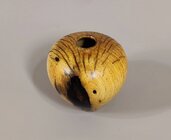
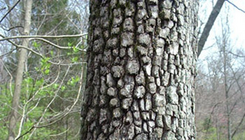
Interesting about the color, I saw no black anywhere on this log. When I got out of the truck he said it’s seems like a hard wood and all white inside. I knew then it probably wasn’t Plum and when I saw the bark I know it was Persimmon.
I may cut a few slabs if I can’t get it all turned in a few days.
I've never seen persimmon that big without some black heartwood at or near the pith, often smaller than a pencil in diameter. (pieces with significant bark as in one of the meat tenderizer handles shown in the other thread is rare!)
The bark can be a good reference although Persimmon bark can vary a lot with age and probably growing conditions. The thing common to all Persimmon bark I've seen in the south east is when seen from a dozen or so ft away the bark will look quite black compared to the browns and greys in many other species. And a "checked" look is common, at least for the Persimmon trees in our part of the country (and all I've seen on our property)
With live trees at the right time of the year, the fruit is distinctive, light orange and strongly astringent before soft and ripe and tasty! Seeds are large and brown and difficult to remove from the fruit. But for the persimmon common here, note that just the female trees produce fruit - the male trees produce only flowers for pollen. (None of this helps without having live trees around, but it's nice to know when out and about looking at trees.)
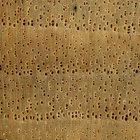
If you want to verify the species, the quickest way is to look at the end grain with a magnifier. Cut a small sample exposing the end grain with at least 2 or 3 rings, maybe 1/2" wide, 1" long, thick enough to grip firmly with the fingers. Shave the endgrain with a single-edge razor blade to cleanly expose the pores. (Can't really prepare the end grain for examination by sanding since the sawdust will clog up the pores plus destroy detail.) Examine with a magnifier (10x recommended)
Persimmon is more or less ring porous and the pores are in singles or multiples of two or three like the picture. Rays are very thin.
The Wood Database has info about the density, sometimes useful to help verify a species (cut a block, measure and weigh carefully, see if it's in the ballpark with the .numbers given (52 lbs per cubic ft, dry)
www.wood-database.com/persimmon/
Their article on Wood ID is helpful. Some instructions about preparing and examining the sample are in section 7 on this page:
www.wood-database.com/wood-articles/wood-identification-guide/
The "Still stumped?" section at the bottom of the page tells how to send a sample off for free gov lab ID. I did that once to verify my own ID of someone's wood. My ID, fortunately, was the same as theirs! Stick a chunk if you want me to take a look - doesn't have to be very big - 2x2" cut somewhere away from the pith is good. I'm no expert but it's an interesting hobby. The book "Identifying Wood" by R. Bruce Hoadley is a good introduction to wood ID. I got started on this when someone passed around a bowl at the club marked "Cherry" on the bottom. One look, even without a preparing a sample, told me it could NOT be cherry.
JKJ


 .
.