@John Snow
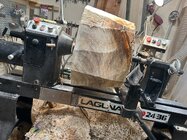
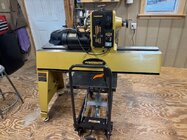
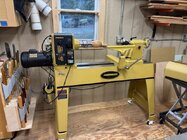
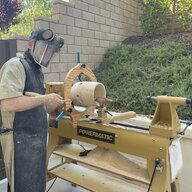
Hey, I've put together (and taken apart and moved) several largish lathes by myself. Arnold was busy that day. One lathe is my PM3520b, perhaps similar in weight to the one you have coming.
I hauled it to my shop in a covered trailer. I was able to back up to a double-door; no steps.
I pulled out the bed enough to position one end on a furniture dolly (the type with four casters and wood pieces covered with carpet), rolled and slid the rest of the bed, then lowered it to a second furniture dolly. Rolled it into the shop. The legs were light enough for me to carry.
To assemble, I positioned one leg close to one end and used an automotive floor jack to lift one end of the bed. Can remember if I needed to use wooden spacer blocks.
When at a suitable height, I tilted the leg to line the bolt holes with the bed then inserted and lightly tightened the screws on that end.
I then lifted the other end with the floor jack and positioned the 2nd leg and fastened with screws, tightened all screws, then was able to scoot the lathe bed+legs across the concrete to the position where it's been for years. I positioned and mounted the bed extension (if you have one, a little hint, insert a piece of wood - 2x4 or something that will fit) into the end of the lathe bed and lift the extension and slide it onto the wood to hold it in approx position, insert, align, and tighten screws.)
I rolled the headstock to the end of the lathe on one of the furniture dollys. I was able to lift and align the headstock by myself but it would have been a lot smarter to enlist help from a second person. The banjo and tailstock were easy.
I moved and assembled two other lathes the same way. One was into an earlier shop with exposed roof structure - for that I rigged a rope to help raise and hold one end of the bed. It was a Jet 1642 with all parts a lot lighter than the PM. Moved another Jet 1642 and assembled it without using anything but a length of 2x4 cut to a useful length - lifted one end of the bed and propped it up with the 2x4 (it was stable enough), mounted the legs one at a time. Later, disassembled it the same way and load it on a trailer myself to give it to a friend. If it was the PM I'd have gotten help as I did when moving a 2nd jet out - at 75 I have to make myself set aside pride and ask for help!
Several lathes are helpful for lessons!
In case Arnold is busy when you get the lathe, if you are in a woodturning club I'm sure a turner (or two) would volunteer to come and help. Woodturners are great people!
Don't know about your shop layout, but two friends mounted I-beams in their shop so they could use a simple chain hoist to lift heavy things. One uses it for heavy wood and equipment, the other for engine work.
I would hesitate to put and leave casters on a lathe. Some I know who mount casters on a club lathe (to regularly move it from storage every month demos) have rigged up clever schemes to lower and lock the casters into place, move the lathe, then release and raise the casters so the lathe sets firmly on the floor on the four threaded levelers/adjusters. Any mechanically-cognizant person could design such a mechanism - those I've seen were made of hardwood with some steel hardware pivots and such. I find the stock lathe adjusters very important, especially for small, detailed, and critical work, since the slightest irregularity in a floor can put one adjuster a bit out of the plane and cause a misalignment between the headstock spindle and the tailstock live center. (It may seem unlikely, but even a heavy cast iron lathe bed can easily twist.) I check this alignment every time I move a lathe, even if moved a little on what appears to be a perfectly flat concrete floor. I've mentioned this before: at a demo by turner Mark StLeger he noticed a slight misalignment in our club lathe and said he would have problems with the next step after the break. During the break, I adjusted the alignment - tool only a minute.
JKJ



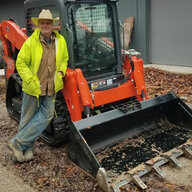

 a job for a stronger (younger) person or helper, or 2