• It's time to cast your vote in the November 2025 Turning Challenge. (click here for details)
  • Congratulations to Dave Roberts for "Low Rider" being selected as Turning of the Week for December 1, 2025 (click here for details)
  • Welcome new registering member. Your username must be your real First and Last name (for example: John Doe). "Screen names" and "handles" are not allowed and your registration will be deleted if you don't use your real name. Also, do not use all caps nor all lower case.

PM 3520C assembly advice

Joined
Jan 29, 2022
Messages
66
Likes
46
Location
Woodinville, WA
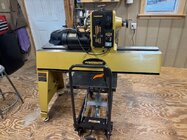
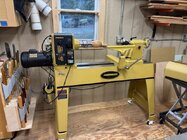
Having waited too long for a fantastic deal on a surplus PM 3520C ($3600 new!) I bit the bullet and bought one from Woodturners Catalog, because I'm not getting any younger. Also a very good deal.

My "problem" (first world problem really) is that I imagine it will come unassembled on a pallet. It's just me here and I'm not Arnold Schwarzenegger in his prime. The lathe parts are heavy. Any advice on putting this beast together? I'm thinking that an engine hoist would work for assembling the base, then hoisting the headstock onto it. Maybe there's an easier way.

Also, I'm considering putting casters on it. Is this a bad idea?
 
Permanently attached casters raise the spindle height, duh. I don't like turning with the spindle above my elbow height. I have done it and can confirm, from experience, that I don't like it. Your preferences are your business.

I have also heard that a hydraulic lift table can be helpful with assembly. probably more with legs to ways than with headstock on to ways.

Congratulations on your new lathe and good luck.
 
@John Snow
Hey, I've put together (and taken apart and moved) several largish lathes by myself. Arnold was busy that day. One lathe is my PM3520b, perhaps similar in weight to the one you have coming.

I hauled it to my shop in a covered trailer. I was able to back up to a double-door; no steps.
I pulled out the bed enough to position one end on a furniture dolly (the type with four casters and wood pieces covered with carpet), rolled and slid the rest of the bed, then lowered it to a second furniture dolly. Rolled it into the shop. The legs were light enough for me to carry.

To assemble, I positioned one leg close to one end and used an automotive floor jack to lift one end of the bed. Can remember if I needed to use wooden spacer blocks.

When at a suitable height, I tilted the leg to line the bolt holes with the bed then inserted and lightly tightened the screws on that end.

I then lifted the other end with the floor jack and positioned the 2nd leg and fastened with screws, tightened all screws, then was able to scoot the lathe bed+legs across the concrete to the position where it's been for years. I positioned and mounted the bed extension (if you have one, a little hint, insert a piece of wood - 2x4 or something that will fit) into the end of the lathe bed and lift the extension and slide it onto the wood to hold it in approx position, insert, align, and tighten screws.)

I rolled the headstock to the end of the lathe on one of the furniture dollys. I was able to lift and align the headstock by myself but it would have been a lot smarter to enlist help from a second person. The banjo and tailstock were easy.

I moved and assembled two other lathes the same way. One was into an earlier shop with exposed roof structure - for that I rigged a rope to help raise and hold one end of the bed. It was a Jet 1642 with all parts a lot lighter than the PM. Moved another Jet 1642 and assembled it without using anything but a length of 2x4 cut to a useful length - lifted one end of the bed and propped it up with the 2x4 (it was stable enough), mounted the legs one at a time. Later, disassembled it the same way and load it on a trailer myself to give it to a friend. If it was the PM I'd have gotten help as I did when moving a 2nd jet out - at 75 I have to make myself set aside pride and ask for help!

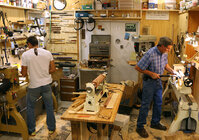
Several lathes are helpful for lessons!
1764699916469.jpeg

In case Arnold is busy when you get the lathe, if you are in a woodturning club I'm sure a turner (or two) would volunteer to come and help. Woodturners are great people!

Don't know about your shop layout, but two friends mounted I-beams in their shop so they could use a simple chain hoist to lift heavy things. One uses it for heavy wood and equipment, the other for engine work.

I would hesitate to put and leave casters on a lathe. Some I know who mount casters on a club lathe (to regularly move it from storage every month demos) have rigged up clever schemes to lower and lock the casters into place, move the lathe, then release and raise the casters so the lathe sets firmly on the floor on the four threaded levelers/adjusters. Any mechanically-cognizant person could design such a mechanism - those I've seen were made of hardwood with some steel hardware pivots and such. I find the stock lathe adjusters very important, especially for small, detailed, and critical work, since the slightest irregularity in a floor can put one adjuster a bit out of the plane and cause a misalignment between the headstock spindle and the tailstock live center. (It may seem unlikely, but even a heavy cast iron lathe bed can easily twist.) I check this alignment every time I move a lathe, even if moved a little on what appears to be a perfectly flat concrete floor. I've mentioned this before: at a demo by turner Mark StLeger he noticed a slight misalignment in our club lathe and said he would have problems with the next step after the break. During the break, I adjusted the alignment - tool only a minute.

JKJ

 
I have also heard that a hydraulic lift table can be helpful with assembly. probably more with legs to ways than with headstock on to ways.
Yes. If you have room for it to live in the shop, a lift table is great. Got mine at the old Harbor Fright.
You can raise/lower the bed to get the height just right to assemble the legs.
You can move a lathe by lifting under the middle of the bed (might eliminate the need for casters).
I also use mine to lift logs and larger blanks up to get them on my chainsaw table and up to the bandsaw.
And an extra table is never a bad thing.

I've moved a PM3520b and my Jet 1642 a few times (removing the legs to make it more manageable. My experience and situation is different than yours, but hopefully maybe something here will help:

Each major piece (legs, bed, headstock) is heavy. Get the bed up at leg-height somehow (lift table, hoist, pickup bed, sawhorses, etc) and bolt on the legs one at a time. I've also heard of some people putting the legs on with the latch upside-down and rolling it over?. If you have a lift table or hoist you can probably leave the headstock on the bed - just side it back-and-forth to distribute the weight. (i.e. once you get one leg on, put the headstock over that leg and the other end will be easier to mess with)
The worst piece to deal with as I remember is the headstock. Not only is it heavy, but it is awkward - no handles, nowhere to grab effectively. Put a faceplate on the spindle and lock the spindle - that at least gets you one hand-hold.

I have attached something like a 8" disc to the faceplate, and put the headstock on the lift table sitting on the faceplate (so the motor is sticking up). Got the lift table situated at the end of the bed, and tipped it over onto the bed. That seemed to work fairly well.
 
The 3520 lathes have a 5/8" bore all the way through the headstock. Get a three or four foot length of 5/8" cold-rolled steel to go through it and a couple of fit people can lift and carry it pretty easily to put in place.
 
I watched a couple of U tubes videos on unpacking and setting it up. For me, the hadest part might have been getting the headstock up onto the lathe bed. But as someone mentioned above a hydraulic lift table makes this a lot easier. You bolt the legs onto the lathe bed while it's upside down (at least I did) and tip it up. I found I couldn't tip it upright. It's either 1:) a job for a stronger (younger) person or helper, or 2:) using some deice like an engine lift. I resorted to using my compact tractor loader and load sling. Once i got it located in the shop, I used the hydraulic lift table to move it around. I'm not all that tall so my lathe doesn't those risers on it, and casters would have made it higher....it's just right (for me) with out that stuff

 
Carl Ford did an assembly review of the 3520 on his website. He has all the weights of the individual pieces listed. At least if you read it you will know what you're dealing with.
 
You've gotten good advice here, but there are also some similar threads available by searching. If you're reasonably mechanical, you can figure out how to manage everything by yourself, except the headstock.

One other solution to the headstock is an overhead hoist to lift it up. After the lathe is all together, you can use the hoist to get heavy blanks on the lathe, as well.
 
The 3520 lathes have a 5/8" bore all the way through the headstock. Get a three or four foot length of 5/8" cold-rolled steel to go through it and a couple of fit people can lift and carry it pretty easily to put in place.
You can use 36" rebar from the big box stores. Just rap it with tape to protect the inside of your spindle's morris taper.

By the way, all the Allen bolts are Metric.
 
Back
Top