• It's time to cast your vote in the January 2026 Turning Challenge. (click here for details)
  • Congratulations to Ric Taylor for "Black Ash Burl" being selected as Turning of the Week for January 26, 2026 (click here for details)
  • Welcome new registering member. Your username must be your real First and Last name (for example: John Doe). "Screen names" and "handles" are not allowed and your registration will be deleted if you don't use your real name. Also, do not use all caps nor all lower case.

Pneumatic drill recommendation for sanding bowls?

Joined
Dec 11, 2023
Messages
23
Likes
14
Location
Saco, Maine
It's that time of year again. My bowl sanding drill has died of dust exposure, again. I did my best to clear it of dust this time. I swear. I was wondering if anyone else uses or has used a pneumatic drill for bowl sanding. I have the compressed air already at the lathe for clearing stuff off. The pneumatic drills can be relatively inexpensive, small and won't be bothered by dust (please tell me if I am wrong, I don't own one and guessing). After looking at them for a day on line..... The pneumatic drills are (mostly) high RPM (1800+) and I want 300-500 RPM for bowl sanding so don't burn out the paper or over sand. Also easy quick reverse is a big feature of me. You can find pneumatic sanders with finger speed control but many on line complain it's kinda hard regulate the speed with the controls on air drills.. OK, all the context out the way: Can you recommend a pneumatic drill for bowl sanding or is this a goofy idea?
 
I tried a small Grex orbital hand sander (random orbital sander). I liked the random orbital feature but the high speed and low torque didn't work for me. Maybe the pneumatic drills will be better.
I have tried the angled drills and hated them They were noisy and were really hard on my hands. I eventually moved to a flexible line attached to a motor hung from my rafters. It has a 3/8" jacobs chuck so I can change sanding pads. It runs too fast (1725 RPM) but with a light touch it works very well. It's quieter, has the power to really sand when needed and is always ready to work. I use this system on my bowls. My smaller boxes and such are normally hand sanded.
 
I tried a small Grex orbital hand sander (random orbital sander). I liked the random orbital feature but the high speed and low torque didn't work for me. Maybe the pneumatic drills will be better.
I have tried the angled drills and hated them They were noisy and were really hard on my hands. I eventually moved to a flexible line attached to a motor hung from my rafters. It has a 3/8" jacobs chuck so I can change sanding pads. It runs too fast (1725 RPM) but with a light touch it works very well. It's quieter, has the power to really sand when needed and is always ready to work. I use this system on my bowls. My smaller boxes and such are normally hand sanded.
I am not a fan of high speed bowl sanding at all because of the hard grain/soft grain issue with lots of wide grained wood that I love to turn and accent. The Grex thing looks neat but probably wouldn't be go to for me either. I am feeling done with the angled electric drills approach as well for the reasons you mention and they always burn up too soon. Interesting idea about the over the head sander - like the Dremel flex shaft? The Dremel type device will let you set the speed which would be nice. I wonder about the shaft limiting access to deeper stuff.... but there all those fun attachments. Sander-n-carver? Maybe some other brand a more flexible shaft. Googling and reading will being. Thank you.
 
I have a couple of the cheap knock-off angle drills from Harbor Freight or some such. They’ve lasted me longer than the more expensive Sioux I bought 30yrs ago. I think the current ones are 10-15yrs old, if I recall correctly I threw one away between the Sioux and these two. I find them heavy and uncomfortable to hold for long so I just use them for heavy sanding with 120 or 150 grit; a 3” mandrel sits permanently on one, a 2” on the other.

Several years ago I bought a pneumatic RO from WoodTurners Wonders that I like a lot, light and comfortable. A year or two ago I had problems with it and had to clean it out a couple times. During this time I purchased a Grex pistol grip RO. I like the WW one much better, but now use both with twist off pads for various grits and sizes; the WW is probably used ~80% of the time.
 
I have a Grex ros for finish sanding inside surfaces with a kludged trigger limiter - still probably runs at 3k+. I often use an electric Festool 5" ros for outside surfaces. For rough sanding I get the most mileage out of a Milwaukee rotary sander/polisher that runs in low range at 2800 rpm. I don't think you will find an air tool that runs at the rpms you are looking for.

I don't have a problem with high rpms as long as the velcro discs don't fly off. Just keep the tool moving. You can burn with dull abrasives or grind out of round at any speed.

I know a couple of pro turners (including Al Stirt) who use high speed (8k+ rpm) air grinders for sanding. They use glue or mechanical means to hold the discs in place. They turn clean so they don't have to remove a lot of material. I'm still working on that aspect.
 
Last edited:
I have a couple of the cheap knock-off angle drills from Harbor Freight or some such. They’ve lasted me longer than the more expensive Sioux I bought 30yrs ago. I think the current ones are 10-15yrs old, if I recall correctly I threw one away between the Sioux and these two. I find them heavy and uncomfortable to hold for long so I just use them for heavy sanding with 120 or 150 grit; a 3” mandrel sits permanently on one, a 2” on the other.

Several years ago I bought a pneumatic RO from WoodTurners Wonders that I like a lot, light and comfortable. A year or two ago I had problems with it and had to clean it out a couple times. During this time I purchased a Grex pistol grip RO. I like the WW one much better, but now use both with twist off pads for various grits and sizes; the WW is probably used ~80% of the time.
Neat. I went and looked and found this:
Is this the one you use? The look interesting for sure! Thank you.

I was not thinking a random orbital sander would work on a bowl effectively as one come up against to beads and base forms. What is your experience with the use case for coming up close to the edge of forms with a random orbital sander?
 
I was not thinking a random orbital sander would work on a bowl effectively as one come up against to beads and base forms. What is your experience with the use case for coming up close to the edge of forms with a random orbital sander?
Can't be done effectively (by me) with a power sander without smearing the details.
 
@Michael McNally - yes, that’s the WW I use and like.

You are correct that you can’t get close to crisp changes in a curve with an RO, a drill mandrel does better but still won’t keep crisp transitions. Fortunately the simple curves and designs that I like don’t have those transitions often. When they do I try to cut very cleanly and sand minimally.
 
Ive been using s standard 3/8" Dewalt corded electric for 20 years. It just wont die. I find the angled drills dont fit my hands very well and I constantly hear about them dying. I bought a second dewalt at a yard sale in case my first one died but it just keeps hanging in there.
 
I use the WW random orbital as well, but not the one pictured. I use the smaller palm variety. Last time I checked they were out of stock, but now that he is back at the helm of WW they may be available again. Give Ken a call and he will give you straight up info.
 
I ran a air drill for sanding for a few years and ended up going back to an electric drill. The particular air drill I had would not reverse and the air compressor ran a lot and I had to contend with condensation in the air line. I personally am using a Performax® 5-Amp Corded 3/8" Right Angle Drill from Menards. It's OK. I would still be running my last Harbor Freight drill but cannot find brushes for it and have worn the originals out.
 
Ive been using s standard 3/8" Dewalt corded electric for 20 years. It just wont die. I find the angled drills dont fit my hands very well and I constantly hear about them dying. I bought a second dewalt at a yard sale in case my first one died but it just keeps hanging in there.
Hi John. I've tried a conventional pistol-grip style drill a few times but found the operation somewhat herky-jerky, not very easy to control. The handle, situated at about 90° to the disk, wants to twist out of control. Any advice to share?

I've had a Sorby sander forever, but rarely use it because it just feels light and cheap.
 
For me, I don't like the high speed and noise of the air tools. I think the best deal out there is the Bauer angled drill form Harbor Fright, especially when they're on sale. I keep 2 of them near the lathe, one with a 2" mandrel and the other with 3 inch. They've fallen off the bed ways, been in piles of dust, but still keep going. If it died today, I'd be OK with it and gladly get another.

1769615017722.png
 
Well, long ago, I got a Sioux pneumatic angle drill. It didn't last any longer than the standard electric ones. I consider the Grex ones to be more fir final sanding with the higher grits, but I have not tried one. With the Sioux drill, it kept my 60 gallon compressor running non stop. I figured that cost more than the angle drills to run. I have a couple of old Milwaukee/Sioux drills that have been rebuilt many times. Most of the time it is the bearings that go out, though I have worn out a couple of external casings. The brushes do need to be replaced once in a while too. Usually it is cheaper to get the old one repaired, though it has been a while since I have gone to the tool repair place. Running at full speed wears them out more quickly, as does pressing too hard. That Bauer one almost looks like a clone of the Milwaukee.

robo hippy
 
I sonetimes use a Grex pistol-grip pneumatic random orbital sanders with fine paper, usually 600 or finer and always off the lathe. I have to, keep a 1" and 2" pads on them. I run these very slowly. I also use a pneumatic palm ROS from Woodturner's Wonders, also with fine paper.. I like it since it has a valve to turn the air way down so I don't have to partially press the trigger like on the Grex (I guess I'd add an in-line valve if I used it a lot.

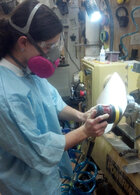
A student using one.
1769635469351.jpeg

But can't answer about a pneumatic drill for general sanding. I don't do power sanding with rotating disks- I don't like the clouds of dust and don't like what it does to the wood in some cases. For me, there are better ways.

JKJ
 
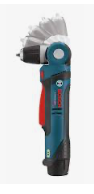
For me, I don't like the high speed and noise of the air tools. I think the best deal out there is the Bauer angled drill form Harbor Fright, especially when they're on sale. I keep 2 of them near the lathe, one with a 2" mandrel and the other with 3 inch. They've fallen off the bed ways, been in piles of dust, but still keep going. If it died today, I'd be OK with it and gladly get another.

View attachment 84602
This is what I have as well. Been running it for 3 years now without any issues. Great idea on having 2. Next time they’re on sale, I’ll get a second one so I don’t have to switch the 2” and 3” pads out.
 
There is an air supply and then there is an air supply for air tools. For air tools you need a compressor that will keep up if you cut the end off the hose. You need around 6cfm at 90psi. So you have an air compressor hammering away in the background and the electrical requirements for that much bigger motor. It’s one thing if you have a auto body shop, but in a little shop I find air tools a real annoyance and the most expensive drill you can own if you need to buy a new compressor.
 
Go to a few yard sales and look for corded drills. Usually, for $10 or so they can be yours. Clean them out once in a while with compressed air. They should last a fair amount of time. Keep going to the yard sales and pick up a couple of spares.
I am with John Lucas on this one.......but mine is a Makita drill. Keeps on running. But, I do have a couple of other drills stuck away for when it goes south.
 
I went through a bunch of cheap drills before buying the Dewalt. Hand drills are not designed to running full time like we use them. The cheaper ones just dont have tge quality parts.
 
I vote with Hugh and John. I use Makita LXT 18V series tools , and those drills just keep on going. I picked makita because my corded 3/8" VSR drill that I bought new in 1987 is still going strong, have yet to need to replace brushes, but have worn out two chucks... so I'll take Makita any day of the week, and for sanding on the lathe I just chuck up my WW sanding arbor kit (1" and 2" kits - roloc arbor with the medium density hook and loop pads plus 1" or 2" sanding disks ) in one of my two 1/2" makita cordless drills.
 
Again way back when I was an early subscriber to Ebay and I bought quite a few Dewalt wired hand drills. One deal was four new in the box for $50. I believe I still have 1 or 2 new ones down in the shop. I also have a Harbor Freight angled drill that is close to 20 years old and 2 angled drills one from each of the guys that sold sand paper. Both claimed theirs was better than the other guys but I took them apart and they were exactly the same on the inside only difference was the outside color of the plastic. They are both still running. A surprise lately was all the battery drills that I had that the batteries wore out but I never found time to throw them away are actually new again as I found that Temu or Ali Express have Lithium Ion batteries to replace the old Nickel Cadmium batteries they used to use. Now have 3 new but old battery drill outfits that work great again.
 
I have a HF right angle corded drill (maybe a Bauer brand) that I use for sanding with 2" discs. It's served me well for several years and it still going strong. It is noisy and heavy, but has survived a drop or two onto the concrete. I like the look of the Bauer angled drill that Darryl posted and will look for it next time there's a sale.
 
Couple of musing (some already mentioned):

Air tools need A LOT of continuous air supply at 90 psi. If you have a big two piston cast iron pump model you’ll be fine. If not………………..

Air tools need constant oiling and require dry air , so you’re gonna need a good filter-oiler.

Pneumatic drills tend to run very fast and usually don’t have keyless chucks. Newer offerings are starting to have keyless chucks, reversing, and lower rpm models can be found - but they aren’t the $49 HF coupon specials.

You’re going to periodically need to grease the planetary gear system in the drill.
 
No doubt serious pneumatic tools need a lot of air, which is expensive. Electric tools are far more efficient. Pneumatic are lightweight, simple and low maintenance though and usually less expensive than an equal grade electric. I never in 15 years of employment in a cabinet shop saw a Dynabrade DA sander give out, and I guarantee nobody ever greased them. A drop or two of oil every day was all the attention they got. We had industrial Ingersoll Rand compressors and as long as they got regular filter and oil changes they just kept going.
 
My comment was for someone that’s newer to the use of air tools that hog supply capacity - not a seasoned vet.
Sorry, my intention was to expand and clarify. (Note that some air tools, such as small ROS run at low speeds, do not need a lot of air.) I wanted to provide some guidance to those without experience who are considering installing a permanent air compressor for general use in a woodturning shop. I'll try again. All air compressors I've had incorporated filters to remove dust and such from the intake air. For output, a good way to remove water is needed for many applications in the shop.

Depending on the use (spraying paint (air brushing) or finish, blowing dust from a piece, even use in a little machine shop or plasma cutting for those who do such things, something inline to remove water from the air is important. (And the process of compressing air can condense a lot of water - see how much water comes out when draining it from the bottom of the tank.) A water separator is the first line of defense - it's cheap and will remove liquid water and extend the life of the desiccant dryer cartridge. (BTW, I quit buying desiccant cartridges - I pry open the old cartridges and replace the desiccant beads with indicator beads - redry those with a little toaster oven when needed - saves a LOT of money.)

BTW, or air brushing a tiny purpose built compressor, regulator, and filter might be the best way to go. Any questions for a comprehensive education, call Joe Flemming! (He sets up at various symposiums too.)
www.airbrushingwood.com/

I was confused about what seemed like the suggestion to add an oiler to an air line. While possibly helpful for some types of shop use, adding oil to the air can be a real problem around wood, automotive paint, and other applications. As otherwise verified, drops of oil added to the air intake of a pneumatic tool itself is not only sufficient but recommended. That oil will go only to the tool, not blown where not wanted.

I use my compressor in and around the shop - at the lathe, in my little welding and machine shops, for equipment maintence outside with air operated impact drivers, die grinders, and grease guns, to blow dust out of air cleaners and radiators (my excavator has a stack of three radiators which get pretty dusty), to clean shears a clippers while shearing lllamas, and gasp, to air up tires!

Also, I mentioned in another thread to always turn off the compressor when leaving a shop. I know a gentleman whos shop, all his wood, and every machine was destroyed when the cutoff switch on the compressor failed and ran continuously until it overheated and started a fire. He was out of town at the time.

JKJ

 
I use a combination of a Grex ROS air sander for finer grits (240/320) and Bauer angle drill for lower grits, both with twist-on quick change mandrels. The Bauer is a bit more aggressive but controllable, while the Grex leaves a cleaner and swirl-free finer finish. I can get pretty close to beads with the Grex using a non-overlapping disk, but always first hand sand around such features to avoid rounding over the detail. I really like the Grex, I've had it for over 20 years with no issues, and the Bauer is hanging in there after 4-5 years. I do blow the Bauer out occasionally with compressed air and feed the Grex 4-5 drops of air tool oil before each session, which works well for me so far.

Gary
 
Sorry, my intention was to expand and clarify. (Note that some air tools, such as small ROS run at low speeds, do not need a lot of air.) I wanted to provide some guidance to those without experience who are considering installing a permanent air compressor for general use in a woodturning shop. I'll try again. All air compressors I've had incorporated filters to remove dust and such from the intake air. For output, a good way to remove water is needed for many applications in the shop.

Depending on the use (spraying paint (air brushing) or finish, blowing dust from a piece, even use in a little machine shop or plasma cutting for those who do such things, something inline to remove water from the air is important. (And the process of compressing air can condense a lot of water - see how much water comes out when draining it from the bottom of the tank.) A water separator is the first line of defense - it's cheap and will remove liquid water and extend the life of the desiccant dryer cartridge. (BTW, I quit buying desiccant cartridges - I pry open the old cartridges and replace the desiccant beads with indicator beads - redry those with a little toaster oven when needed - saves a LOT of money.)

BTW, or air brushing a tiny purpose built compressor, regulator, and filter might be the best way to go. Any questions for a comprehensive education, call Joe Flemming! (He sets up at various symposiums too.)
www.airbrushingwood.com/

I was confused about what seemed like the suggestion to add an oiler to an air line. While possibly helpful for some types of shop use, adding oil to the air can be a real problem around wood, automotive paint, and other applications. As otherwise verified, drops of oil added to the air intake of a pneumatic tool itself is not only sufficient but recommended. That oil will go only to the tool, not blown where not wanted.

I use my compressor in and around the shop - at the lathe, in my little welding and machine shops, for equipment maintence outside with air operated impact drivers, die grinders, and grease guns, to blow dust out of air cleaners and radiators (my excavator has a stack of three radiators which get pretty dusty), to clean shears a clippers while shearing lllamas, and gasp, to air up tires!

Also, I mentioned in another thread to always turn off the compressor when leaving a shop. I know a gentleman whos shop, all his wood, and every machine was destroyed when the cutoff switch on the compressor failed and ran continuously until it overheated and started a fire. He was out of town at the time.

JKJ

Thanks for the detailed reply! I'm curious if those who have the bigger air systems e.g. refrigerated air dryers, main airline filters, etc. still have a filtering manifold at each station, or would that be something you might only find for extra protection at a CNC machine, lasers, and similar machines/processes that require very dry air?
 
Thanks for the detailed reply! I'm curious if those who have the bigger air systems e.g. refrigerated air dryers, main airline filters, etc. still have a filtering manifold at each station, or would that be something you might only find for extra protection at a CNC machine, lasers, and similar machines/processes that require very dry air?

I don't have much experience with that, but for plasma cutting it's important to use very dry air. Besides the dryer at the compressor I put a second small disposable desiccant filter inline at the plasma cutter. I understand some people use cylinders of dry nitrogen instead but after trying it once, yikes, it was expensive!
 
It's that time of year again. My bowl sanding drill has died of dust exposure, again. I did my best to clear it of dust this time. I swear. I was wondering if anyone else uses or has used a pneumatic drill for bowl sanding. I have the compressed air already at the lathe for clearing stuff off. The pneumatic drills can be relatively inexpensive, small and won't be bothered by dust (please tell me if I am wrong, I don't own one and guessing). After looking at them for a day on line..... The pneumatic drills are (mostly) high RPM (1800+) and I want 300-500 RPM for bowl sanding so don't burn out the paper or over sand. Also easy quick reverse is a big feature of me. You can find pneumatic sanders with finger speed control but many on line complain it's kinda hard regulate the speed with the controls on air drills.. OK, all the context out the way: Can you recommend a pneumatic drill for bowl sanding or is this a goofy idea?
I have two angle drills from Woodturning Wonders. I keep a 2 inch quick change mandrel on one and a three inch on the other. I also have two pneumatic RO sanders set up the same way. I’ve pushed them all hard and no failures after three years.
 
Sorry, my intention was to expand and clarify. (Note that some air tools, such as small ROS run at low speeds, do not need a lot of air.)

JKJ
What is not a lot? I consider a Grex 3” random orbit air tool as small and according to Google;

Grex AOS368 3" random orbit sander requires a consistent 90 PSI operating pressure and consumes approximately 8 CFM of air. It features a 1/4" NPT air inlet, 1/3 HP motor, and 3mm orbit.

Here is a good video.
View: https://www.youtube.com/watch?v=xXXCWaEOltg&t=11s
 
Last edited:
What is not a lot? I consider a Grex 3” random orbit air tool as small and according to Google;

Grex AOS368 3" random orbit sander requires a consistent 90 PSI operating pressure and consumes approximately 8 CFM of air. It features a 1/4" NPT air inlet, 1/3 HP motor, and 3mm orbit.

Here is a good video.
View: https://www.youtube.com/watch?v=xXXCWaEOltg&t=11s
I run my small WW RO, and my Grex pistol-grip RO all of the time on my half-size compressor (26gal tank) with 4.5cfm at 90psi without ever having bogged down on air. I’m sure that I expend more air blowing dust than I do running sanders. Unless you hog down sanding for a long period I don’t think capacity should be of real concern with any reasonable size compressor (beyond ~3gal pancakes etc )
 
What ever happened to elbow grease?
Just thinking here.
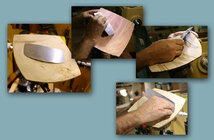
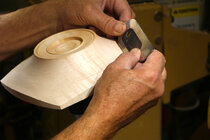
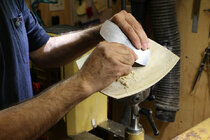
Elbow grease is still widely used by many, including me. I refuse to sand with rotating disks on a drill. I use gouges to cut as cleanly as I can, clean up gouge marks with negative rake scrapers, then clean up NRS marks with hand scraping. Then sand by hand. I often start with 400 grit but have one piece I show at demos that the only sandpaper that had touched it was 600 grit.

The real key to all this is the scrapers - shaped and sharpened in a way that really works well.

For me, the hand scrapers are a must for all bowls, platters, and other face work. I've taught it in demos, to students. Both the hand scraping and hand sanding are easier off the lathe with the work mounted in a carving/finishing stand. Sorry, I've posted these pictures before but here are just a couple again, working on some of my "small squarish dished platters" (what a mouthful...):


1769817820329.jpeg
1769817855697.jpeg
1769818398184.jpeg
Note that all this is with dry wood.

For hand sanding (also off the lathe or with the lathe not spinning) I usually back up the sandpaper with a soft white "Magic Rub" eraser, what I call a soft sanding block. Works for me.

JKJ
 
What ever happened to elbow grease?
Just thinking here.
The same thing that happened to writing letters or sending postcards to fellow turners to ask questions (or waiting for the monthly club meeting)--people jump online, it's easier.
 
Back
Top