• Congratulations to Bernie Hyrtzak, People's Choice in the January 2026 Turning Challenge (click here for details)
  • Congratulations to David Croxton for "Geri's Basket Illusion" being selected as Turning of the Week for February 2, 2026 (click here for details)
  • AAW Symposium demonstrators announced - If the 2026 AAW International Woodturning Symposium is not on your calendar, now is the time to register. And there are discounts available if you sign up early, by Feb. 28. Early Bird pricing gives you the best rate for our 40th Anniversary Symposium in Raleigh, North Carolina, June 4–7, 2026. (There are discounts for AAW chapter members too) For more information vist the discussion thread here or the AAW registration page
  • Welcome new registering member. Your username must be your real First and Last name (for example: John Doe). "Screen names" and "handles" are not allowed and your registration will be deleted if you don't use your real name. Also, do not use all caps nor all lower case.

Pneumatic drill recommendation for sanding bowls?

I went through a bunch of cheap drills before buying the Dewalt. Hand drills are not designed to running full time like we use them. The cheaper ones just dont have tge quality parts.
Makes sense. Maybe I should just fork up the cash instead of going the cheap route that I tend to take.
 
I have had several different iterations of devices for sanding over the years. I will leave out passive sanders because they just take too long to work in my personal workflow.
I have two of the Sioux electric drills, which are discontinued long ago, but they have the added bonus of the ability to rebuild them.
I have used DeWalt and Makita cordless drills, they work ok but are kind of cumbersome and although I haven't experienced it, a drill isn't meant for that duty cycle of high continuous use.
I have a Grex random orbit pneumatic, and a 80 gallon quiet air compressor , but the Grex can't take much surface pressure and it stops rotating. If you want to talk about Grex, contact Joe at Airbrushing Wood. He is a Grex dealer.
I have bought two different 3" right angle sanders from the autobody side of things, and if you are going to only use 3", Griots Garage random orbit is really nice as the stall is somewhat adjustable.
What I have been using for a couple years now is the Milwaukee M12 sander polisher. It is light weight, seems to have no problem with extended high duty use and the batteries are reasonably priced. I was told about this from a customer and like it alot. The wierd thing about it is it uses a 9.5mm thread on the (nose) pads to attach. We (Turningwood.com) carry really high quality Tim Skilton sanding mandrels (Crafts Supplies Artisan, Lee Valley Skilton) and you can buy a 9.5 to 1/4"x20 adapter off of Amazon. We also sell the Skilton with these adapters.
I have found it to be a solid workhorse, it is what I use full time now. You have to use it on the #1 setting (there is a slide switch) as #2 (for polishing) is just too fast. Bonus though is I can use it for polishing the work that I paint.

Under full disclosure, I own Turningwood.com, which sells (among other things) woodturning abrasives and have done so for 26 years, so I have to buy things to research what works with woodturning and our products. I have also been woodturning and demonstrating for close to that period of time.
If you have questions, feel free to leave them here or email me - steve @turningwood.com

I used Grex for all my airbrush art and with turned bowls stuff. I am happy with the products but a sander that won't rotate is a drag. I think I need stop being such a penny pincher and move up to a nice drill. Milwaukee is spendy but if it lasts it's smart.I will check out your website. Thanks!
 
Elbow grease is still widely used by many, including me. I refuse to sand with rotating disks on a drill. I use gouges to cut as cleanly as I can, clean up gouge marks with negative rake scrapers, then clean up NRS marks with hand scraping. Then sand by hand. I often start with 400 grit but have one piece I show at demos that the only sandpaper that had touched it was 600 grit.

The real key to all this is the scrapers - shaped and sharpened in a way that really works well.

For me, the hand scrapers are a must for all bowls, platters, and other face work. I've taught it in demos, to students. Both the hand scraping and hand sanding are easier off the lathe with the work mounted in a carving/finishing stand. Sorry, I've posted these pictures before but here are just a couple again, working on some of my "small squarish dished platters" (what a mouthful...):


View attachment 84684
View attachment 84685
View attachment 84686
Note that all this is with dry wood.

For hand sanding (also off the lathe or with the lathe not spinning) I usually back up the sandpaper with a soft white "Magic Rub" eraser, what I call a soft sanding block. Works for me.

JKJ
I end up using scrapers, hard and soft sanding blocks, 3d printed forms, paper alone, drills as needed. What ever is best for the job. I do find scrapers the most satisfying!
 
What I have been using for a couple years now is the Milwaukee M12 sander polisher. It is light weight, seems to have no problem with extended high duty use and the batteries are reasonably priced.
I just got one of these a few weeks ago and I really like it.

Previously was using a Milwaukee angle drill. Had velcro strap around the trigger (so I didn't have to hold it). Plugged it into a speed controller (running at about half voltage). And I'd rigged it with a foot switch.
That combo was pretty good, but the drill was wearing out. And M12 sander is lighter and easier to handle for me.
 
I end up using scrapers, hard and soft sanding blocks, 3d printed forms, paper alone, drills as needed. What ever is best for the job. I do find scrapers the most satisfying!

Yay! Another pic I've posted before, but if you didn't see it (or someone else might be interested):
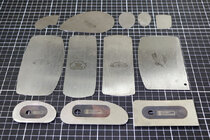
These are some of the scrapers I use, some shaped from cabinet scrapers, those at the bottom are from StewMac who sells things to people who make guitars and violins. The cabinet scrapers get a burnished burr, the StewMac are 1/8" steel, edge ground very slightly concave.

1770132969625.jpeg

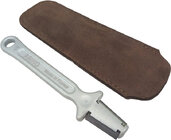
I made them from cheap cabinet scrapers but I think the steel in some name brands is better. The best way I've found to shape cabinet scrapers is with a coarse grit belt sander - I use a 1" belt with 60 grit. I then grind the edge square on a 600 grit CBN wheel, smooth with an extra file diamond hone, then burnish a burr with an ARNO burnisher - the best I've ever tried! (I don't turn the burr twice as for use on flat wood, but just turn a hook down away from the edge.)

1770133530642.jpeg

I got started using scrapers soon after I began turning. Making a bowl from eastern red cedar I followed the bad advice from someone to back up the coarse sandpaper with something to keep your fingers from getting too hot while sanding with the lathe spinning. The problem with this is the heat caused terrible heat checks in the wood on the inside which I couldn't get out.

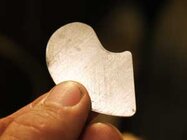
I grabbed a goose neck cabinet scraper and cut the end off with a Dremel, sharpened and added a burr and it worked wonderfully. Then sanded with fine grit with the lathe off. I've been on the scraper soapbox ever since!

1770133256341.jpeg

This is the finished bowl. Wood from a neighbor's tree.

1770133320943.jpeg

JKJ
 
Yay! Another pic I've posted before, but if you didn't see it (or someone else might be interested):
These are some of the scrapers I use, some shaped from cabinet scrapers, those at the bottom are from StewMac who sells things to people who make guitars and violins. The cabinet scrapers get a burnished burr, the StewMac are 1/8" steel, edge ground very slightly concave.

View attachment 84809

I made them from cheap cabinet scrapers but I think the steel in some name brands is better. The best way I've found to shape cabinet scrapers is with a coarse grit belt sander - I use a 1" belt with 60 grit. I then grind the edge square on a 600 grit CBN wheel, smooth with an extra file diamond hone, then burnish a burr with an ARNO burnisher - the best I've ever tried! (I don't turn the burr twice as for use on flat wood, but just turn a hook down away from the edge.)

View attachment 84813

I got started using scrapers soon after I began turning. Making a bowl from eastern red cedar I followed the bad advice from someone to back up the coarse sandpaper with something to keep your fingers from getting too hot while sanding with the lathe spinning. The problem with this is the heat caused terrible heat checks in the wood on the inside which I couldn't get out.

I grabbed a goose neck cabinet scraper and cut the end off with a Dremel, sharpened and added a burr and it worked wonderfully. Then sanded with fine grit with the lathe off. I've been on the scraper soapbox ever since!

View attachment 84810

This is the finished bowl. Wood from a neighbor's tree.

View attachment 84811

JKJ
Fantastic array of scrapers have there. Beauty bowl too! A life time ago, stationed in Japan, I saw a demo of Japanese turner use different thickness/width scrapers to shape and final finish to a highly polished final finish using no sandpaper. Diversity of thought makes everything better.
 
Fantastic array of scrapers have there. Beauty bowl too! A life time ago, stationed in Japan, I saw a demo of Japanese turner use different thickness/width scrapers to shape and final finish to a highly polished final finish using no sandpaper. Diversity of thought makes everything better.

Thanks, I'd love to see that Japanese turner work! On some pieces I can get close to a finished surface with scrapers, but not there yet. Can remove heavy shaving with some. Maybe I'll try some thinner scrapers with less burr. (All these burrs are burnished so they are like smooth knife edges I always sand after scraping, but as said by hand and often with 600.

I have one piece I show students and take to demos that I've divided into four quadrants - one is off the gouge, the second is gouge followed by curved NRS, the third is after hand scraping, and the last is after 600 grit. It is a little hard to tell between the last to by feel so maybe I'm getting closer.

The striking thing to me is the difference between the curved NRS and the hand scraping.

If anyone is interested, I could provide more info about preparing and using hand scrapers. I should break down and make a video sometime - some could be shown better that way. I've touched on this in demos, have one planned a few months from now. Or come visit the shop!

JKJ
 
Back
Top