• The forum upgrades have been completed. These were moderate security fixes from our software vendor and it looks like everything is working well. If you see any problems please post in the Forum Technical Support forum or email us at forum_moderator (at) aawforum.org. Thank you
  • It's time to cast your vote in the March 2026 Turning Challenge. (click here for details)
  • Congratulations to Chris Lawrence for "Dragon's Grip" being selected as Turning of the Week for March 30, 2026 (click here for details)
  • Welcome new registering member. Your username must be your real First and Last name (for example: John Doe). "Screen names" and "handles" are not allowed and your registration will be deleted if you don't use your real name. Also, do not use all caps nor all lower case.

Popular Woodworking - Unicorned Chisel Edges?

Joined
Jul 30, 2021
Messages
917
Likes
282
Location
Aurora, CO
Anyone else read this article on "unicorned" chisel edges?
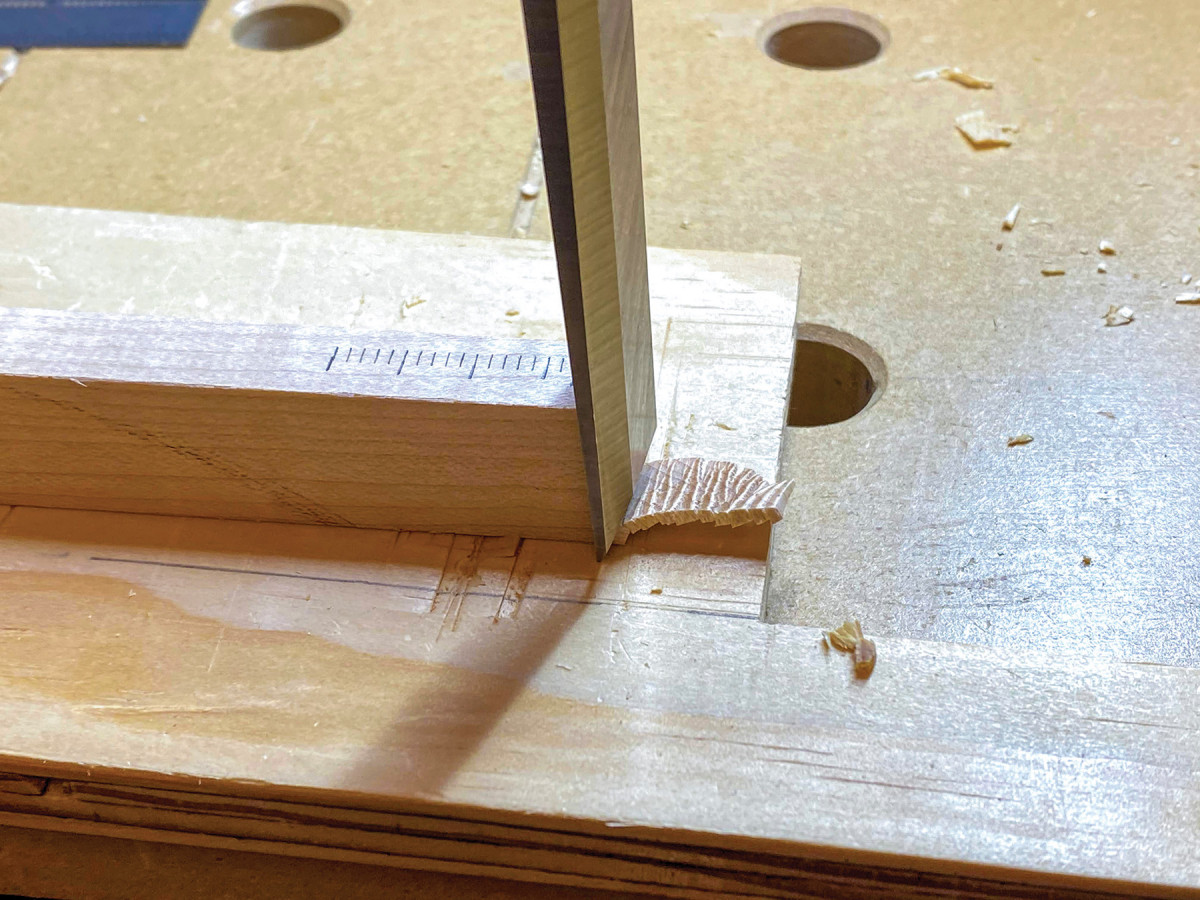

Curious what people's thoughts are. I have always been frustrated with out short lasting my sharpened edges are. This concept of "unicorning" the edge seems intriguing. What they didn't say much about, was performance. Not sure if anyone else has used this technique much. It does intrigue me, as I don't like to have to spend a lot of time sharpening, anything. I recently managed to reduce my gouge sharpening time with a 600 grit CBN wheel that just seems to have a superior grit than my other CBN wheels, and it produces a better and longer lasting edge. Wonder if this would do the same with chisel (or even skew) edges.

 
Well, that wasn't published on April Fool's Day, so...

It just seems to be a micro-micro bevel. An edge is an edge. They happened to create a very, very small bevel that is backed up by a relatively substantial amount of steel. It's all anecdotal until scientific study is used to support or refute the claim.

Personally, I don't mind sharpening, it's part and parcel to being a woodworker of any kind. If I'm turning, I've got to make trips to the grinder. If I'm doing flat board joinery, I'll be at the waterstones and strop. And when that edge sings a pretty song on the lump of wood, I feel happy about both my sharpening efforts and the improved results that fresh edge provides.

There are lots of ways to sharpen edges. Find one that works for you and stick with it. Even if it was through discovering mythical critters.
 
Agree with Steve - I don't think it is anything really new - I get the very same results with a few strokes of my chisel or plane blades on a strop... I see nothing really unique about it, TBH. Have used strop wheels before in knife sharpening as well... and many of us will grind a very fine micro bevel on gouges.... With my chisels (I do a lot of flat work too) I have my strop handy nearby and frequently will re-strop as soon as it "feels like" things aren't cutting as good as they could be. Same with my finely set smoothing planes - no need to go back to sharpening station and go through the grits if you're doing a quick strop often enough, could be quite a while between actual sharpenings.
 
No no no no. Microbevels or stropping bench chisels is a bad idea. Carving tools benefit from this approach as their geometry is different but plane blades and bench chisels do not.

Once the blade has been sharpened a couple times, the bevel becomes so large that the sharpening process has to start all over again, wasting steel and time.

The sharpest edge is when two straight planes intersect. Stropping will slightly round over that edge, creating a false sense of sharpness.
 
Rob Cosman has a reall good video (IMHO) on sharpening a bench chisel. He puts a micro bevel on the flat side.
 
Rob Cosman has a reall good video (IMHO) on sharpening a bench chisel. He puts a micro bevel on the flat side.
Really? The flat (back) side is what registers the chisel against the surface that is not to be cut. Taking the edge away from that plane/surface changes where the fibers will be cut.

I am of the two-surface edge design philosophy. A flat back, and a single-facet bevel meeting at a keen edge. No micro-bevels for me- as the become "larger than micro" over time, they lead to eventual re-grinding of the main bevel rather than simple honing of the main bevel to maintain the angle and a keen edge. But I respect practices performed by others and the results that satify their needs. In woodworking there is almost always more than one mean to an end.
 
Really? The flat (back) side is what registers the chisel against the surface that is not to be cut. Taking the edge away from that plane/surface changes where the fibers will be cut.

I am of the two-surface edge design philosophy. A flat back, and a single-facet bevel meeting at a keen edge. No micro-bevels for me- as the become "larger than micro" over time, they lead to eventual re-grinding of the main bevel rather than simple honing of the main bevel to maintain the angle and a keen edge. But I respect practices performed by others and the results that satify their needs. In woodworking there is almost always more than one mean to an end.
Whoops - my error. I should have said he puts a micro bevel on the bevel of bench chisels. He puts a microbevel on the flat side of his plane blades.
 
Last edited:
Whoops - my error. I should have said he puts a micro bevel on the bevel of bench chisels. He puts a microbevel on the flat side of his plane blades.
Well, then... never mind! Ha!
 
Well, Rob Cosman does have his 30 seconds to sharp method, and he does end up with 3 bevels. Personally, it does not work for me. That is just too many bevels to adjust to, and I have gone to just one bevel. I did just skim through that article about the Unicorn bevel.... As for stropping, it is essential because it removes the burr from sharpening. Rob stops at a 16,000 grit stone. I can still feel a burr from that stone. The whole thing about removing the burr is that the burr is a weak point on the cutting edge, and it needs to be removed for a longer lasting cutting edge. Edge geometry can also make a difference in how long the cutting edge lasts. More acute, and the blade does not keep the edge as long as a more obtuse edge, but the more acute edge will cut with less effort. I strop my skew chisels, ALWAYS! I have had many say that it is not necessary. Maybe it is the newer M42 and V10 metals, but if I strop, it cuts far more easily, and in both directions. The skew chisel was the first negative rake scraper. For me, they just work better when stropped. As far as stropping rounding over the edge, maybe if I used 800 grit/black compounds from the big box store, and spent 30 or more minutes stropping, then it may round over the cutting edge. I don't know of any flat wood workers who do not strop their cutting edges. Biggest difference is how fine of a stone they go to. Many stop at 1000 grit. I do have one of the Shapton 16000 grit stones and use it as the final grit. Take Rex Kruger, James Wright, Matt Estlea, and many others, they ALL strop. There still is a burr after I am done sharpening anything on it. I do have the 30,000 grit stone, but don't use it. It just isn't enough of a step up. Stropping compounds can go as high as 60,000 grit for some, like the green ones from Taylor Tools.

robo hippy
 
Personally, I don't mind sharpening often - that fresh edge is doing a lot of work. Math has never been my long suit, but, on a 12" bowl turning at 850 rpm you're generating a shaving that's 1/2 mile long every 60 seconds. Is there any wonder why that burr doesn't last more than a few seconds or the gouge edge needs a refresh? Getting to a fresh edge with cbn wheels and a grinder just a step away from the lathe takes less than 30 seconds. I was taught to sharpen by my first mentor who could hear a dull edge from the other end of the shop and wouldn't hesitate to loudly point out that a trip the grinder was needed.

I've taken advantage of the newer steels and the angles I've been using have worked well for a couple of decades now. Unless there's some sign that there's a better finish off the tool than I'm getting or I can eliminate several trips to the grinder, or reduce sanding to an afterthought I see no need to modify what has worked so far. Sometimes old dogs don't require new tricks...
 
Myself and Neil Strong published here our efforts to produce long lasting edges on various steels, M42, Tantung, and Tungsten Carbide. The idea was to produce a cutting edge that would/could handle our Aussie hardwoods. The out come was we came up with a Tungsten Carbide tip that had superior edge holding qualities up to 10 time conventional steels. The downside was that in order to get a decent price the capital outlay was too high. There other issues around grinding dust and grinding wheels.
But what we found was the finer the grind the longer the edge lasted on all the materials we tested, in fact many if not all were finished with 1000grit diamond wheels. So now I finish all my edged tools with the 1000grit finish

 
Well, Rob Cosman does have his 30 seconds to sharp method, and he does end up with 3 bevels. Personally, it does not work for me. That is just too many bevels to adjust to, and I have gone to just one bevel. I did just skim through that article about the Unicorn bevel.... As for stropping, it is essential because it removes the burr from sharpening. Rob stops at a 16,000 grit stone. I can still feel a burr from that stone. The whole thing about removing the burr is that the burr is a weak point on the cutting edge, and it needs to be removed for a longer lasting cutting edge. Edge geometry can also make a difference in how long the cutting edge lasts. More acute, and the blade does not keep the edge as long as a more obtuse edge, but the more acute edge will cut with less effort. I strop my skew chisels, ALWAYS! I have had many say that it is not necessary. Maybe it is the newer M42 and V10 metals, but if I strop, it cuts far more easily, and in both directions. The skew chisel was the first negative rake scraper. For me, they just work better when stropped. As far as stropping rounding over the edge, maybe if I used 800 grit/black compounds from the big box store, and spent 30 or more minutes stropping, then it may round over the cutting edge. I don't know of any flat wood workers who do not strop their cutting edges. Biggest difference is how fine of a stone they go to. Many stop at 1000 grit. I do have one of the Shapton 16000 grit stones and use it as the final grit. Take Rex Kruger, James Wright, Matt Estlea, and many others, they ALL strop. There still is a burr after I am done sharpening anything on it. I do have the 30,000 grit stone, but don't use it. It just isn't enough of a step up. Stropping compounds can go as high as 60,000 grit for some, like the green ones from Taylor Tools.

robo hippy

Thanks for the response. I think this cleared things up for me. I do use a stropping panel to remove the burr after I go through the normal sharpening process. I guess, that does much the same thing, although it probably is not putting quite as much of a microbevel on, as the buffing might. I do have a very thin shiny line after I strop to remove the sharpening burr (which sometimes comes off as a little "wire" right off the edge of the bevel.)

FWIW, I follow the Paul Sellers approach to sharpening and stropping. I have two primary stones (don't have an ultra high grit third yet, soon though), and a strop I've coated in green compound. I guess I do have a very slight curvature to the main bevel as well...as I follow Sellers' approach where he slightly rocks the blade (or chisel) as he runs it across the sharpening stone.
 
Personally, I don't mind sharpening often - that fresh edge is doing a lot of work. Math has never been my long suit, but, on a 12" bowl turning at 850 rpm you're generating a shaving that's 1/2 mile long every 60 seconds. Is there any wonder why that burr doesn't last more than a few seconds or the gouge edge needs a refresh? Getting to a fresh edge with cbn wheels and a grinder just a step away from the lathe takes less than 30 seconds. I was taught to sharpen by my first mentor who could hear a dull edge from the other end of the shop and wouldn't hesitate to loudly point out that a trip the grinder was needed.

I've taken advantage of the newer steels and the angles I've been using have worked well for a couple of decades now. Unless there's some sign that there's a better finish off the tool than I'm getting or I can eliminate several trips to the grinder, or reduce sanding to an afterthought I see no need to modify what has worked so far. Sometimes old dogs don't require new tricks...
For my gouges, its usually about 30 seconds.

I've been getting into texturing my work now, and have been experimenting with that a fair bit on junk pieces of wood. I seem to have to spend a lot more time sharpening chisels and hand carving tools, which is why this article piqued my interest.
 
I do like to see the Japanese guys sharpening their plane blades. When done properly, they always finish a pass and leave the blade. It will stand up all by itself at the 45 degree angle just because it is dead flat on the stone.... Me, I am not nearly there....

robo hippy
 
Back
Top