• January 2026 Turning Challenge: Turned and Bent! (click here for details)
  • Congratulations to Phil Hamel, People's Choice in the December 2025 Turning Challenge (click here for details)
  • Congratulations to Clayton Thigpen for "Armillary Sphere" being selected as Turning of the Week for January 19, 2026 (click here for details)
  • Welcome new registering member. Your username must be your real First and Last name (for example: John Doe). "Screen names" and "handles" are not allowed and your registration will be deleted if you don't use your real name. Also, do not use all caps nor all lower case.

Question about my finishing process

Joined
Jan 14, 2020
Messages
327
Likes
133
Location
Austin, TX
Hi, I've been using osmo polyx-oil 3043. This week I did a batch of pieces.
Here are my questions/issues
1) I've been applying and wiping off with the white scratchless pads. When wiping off it kind of leaves streaks. The pads are not really absorbent. Is this ok given point #2 below? or should I use a cloth
2) I have the beall buffing system. This week I applied 1 coat osmo, next day 1 coat osmo next day buffed with red and white compounds.
a) I let the osmo cure for a day before buffing. One of the piece had streaks from wiping with pad and I couldn't really get them out with the buffing pads ( this piece had actually been finished with osmo once before so it's possible these marks were from the first time ). Should I not let it cure before buffing? should I let it completely cure before buffing? I kind of feel that once it cures fully it will be really hard and I wont be able to get the wiping marks out. Maybe I secretly want that to be true because it would mean that osmo is super tough, or maybe I want it not to be true so I can not worry about when to buffing. I don't know
3) I finish sanded my pieces, which were all pecan wood with 400 grit paper. After applying the finish I could see fine sanding marks when looking at the right angle. Super annoying.
a) what the hell? should I sand up to like 800 or something?
b) should I perhaps buff with red and white compound before I apply the osmo?


Thanks for your thoughts. Sorry if this is long and incomprehensible
Raif

 
Howdy Raif, I do not have any experience with Osmo so cannot address that. However, your sanding to 400 or higher is something I do. I have found it is very dependent on the type of wood or even the orientation of the grain if 400 is sufficient to remove visible scratches. I usually consider 400 as a minimum in my small detail style projects. Going up to 500-600 or higher and inspecting my project with my Geezer Glasses and raking light can highlight my sins where I need to go back and do a better job of sanding.
I know when I shoot for a high gloss, the sanding is best above even the 600 grit before I go to any level of buffing. Of course, if you start talking acrylics or anything like that, the sanding needs to go way higher before heading to the buffing wheel. Best of luck and I look forward to other folks response on the Osmo part.
 
I started using Osmo 3043 last year and have been happy with the results. I normally sand to 400 grit then use a clean room pad to wipe on the Finish. I’ll let it sit for no longer than 10 minutes and wipe it off with a soft paper towel. I never get any streaks left on the surface. I’ll let it dry for 24 hours before the second coat. I don’t do any buffing other than a hand buffing with a cotton rag. Osmo will dry in 24 hours but it will take a few weeks or longer to fully cure. I would try the paper toweling to wipe off the excess Osmo since it’s absorbent. Hope this helps.
 
I apply Osmo with the white Scothchbrite pads, wait 5-10 minutes, and wipe off the excess with a cotton rag. This "wiping" is relatively vigorous, almost like scrubbing. The next day I apply a second coat by the same method. I am not always convinced that the second coat is necessary, but I almost always put on the second coat. I then wait 1 week or so and Beall buff, the white diamond wheel only. If I see wiping marks on the cured finish, this means the wiping with the cotton rag was not adequate. I need to remove the wiping marks with 400 grit sandpaper prior to buffing. Is it possible the "fine sanding marks" that you refer to are really wiping marks?

Also, buffing bare wood does refine the surface in a manner similar to higher grit sandpaper and/or abrasive paste. I sometimes buff with Tripoli prior to applying the first Osmo coat. I cannot say I have done a good apples to apples comparison of the sheen achieved from Procedure A = 400 grit sanding + Osmo + buffing versus Procedure B = 400 grit sanding + buffing + Osmo + buffing. I suspect the affect is subtle.
 
1) I've been applying and wiping off with the white scratchless pads. When wiping off it kind of leaves streaks. The pads are not really absorbent. Is this ok given point #2 below? or should I use a cloth...
...3) I finish sanded my pieces, which were all pecan wood with 400 grit paper. After applying the finish I could see fine sanding marks when looking at the right angle. Super annoying.

Never used Osmo but very often use some form of "danish" oil, Watco, similar, or home-made (usually BLO, poly, mineral spirits)

I never apply finish until all scratches are gone. How do you find them? I apply naphtha with a small piece of paper towel. This evaporates quickly and leaves no residue. The liquid drys last in any scratches making them darker and more visible. Good lighting is important - high overhead diffuse lighting is the worst, best is small diameter lights on adjustable stands that can be positioned so the light is at a glancing angle. I apply naphtha, let partially dry, then rotate the piece under the glancing light. I fix any scratches before before going to a finer grit and certainly before applying finish,

I never sand with rotating disks on a drill - instead I sand by hand. For bowls and platters I first smooth with hand scraers which give an incredibly smooth surface with very little sanding - but that's another topic.)

For every grit, I sand, by hand than sand perpendicular to the last sanding - I figure if I can't get out the scratches, say from 220 paper with one grint, it will be difficult or impossible to get them out with the next finer grit. I usually sand to 400 or 600. I often back my sandpaper with a white "magic rub" eraser, a "soft sanding block".

For applying "danish" oil, I
  • Add as much with a piece of paper towel as the wood will absorb.
  • Wait 30 minutes and wipe it all off.
  • Let the oil dry over night.
  • Repeat the next day and following days.
  • I sometimes wet sand with oil and very fine sandpaper between coats. Sometimes with 0000 steel wool.
I usually use from 3-10 coats depending. This will built up an extremely thin and durable layer. If I want a glossy buffed surface let it dry for another week then buff. I rarely want a glossy surface but prefer a soft sheen.)

This method is not recommended for those in a rush!

JKJ
 
I guess I don't understand the application of a finish with abrasive pads. If you want to raise the grain, do it with water, alcohol, etc. before applying the finish. I've had pretty decent results just sanding my pieces, then applying Osmo with a disposable chip brush or rag. I wait about 10 or 15 minutes, apply more, wait more, then then wipe away the excess. I do a repeat coat a day or 2 later, then a light buffing a few days later when they don't feel slimy anymore.
 
It seems that we all have our favourite method. I always aim for a satin sheeen. This is mine with Osmo 3032:
1. Power sand 120gr with disc in drill, to take out all tearout tool marks etc.
2. ditto 180 gr to remove previous scratches
3. ditto 240 gr, if visible scratches remain 240 gr in random orbital sander.
4. if segmented, leave alone for a couple of days, to let glue joints relax, and then repeat step 3, otherwise proceed directly
5. very quick hand sanding with 320 gr,
6. if any visible scratches remains hand sanding with 360 gr abralone
7. wipe on generous amount of Osmo 3032 with tissue paper,
8. let soak in 10 minutes and wipe off with tissue paper, only a barely visible coat should be left, no ridges (brush marks)
9 let dry over night, lightly sand with abralone 360 gr
10 repeat step 7-9 4-5 times
11 final sanding with steel wool 000

Example of the finish I want:
K3_07496LRs.jpg
 
guess I don't understand the application of a finish with abrasive pads. If you want to raise the grain,......
I never considered that the white Scotchbrite was abrasive. But I tried to confirm this and the exact description is hard to find. 3M puts the white color as the "finest" or "least abrasive" 3M literature uses terms like F-SFN (Flint Super Fine) S-ULF (Silicon Carbide Ultra Fine) to describe the different color pads. I did find some non-3M references that put the white pads as equivalent to 1200-1500 grit. Note also that the Osmo site shows different application methods, albeit centered on flat work. White Scotchbrite is one of the methods they promote. The common theme in all of the above posts plus the Osmo website is wiping off the excess.
 
At sometime and do not ask me where, I read that the white Scotchbrite incorporated Talc as the abrasive. Talc is the softest mineral on the Moh’s scale of hardness.
 
3M indicates the abrasive is fine mineral with abrasion equivalent to 0000 steel wool. One advantage over steel wool is in eliminates the problem with rust with certain usage.

I found this:
3M SCOTCHBRITE NYLON PAD GRIT CHART
7445 - White pad, called Light Duty Cleansing - 1200-1500 grit
7448 - Light Grey, called Ultra Fine Hand - 800 grit.
6448 - Green (?), called Light Duty Hand Pad - 600 grit
7447 - Maroon pad, called General Purpose Hand -320 grit
6444 - Brown pad, called Extra Duty Hand - 240 grit
7446 - Dark Grey pad, called Blending Pad 150 grit
7440 - Tan pad, called Heavy Duty Hand Pad - 60(?)
Blue Scotch-Brite is considered to be about 1000 grit.
 
Wow, great responses. Thanks.
I instinctively agree with @Darryl Fective . I do think that rubbing the osmo in is helpful, but I don't know why I would start with scotchbrite. Except that they told me too. I also feel like letting it sit and soak in makes sense. Except I don't. Cuz they didn't tell me to. Hmm. what's wrong with me. I wonder what the exact grit equivalent of "cheap ass Chinese white synthetic steel wool pads" is. Well, anyway, this is all great information and I will digest it all.
I do love Osmo though. I mean it really hits the sweet spot between not having to worry about application at all ( oil finish ) and getting a really strong had finish that is a super pain to get right.
I'd love to hear peoples impressions about it's durability vs say lacquer or poly or something.
Thanks
R
 
Depending on the surface you want you can also use an abrasive to get grain filling. In that, rub on generous amount of oil (does not matter what you use, tissue paper or what, and let it soak in for say 10 min, apply more oil if soaked in and sand with 360 gr or so in the oil. This creates a slurry that fills the pores. Wipe off excess oil.
 
I do love Osmo though. I mean it really hits the sweet spot between not having to worry about application at all ( oil finish ) and getting a really strong had finish that is a super pain to get right.
I'd love to hear peoples impressions about it's durability vs say lacquer or poly or something.
This is a complicated answer to your question. 1. Hardwax oils are used as as finishes on floors and dining room/kitchen tables; this implies some reasonable durability 2. You can find videos on Youtube where durability and degree of protection of many finishes are comparison tested; If I recall, Osmo is not the most protective, for example, in resisting a stain from red wine sitting on the surface for a period of time. 3. In theory, mixing wax with oil or varnish should reduce the hardness and durability of a finish. But I have also read that in a hardwax oil, the oil penetrates into the wood while the wax remains on the surface. In this case, the wax wouldn't compromise the hardness of the oil. 4. In one of my favorite books, Flexner states that oils are much softer than varnishes. However, he doesn't discuss hardwax oils at all. My own experience is that the surface of a piece finished with Osmo is quite hard. (But its not like I went out of my way to scuff it up to compare it to varnish.) I will say that lacquer is definitely easier to damage by dings or scratches. 5. Don't forget that a big advantage of hardwax oils is the ease of repair. 6. It depends on what you are using for. I have only used Osmo on decorative pieces with a glossy sheen. For utility ware, I usually use walnut oil or no finish at all and go with a matte sheen.
 
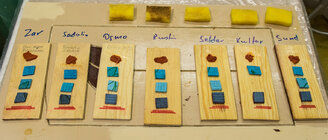
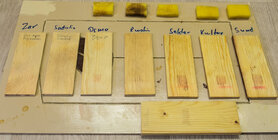
Concerning durability I did a test, there are several on Youtube. This is a comparison I did. Applied 3 coats with drying over night. Final drying one week.
Top to bottom Ajvar relish, water, whisky, red wine, permanent ink marker. Covered with plastic foil over night. Wiped clean next day, denatured alcohol to remove permanent ink marker.
Zar - waterborne polyurethane
Sadolin - waterborne acrylic
Osmo - Osmo 3032
Rustin - Rustin´s Danish oil
Selder - Boiled linseed oil
Kultur - boiled linseed oil
Sund - raw linseed oil
K3_05008LRs.jpgK3_05015LRs.jpg
 
My understanding is that the 3M white non-woven pads don't have any added abrasive beyond the pad itself. However, I don't make the pads, so maybe that's not true.

It only takes a very small amount of Osmo to finish a small object. So one reason to use the WN-W pad to apply Osmo is that it doesn't absorb/waste the material the way a rag or brush would. Another reason is because, however surprisingly, it works ;).

Raif, I would not use a WN-W pad to wipe off excess Osmo. Use a rag (or similar), then use a clean cotton rag to hand buff.
 
Raif, I use Osmo Polyx 3043 (and other Osmo hardwax oil finishes) for some pieces, and I buff after, but some caveats are in order.

Streaks with the white non-woven polyester pads: Yes, this is an issue. As other have noted, these can be avoided by doing the wipe-off with a cotton cloth. The downside (as with other wipe-on-wipe-off finishes) is that you are not leaving much finish on the wood. And you can't really address this by putting on many coats, because the wax in the finish limits both absorption and adhesion. For me, for decorative pieces, this is not an issue, and I do like the Polyx satin finish, but I do not use Polyx when I want a durable finish.

Buffing: I wait at least a week, usually more, to avoid smearing the finish around. I try to get away with fine abrasive (e.g. white diamond or a polishing cream); I only use the tripoli wheel if I have somehow gotten surface issues. I am not looking to buff to gloss: the satin 3043 really just evens-out on the fine buffing wheel.

What should be noted by those puzzling over the many (and often contradictory) suggestions for applying Osmo Polyx, and the highly variable reviews / test results you see, is that it was not developed or formulated for the wipe-on-wipe-off application that turners (and in some contexts cabinet makers, trim carpenters etc.) use. It was developed to go on floors in coats of several mil, never wiped off. (I have it on my maple floors and it has been great.) According to Osmo, this is why Polyx on flooring is very durable but Polyx applied by hand with the wipe-on-wipe-off process, while attractive, often provides much less protection: there is simply not much finish left on the piece. Osmo has struggled to keep this unexpected market--a bonus for a product developed for flooring--when the application method leaves so little finish on the surface. Osmo's own directions have changed radically over time, including from "no more than two coats" (a hangover from the flooring context) to "five to six coats" (which I have found to be way too many, it gets filmy and streaky). You can still find quite different instructions on different Osmo websites and product sheets.


Though, as I say, I do use Polyx, especially when I want an oil finish but don't want the wood darkened much, I would say that Polyx and the other hard wax oils, while easier to apply, don't have anything over a high quality tung oil or similar drying oil finish, and tend to fall short on durability. If I am not in a hurry to get a piece out of the shop, I tend to accept the longer drying times and sometimes extra coats of polymerized tung oil in exchange for the more adaptable and more durable finish.
 
Back
Top