• The forum upgrades have been completed. These were moderate security fixes from our software vendor and it looks like everything is working well. If you see any problems please post in the Forum Technical Support forum or email us at forum_moderator (at) aawforum.org. Thank you
  • Congratulations to Bernie Hyrtzak, People's Choice in the January 2026 Turning Challenge (click here for details)
  • Congratulations to David Croxton for "Geri's Basket Illusion" being selected as Turning of the Week for February 2, 2026 (click here for details)
  • AAW Symposium demonstrators announced - If the 2026 AAW International Woodturning Symposium is not on your calendar, now is the time to register. And there are discounts available if you sign up early, by Feb. 28. Early Bird pricing gives you the best rate for our 40th Anniversary Symposium in Raleigh, North Carolina, June 4–7, 2026. (There are discounts for AAW chapter members too) For more information vist the discussion thread here or the AAW registration page
  • Welcome new registering member. Your username must be your real First and Last name (for example: John Doe). "Screen names" and "handles" are not allowed and your registration will be deleted if you don't use your real name. Also, do not use all caps nor all lower case.

rice bran oil as a finish?

Joined
Oct 25, 2020
Messages
1,401
Likes
1,282
Location
Minneapolis, MN
I was watching a June 2024 Richard Raffan video this morning-
View: https://youtu.be/E9lenkr3Dbc?si=Z1p_p1PwvEy_7XXq

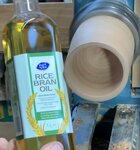
and at about 9:15 he shows a bottle of rice bran oil (he states in the comments it is Aldi Australia supplied) he is going to use, without explanation, as a substitute to his normal unnamed boiled linseed oil. Screenshot from the video-
1000016999.jpg

I wonder to myself- but does it cure (polymerize)? Searching here on this board brought up a thread from a year ago where @Mick Fagan used it, based on watching Raffan use it. This was the only thread I found referring to rice bran oil.

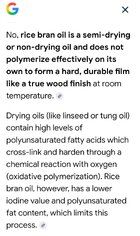
In the discussion, the answer to the question from @Sarah S Elkind about the ability of rice bran oil to fully polymerize into a hard cured finish remained unclear (and even I looked right past the use of this oil when I was part of that thread), so I did what any curious person would do nowadays, I asked Goo-Guhl, "Does rice bran oil polymerize as a wood finish?" Since the art. intel. answer can't seem to be linked directly for posting here, here is a screenshot giving the gist of the answer. If you want to see more, including the AI search result source, search that same question, but the point is made here. Reading further at the source, rice bran oil needs high temperatures, near its smoke temp of about 450°F, to polymerize into a hard, cured film. But, it seems this oil, and this high temp quality, make it ideal for seasoning cast iron and carbon steel cook pans. A silver lining.

Would I use rice bran oil as a wood finish? No. Hopefully, as Mick explained, linseed is once again available in Australia at this time.
1000016997.jpg As Paul Harvey always used to tell us, "Now you know... the rest of the story."
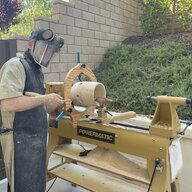

 
I don't want a hard finish on anything utilitarian. Throughout the 1970s and early 80s I finished everything with a cooking oil and beeswax mix. The cooking oils rarely dried, but mixed with the beeswax never leached on to gallery shelves. Then in the mid-1980s I was selling mostly burl bowls full of fissures. I needed an oil that dries and started using boiled linseed oil as my only finish, later mixing that with beeswax on everything without fissures. I’d prefer to use Mike Mahoney’s walnut oil but that’s not available in Australia. I purchased the rice oil when I couldn't find any BLO at my nearest Bunnings.

To me, the advantage of an oil/beeswax finish is that when utilitarian bowls are washed the finish comes off, after which a patina develops with use as it does on a wooden chopping or serving board, wooden plate, wooden salad bowl, or cup. On pieces that won’t get wet, the oil/beeswax is a good base for ongoing care and regular polishing with wax polish or boiled linseed oil that can build to a glossy patina in a few months. My observation is that hard finishes and sealers eventually crack, look terrible, and need refurbishing, whereas my bowls tend to look better with age, use, and ongoing care.
 
Hello @Richard Raffan, I agree with you, I do not care for a hard cured film finish on any woodturnings, utilitarian or display-only. For me, the appeal of penetrating finishes is the ability to feel the wood and its characteristics while seeing the visual enhancements of the finish. Pure tung oil, and for many years now the Tried & True linseed oils, are all that I use. Utilitarian pieces (turnings, utinsels, cutting boards) stay close to home, so for these I use no finishes at all, and just let the natural appearance develop with use.

Congratulations with your new VL200 lathe. Vicmarc lathes have been in my shop for 25 years. What became of your VL150 lathe?

All the best...
 
I too was puzzled by Richard's use of rice bran oil. For me, there is no place for a non-drying oil in wood finishing unless, as in the situation Richard encountered, there was simply no drying oil to be had and the piece had to be finished.

Even then, I wouldn't feel comfortable sending into the world a piece that presents itself as being finished but (as it is only finished with a non-drying oil) will very soon be bare. While it is true that even a drying oil finish will fade away over time, there is a world of difference between the longevity of the finish on a piece with several coats of tung oil versus one finished with a non-drying oil. A good drying oil finish (I prefer tung oil) will have the sought-after in-the-wood oil finish appearance, will endure for a few years, and can be easily renewed.

I also have a number of unfinished items that get stained and generally rough-looking, because I am OK with that: sometimes this has an attractiveness of its own. But when a utility piece is leaving my house, it either has a decent drying oil finish on it or--because the recipient has requested an unfinished piece--it has nothing on it.
 
Vegetable oils do not cure and harden, EVER, unless they are heated like when you are seasoning a cast iron skillet. Nut oils will cure and harden, but at a very slow rate. This is why tung oil and walnut oil have long been used. Apparently they used to use walnut oil for mixing with paint/pigments for oil painting before some one thought of using linseed oil. I don't know if that gets used on wood bowls or not. I am sure there are other oils that will slowly cure and harden. I do have some "hard wax" oil that is used a lot in Europe on floors, and sold as LED oil. It is supposed to cure instantly under UV lights. You don't want to have unshaded windows if you are doing floors. Not sure why they call it LED oil since it cures with UV light, and I guess the UV light will accelerate the curing of walnut oils. Apparently there is bad PR with the term UV. Side note, animal fats never cure and harden. My grandma cooked everything in half lard and half bacon grease. In researching how to "season" cast iron cook ware, many warn against using animal fats to season cast iron cook ware because it can go sour.

robo hippy
 
I don't want a hard finish on anything utilitarian. Throughout the 1970s and early 80s I finished everything with a cooking oil and beeswax mix. The cooking oils rarely dried, but mixed with the beeswax never leached on to gallery shelves. Then in the mid-1980s I was selling mostly burl bowls full of fissures. I needed an oil that dries and started using boiled linseed oil as my only finish, later mixing that with beeswax on everything without fissures. I’d prefer to use Mike Mahoney’s walnut oil but that’s not available in Australia. I purchased the rice oil when I couldn't find any BLO at my nearest Bunnings.

To me, the advantage of an oil/beeswax finish is that when utilitarian bowls are washed the finish comes off, after which a patina develops with use as it does on a wooden chopping or serving board, wooden plate, wooden salad bowl, or cup. On pieces that won’t get wet, the oil/beeswax is a good base for ongoing care and regular polishing with wax polish or boiled linseed oil that can build to a glossy patina in a few months. My observation is that hard finishes and sealers eventually crack, look terrible, and need refurbishing, whereas my bowls tend to look better with age, use, and ongoing care.
Richard, after watching your videos many times over, I use a mixture of Mahoneys walnut oil and beeswax as my go to finish followed by a pure beeswax rub as you do. . This mixture has been around on the internet forever I think. I like the results as do the recipients of my bowls. If I could I would happily trade you several bottles of Mahoney's oil for some of the color coated sandpaper you use. Craft Supplies carried it for some time but no longer stock it and there do not seem to be good alternatives here.
 
Richard, after watching your videos many times over, I use a mixture of Mahoneys walnut oil and beeswax as my go to finish followed by a pure beeswax rub as you do. . This mixture has been around on the internet forever I think. I like the results as do the recipients of my bowls. If I could I would happily trade you several bottles of Mahoney's oil for some of the color coated sandpaper you use. Craft Supplies carried it for some time but no longer stock it and there do not seem to be good alternatives here.
Tried and True Original is linseed oil and beeswax, if that interests you. Nothing else. No dryers, etc.
 
I am 99% certain this (below) is the source of the color coded sandpaper in Australia. Tariffs and shipping notwithstanding, $0.70 US buys you $1.00 of Australian goods right now.

Here is a message I posted a month ago about this sandpaper. Looks like emery abrasive, though, not aluminum oxide.

Post in thread 'Sandpaper for Spindles' https://www.aawforum.org/community/threads/sandpaper-for-spindles.25030/post-284169

Some more info on the different sandpaper abrasives out there-
 
Thanks Steve. I believe this is the same “sandpaper” I was buying from Craft Supplies and that Richard Raffan uses. At least it is the website listed on the stuff I have. I asked them some time ago and these said they do not ship to the US. I have asked again to be sure.
 
Back
Top