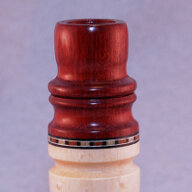
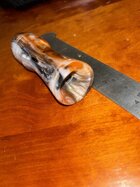
Howdy George, Acrylics are a bit different in my experience than when sanding wood. You can't rush the grits. Let me explain. When I do acrylic, I start with the courses grit and that is my woodturning tool. I have used both High Speed Steel (HSS) and carbide and carbide negative rake. They all can work well. But, you need to do everything you can at this stage to make it easier at the next. Clean cuts. Take your time and stop the lathe to evaluate how you are doing. There is a learning curve to each tool. And SHARP. Always sharp.
LIFE IS TOO SHORT FOR CHEAP SANDPAPER. Learn it. Live it. Love it.
When it is time to sand, I usually can start at 320 and sometimes when needed 220. But the method is always the same.
Sometimes I cut my sandpaper, and other times I tear it. In an acrylic call project where there are coves, I might tear the paper. A sharp cut edge may not glide (Yes, glide) along the cove shape and dig into an area you don't want it to. The softer edge on torn paper is gentler. Given that hint, when I say "cut" you might be looking at tearing and folding in edges of the paper to make a perfect sanding tool for different areas of the form. Another thing is I only use a single layer of sandpaper between my fingers and the project. It increases my control and keeps me from applying too much pressure (and heat).
Of course, a sharp fold in sandpaper can make a great sanding tool when needed.
320 Right after the tool I start here but if you need 220, go for it. Choose the right tool for the job. The surface may have ripples that I might or might not see, but I will be able to feel them. Cut a strip of 320 about an inch wide and use it as a single layer. Stretch this strip between your hands at 90 degrees to the spin of your spindle shape. Do not apply finger pressure on the paper. let the paper FLOAT across the surface for a few seconds while moving left and right. Stop the lathe and inspect. Where it sanded are you high spots and not sanded are the low spots. Your goal is to blend these and get your project to your liking. Don't mow over your details. Try the keep those crisp. Details might need to wait for a finer grit to retain their crisp shapes. When this is complete, the entire surface will have consistent scratch patterns.
400 Do the same thing with the 400 until all the 320 radial scratches are gone. Move the paper around to fresh surfaces to avoid building heat. If you are feeling heat while sanding, you are not allowing the sandpaper to work correctly and could also be heat damaging your project. Right now you have all radial scratches. Stop the lathe and sand with the 400 along the length of the smooth areas and inspect. Do this until you determine you need to go back and sand with the lathe running to get spots you missed or have all the radial scratches gone. You may need to adjust this plan to accommodate the shapes and forms of your project.
500 and/or 600 Same as the 400 grit Take your time! It should only take a few minutes if you did everything at 400 correctly, then these go quick.
At this point, Acrylic people will probably keep going. Wood folks may not need to go to a higher level of sanding and then choose to go with compounds, waxes, buffing, or the finish of their choosing.
1200 (ish) At this point I have a very high quality 1200 (9 micron) sand paper that I use. Some people like to use those sanding paste products that are all the rage these days. I have some, but don't like them because the waxes can interfere with finishes bonding to the material. I also don't like them because if used, they may clog my Micro-Mesh Sandpapers or the grit get imbedded into my polishing wheel. I use the 1200 the same way as the previous grits. Although I need to reduce speed (500-800) on the lathe since the soft cloth backing on my papers from this point on can easily melt. At this time even if you are not 40 years old or higher... (Sorry) get out your Geezer Glasses and inspect. A raking light will help here! Look for a consistent surface everywhere. If not, go back and fix it. (For those of you who might be offended at the thought of wearing Geezers, DON'T BE! What a valuable addition to your tool arsenal! in this process, I was wearing mine at the point I put my acrylic blank on the lathe!)
3 Micron Here is a step I always include because I have it and it has never failed when I get into a super fine detail that my Micro-Mesh can not access because it is too thick. My 3M soft cloth 3 Micron Pink paper is sold for jewelers to use, but I use it also. It is just a problem solver for me. Your set of Micro-Mesh pads will do the same thing as you work up those grits towards 12,000.
Micro-Mesh Miricle product worth every penny. go all the way through the grits. Take your time. Water or no water is up to you. I don't use water as I am too much of a messy person already and playing in the mud compounds the problem. But, what I I do is 500-800 rpm and rotate the sanding pads around to prevent heat and debris build up in any spot. I also wipe off the dust from the pads often to increase sanding efficiency and the life of the pads.
Buffing! Final step!
Beal Buff is not the solution for those who want to try it, great. But be warned, the grits used there are coarser than the process I just described above. Here you have two choices a finishing compound at the buffing wheel or carnauba wax or similar and buffed out. Some folks use automotive paint buffing products, and I gave up on experimenting with those long ago. I found a wonderful product the Tiny Turner suggested a while back and really like it. Menzerna tan very fine high gloss. Difficult to find and comes in a block that will last three lifetimes, but I like it.
My buffing wheel is a dedicated one use only tool. I keep it covered when not in use and also the block of compound covered in plastic to keep chips and dust off. I learned that lesson the hard way.
I hope this helps.
I also hope Mr. John K. Jordan does not feel challenged about the length of my story here... he is the king of detailed responses... ;-)