• January 2026 Turning Challenge: Turned and Bent! (click here for details)
  • Congratulations to Phil Hamel, People's Choice in the December 2025 Turning Challenge (click here for details)
  • Congratulations to Clayton Thigpen for "Armillary Sphere" being selected as Turning of the Week for January 19, 2026 (click here for details)
  • Welcome new registering member. Your username must be your real First and Last name (for example: John Doe). "Screen names" and "handles" are not allowed and your registration will be deleted if you don't use your real name. Also, do not use all caps nor all lower case.

Scrapers and understanding the forces behind them?

Joined
Jul 9, 2010
Messages
22
Likes
18
Location
Webster, NY
I recently reread the recent thread on negative rake scrapers, https://www.aawforum.org/community/threads/negative-rake-scraping.25073/#post-284343
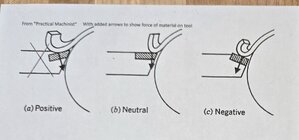
There was only one comment by Dave Landers on the forces that are at play with straight (standard) scrapers and negative rake scrapers (NRS). For the record I use NRS almost exclusively. They are easily controlled and almost never catch on wood. (If you want a catch with a NRS, use it on a PVC plumbing fixture at high speed. It is soft enough that it will catch.) We all understand that straight scrapers can easily catch. I have heard several respected demonstrators say that tilting a straight scraper down to a NRS angle makes it perform just like a NRS scraper. This is not my experience.
My question is has anyone figured why straight scrapers tend to self feed and NRS don't? Can anyone generate a force diagram for these? If I can understand the forces behind the scrapers I might be able to set up straight scrapers to be as safe and easy to use as a NRS.
Cheers,
 
I find lifting the handle to make the scraper negative puts it in a trailing mode and the chances there of catch minimal to say the least. The straight scraper is higher up at the centre, here you can easily slip into catch mode by letting your attention slip, especially if you have a large round scraper and the leading edge is allowed to come in contact with the work.
I have several flat and thin scraper 3mm thick that are curved for working inside hollow vessels, shear scraping the bottom half of the scraper works well but if I engage the upper half in the slightest way its all over. The top edge is not supported and over it goes, bang! I'm in trouble.
 
Every scraper will never get a catch if you keep the end of the end of the handle higher than the burr on the cutting edge. The physics is such that you can not put enough power through your hand and arm to resist that big cutting edge without a bevel rubbing. You can make a scraper cut a curl and control it from digging in if you have full contact with the bevel, But get somewhere in the middle and you get a disaster. Remember, all styles of scrapers are supposed to have the burr do all the work. Get out your Richard Raffen books and start reading.
 
Last edited:
I think Richard Findley covered it in one video he did. Why the NRS doesn't catch is because of the top angle. You have to drop your handle really far in order to get that surface level to where it might get a catch. I use scrapers as my primary tool for roughing out bowl blanks, mostly a 1 inch Big Ugly tool. I did a video "Scary Scrapers" a while ago. I think the main thing that gets people into trouble with scrapers is using one that is too big. This mostly happens when sweeping across the bottom of a bowl and not pivoting when you get into the transition area and you get way more metal/cutting surface into the wood which even I would have trouble controlling. I don't have any scrapers over 1 inch wide for that reason. Also, I do not hang out very far off of the tool rest which is part of why I invented my inside bowl rest which Robust now sells. It fits into the inside of a bowl far better than a straight rest.

robo hippy
 
I think Richard Findley covered it in one video he did. Why the NRS doesn't catch is because of the top angle. You have to drop your handle really far in order to get that surface level to where it might get a catch. I use scrapers as my primary tool for roughing out bowl blanks, mostly a 1 inch Big Ugly tool. I did a video "Scary Scrapers" a while ago. I think the main thing that gets people into trouble with scrapers is using one that is too big. This mostly happens when sweeping across the bottom of a bowl and not pivoting when you get into the transition area and you get way more metal/cutting surface into the wood which even I would have trouble controlling. I don't have any scrapers over 1 inch wide for that reason. Also, I do not hang out very far off of the tool rest which is part of why I invented my inside bowl rest which Robust now sells. It fits into the inside of a bowl far better than a straight rest.

robo hippy

Robo is correct here.....in that it's imperative to have the tool rest close to the work for less overhang.

I'm one of the lucky ones here to have a couple of Robo's curved interior tool rests.

Standard scrapers are more aggressive than NR scrapers, and this is why they still are very popular with those who know how to use them to their best advantage. There is a time and place for BOTH! :)

=o=
 
Back
Top