• The forum upgrades have been completed. These were moderate security fixes from our software vendor and it looks like everything is working well. If you see any problems please post in the Forum Technical Support forum or email us at forum_moderator (at) aawforum.org. Thank you
  • April 2026 Turning Challenge: Salad Bowl! (click here for details)
  • Congratulations to David Bartell, People's Choice in the March 2026 Turning Challenge (click here for details)
  • Congratulations to Gianni Di Gregorio for "Simple Piercing" being selected as Turning of the Week for April 20, 2026 (click here for details)
  • Welcome new registering member. Your username must be your real First and Last name (for example: John Doe). "Screen names" and "handles" are not allowed and your registration will be deleted if you don't use your real name. Also, do not use all caps nor all lower case.

Shiny finishes with Tung oil?

Tru-Oil, mktd for gun stocks. Gloss only I believe.

Tru-Oil is gloss, however the gun stocks I've used it on were never glossy. Apply the Tru-Oil, then use a padding/rubbing technique with powdered abrasive - first pumice then rottenstone. Last one was walnut came out great. The pumice is coarser and can fill in the pores and flatten smooth/flatten the surface. Repeat with rottenstone to the level of satin sheen desired (prob about a 2000 grit). These both come as powder and are used with some liquid lubrication such as water or some type of non-polymerizing oil. The methods used for gun stocks work well on woodturnings and can be used on a variety of finishes. A little goes a LONG way. I bought cans of both grits 10 years ago and they are still mostly full.

In my experience, the Tru-Oil finish is quite tough, practically impervious to damage by the elements. Could probably scratch it by fighting off a bear with the butt of the stock but I haven't experimented with that.

My earlier warning about Tru-Oil is unchanged - in my experience once opened, it can quickly set up in the bottle unless the air is displaced with an inert gas. I use argon.

JKJ
 
@Jon Rista a thought just occurred to me (can be dangerous, I know). I mentioned TruOil earlier, and then their is the aspect that you need to do this egg finish off the lathe. I think the type of finish you are after is about = to high end gun stock finishes. I know some about how they are achieved, but I think some research into it could possibly provide some good information. This would be a good one to use an AI bot to filter through the gargantuan amount of info about gunstock finishes.

Thanks for the insight, Doug. I'll check it out...I'm curious, is finishing gunstock, similar in any way to french polishing or other heavily rubbed-in finishing processes?

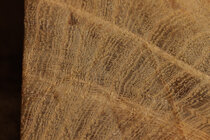
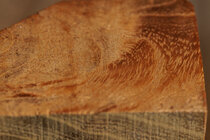
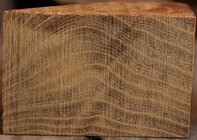
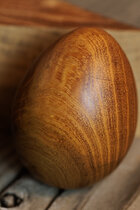
Here are some shots of the eggs I felt needed a glossy finish to really bring out the chatoyance. Two I shared not too long ago, for a wood id (consensus was some variety of plum, probably well-aged plum wood.) The other, is this unknown cutoff I bought for about a buck at Rockler from their cutoff bin. It has some wonderful figure with a lot of chatoyance, but it doesn't shimmer much unless its glossy. Hence...where I'm at. ;) Hopefully one of you will be able to identify the wood. It is porous, however, I am continuing to sand it...I've been wet sanding with the tung oil. I finished through 800 grit, and I have 1000/1200, 1500, 2000 and 3000 grits as well. It IS getting smoother, and more and more visible (but fine) scratches are being eliminated with each grit. I am hoping by 2000 all visible scratching is totally gone. The wood IS porous, you can see that in the remaining chunk of the wood that is left over after turning the egg. The egg, however, the pores seem to be getting filled in fairly well with the oil-wet sanding.
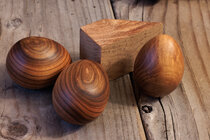
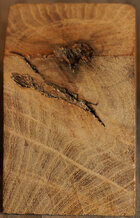
Wood Finishing 001 - Polishing and Gloss Finishing Eggs-1.jpg

Close ups of the unknown wood egg and offcut:

Wood Finishing 001 - Polishing and Gloss Finishing Eggs-2.jpg

Wood Finishing 001 - Polishing and Gloss Finishing Eggs-3.jpg


Wood Finishing 001 - Polishing and Gloss Finishing Eggs-4.jpg
 
Identifying mystery wood:
Read this article on the Wood Database.
Follow the instructions in section "7. LOOK AT THE ENDGRAIN." It's fun and useful to learn how to do this.
Or you can get professional help. See the "STILL STUMPED?" section at the bottom (before the comments)

JKJ
 
Jon, I use thinned poly wet sanded at 320 and then wiped off, then 400 several days later. Wait at least a week or two, then buff for a beautiful glow. I have to go to 600 on black walnut (it show fine scratches more than most woods). The thinning of the poly keeps it from getting tacky while sanding. I don't drench the wood with finish because that will greatly extend the curing time. So much advice, so little time.
Good luck!
 
Back
Top