• The forum upgrades have been completed. These were moderate security fixes from our software vendor and it looks like everything is working well. If you see any problems please post in the Forum Technical Support forum or email us at forum_moderator (at) aawforum.org. Thank you
  • It's time to cast your vote in the April 2026 Turning Challenge. (click here for details)
  • Congratulations to Ted Pelfrey for "Cherry Blossoms on Cherry" being selected as Turning of the Week for April 27, 2026 (click here for details)
  • Welcome new registering member. Your username must be your real First and Last name (for example: John Doe). "Screen names" and "handles" are not allowed and your registration will be deleted if you don't use your real name. Also, do not use all caps nor all lower case.

Shiny finishes with Tung oil?

Tru-Oil, mktd for gun stocks. Gloss only I believe.

Tru-Oil is gloss, however the gun stocks I've used it on were never glossy. Apply the Tru-Oil, then use a padding/rubbing technique with powdered abrasive - first pumice then rottenstone. Last one was walnut came out great. The pumice is coarser and can fill in the pores and flatten smooth/flatten the surface. Repeat with rottenstone to the level of satin sheen desired (prob about a 2000 grit). These both come as powder and are used with some liquid lubrication such as water or some type of non-polymerizing oil. The methods used for gun stocks work well on woodturnings and can be used on a variety of finishes. A little goes a LONG way. I bought cans of both grits 10 years ago and they are still mostly full.

In my experience, the Tru-Oil finish is quite tough, practically impervious to damage by the elements. Could probably scratch it by fighting off a bear with the butt of the stock but I haven't experimented with that.

My earlier warning about Tru-Oil is unchanged - in my experience once opened, it can quickly set up in the bottle unless the air is displaced with an inert gas. I use argon.

JKJ
 
@Jon Rista a thought just occurred to me (can be dangerous, I know). I mentioned TruOil earlier, and then their is the aspect that you need to do this egg finish off the lathe. I think the type of finish you are after is about = to high end gun stock finishes. I know some about how they are achieved, but I think some research into it could possibly provide some good information. This would be a good one to use an AI bot to filter through the gargantuan amount of info about gunstock finishes.

Thanks for the insight, Doug. I'll check it out...I'm curious, is finishing gunstock, similar in any way to french polishing or other heavily rubbed-in finishing processes?

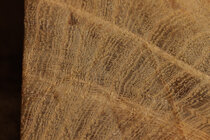
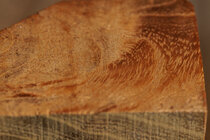
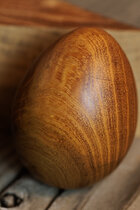
Here are some shots of the eggs I felt needed a glossy finish to really bring out the chatoyance. Two I shared not too long ago, for a wood id (consensus was some variety of plum, probably well-aged plum wood.) The other, is this unknown cutoff I bought for about a buck at Rockler from their cutoff bin. It has some wonderful figure with a lot of chatoyance, but it doesn't shimmer much unless its glossy. Hence...where I'm at. ;) Hopefully one of you will be able to identify the wood. It is porous, however, I am continuing to sand it...I've been wet sanding with the tung oil. I finished through 800 grit, and I have 1000/1200, 1500, 2000 and 3000 grits as well. It IS getting smoother, and more and more visible (but fine) scratches are being eliminated with each grit. I am hoping by 2000 all visible scratching is totally gone. The wood IS porous, you can see that in the remaining chunk of the wood that is left over after turning the egg. The egg, however, the pores seem to be getting filled in fairly well with the oil-wet sanding.
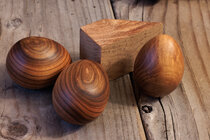
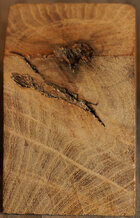
Wood Finishing 001 - Polishing and Gloss Finishing Eggs-1.jpg

Close ups of the unknown wood egg and offcut:

Wood Finishing 001 - Polishing and Gloss Finishing Eggs-2.jpg

Wood Finishing 001 - Polishing and Gloss Finishing Eggs-3.jpg


Wood Finishing 001 - Polishing and Gloss Finishing Eggs-4.jpg
 
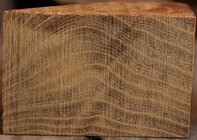
Identifying mystery wood:
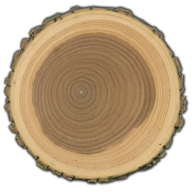
Read this article on the Wood Database.
Follow the instructions in section "7. LOOK AT THE ENDGRAIN." It's fun and useful to learn how to do this.
Or you can get professional help. See the "STILL STUMPED?" section at the bottom (before the comments)

JKJ
 
Jon, I use thinned poly wet sanded at 320 and then wiped off, then 400 several days later. Wait at least a week or two, then buff for a beautiful glow. I have to go to 600 on black walnut (it show fine scratches more than most woods). The thinning of the poly keeps it from getting tacky while sanding. I don't drench the wood with finish because that will greatly extend the curing time. So much advice, so little time.
Good luck!
 
Jon, I use thinned poly wet sanded at 320 and then wiped off, then 400 several days later. Wait at least a week or two, then buff for a beautiful glow. I have to go to 600 on black walnut (it show fine scratches more than most woods). The thinning of the poly keeps it from getting tacky while sanding. I don't drench the wood with finish because that will greatly extend the curing time. So much advice, so little time.
Good luck!

I might need to go to 600, as this wood is a bit porous like walnut. Do you use just a single coat, and still get a glossy finish?
 
I might need to go to 600, as this wood is a bit porous like walnut. Do you use just a single coat, and still get a glossy finish?
any sanding is done wet and then wiped off. all produce a nice gloss. Sanding at finer grits helps on harder woods that show fine scratches. Red oak does great with only one wet sanded coat.
Note: I dry sand to 220 on the lathe.
Hope that helps.
 
I use Tallahassee pure tung oil and dilute 50% with paint thinner or mineral spirits (DNA doesn't play well with tung oil as it separates). Like the OP, I will use multiple coats allowing the first few coats to soak in. I can usually do several coats in a few hours and then let it dry for 24 before reapplying. The oil will cure within 72 hours where BLO usually cures quicker. After the 72 hours I can then apply more coats to the desired look and then buff it after the final drying period. It gives a satin sheen finish look. It is also good as a base before using other finish types and because of the way it penetrates deep into the wood, you don't waste finish that would normally soak into the wood before you can get a good buildup finished look.
 
Pure, 100% tung oil is widely considered food safe.

Might be useful to read this:

JKJ
 
Lou, I’ve been experimenting with Tallahassee pure tung oil. I was wondering how durable it is for food bowls. I’d appreciate your thoughts.
I'm not Lou, but the first few coats of tung/linseed/walnut oil penetrate the wood and polymerize in the wood fibers. Once polymerized, it is essentially a cured, natural "plastic". Food contact and washing will not pull the cured oil out of the wood fibers. The surface will take on a bit of wear and patina, but should look great as time goes by. You're in good shape with cured pure tung oil, just give it a good month, maybe more, to fully cure/polymerize before food and washing.
 
Thanks for the responses folks. My question was about the durability. If you have used it on food bowls and then used the bowls for any length of time, how has it held up?
 
any sanding is done wet and then wiped off. all produce a nice gloss. Sanding at finer grits helps on harder woods that show fine scratches. Red oak does great with only one wet sanded coat.
Note: I dry sand to 220 on the lathe.
Hope that helps.
Thanks Jonathan. This is the approach I'm taking here. The first egg is pretty hard wood (I've tried to identify it but have not conclusively found anything that seems to be a good fit). I can see scratch marks in certain places from the original grits (I think I started at 220, as the initial turning was pretty smooth, but on this wood even that left scratch marks in certain places that I can still see.)

Is there any need to leave any degree of slight roughness for the finish to hold onto, or can I sand as smooth as possible for maximum shine? I'd sand up to 2000 grit here, if I can, to make sure this is as shiny as possible. I'll be using the minwax gloss poly on it.
 
I use Tallahassee pure tung oil and dilute 50% with paint thinner or mineral spirits (DNA doesn't play well with tung oil as it separates). Like the OP, I will use multiple coats allowing the first few coats to soak in. I can usually do several coats in a few hours and then let it dry for 24 before reapplying. The oil will cure within 72 hours where BLO usually cures quicker. After the 72 hours I can then apply more coats to the desired look and then buff it after the final drying period. It gives a satin sheen finish look. It is also good as a base before using other finish types and because of the way it penetrates deep into the wood, you don't waste finish that would normally soak into the wood before you can get a good buildup finished look.

Thanks for the not about DNA vs. mineral spirits.

Sounds like buffing is really what brings out the shine. I have the beall three wheel system. What buffing compounds do you use? Trip and WD, or something else?
 
Pure, 100% tung oil is widely considered food safe.

Might be useful to read this:

JKJ

I've been making some food contact products lately. Was going to finish with food safe mineral oils, but, I am a fan of tung oil. I don't think pure unthinned tung oil will penetrate well, though.... Anyone know if there are food safe mineral spirits it could be thinned with for deeper penetration?
 
Thanks for the responses folks. My question was about the durability. If you have used it on food bowls and then used the bowls for any length of time, how has it held up?
A neighbor of mine has had a bowl I made her with tung oil on it for two years. I asked her the other day how it's holding up since she actually uses it for its intended purpose. She puts salad in it and dresses the salad before serving it from this bowl to smaller individually sized bowls to eat from. Then she washes it with soap and water and dries it immediately. She said it looks as good as when she got it. I use Sutherland Welles original high gloss tung oil and reduce it with food grade di limonene orange thinner for the first coat then use it full strength for successive coats. I usually do 4 to 6 coats. I allow at least a month cure time before I let a bowl go to a new owner. I tell them it's listed as food safe but the ultimate decision is theirs because as stated in other threads different people react differently to different products.
 
Lou, I’ve been experimenting with Tallahassee pure tung oil. I was wondering how durable it is for food bowls. I’d appreciate your thoughts.
I've been making some food contact products lately. Was going to finish with food safe mineral oils, but, I am a fan of tung oil. I don't think pure unthinned tung oil will penetrate well, though.... Anyone know if there are food safe mineral spirits it could be thinned with for deeper penetration?
Tung oil is the most resilient oil finish, so it is a good option for a bowl finish. Pure tung oil; that is, pure, unmodified and unthinned tung oil--can build to a very durable finish, but it is not the best way to work with tung oil; some would say it is not a good way at all. Pure tung oil is thick and difficult to apply, and it takes forever to cure. Polymerized tung oil cures much more quickly and cures to a more resilient finish.

Polymerized tung oil is often (though not always) thinned with solvents, typically mineral spirits, which aid in application, penetration and drying time. While I consider a tung oil finish that has been thinned with mineral spirits to be food safe when cured, others worry about this, and so to answer Jon's question, you can get polymerized tung oil that is thinned with citrus-based solvents. The one I like is the Sutherland Welles Botanical Polymerized tung oil. It is available in various gloss levels (which result from different solvent proportions, not matting agents), or you can buy the high gloss and the citrus solvent separately and mix your own gloss level.

You can get a very good looking and durable finish on a bowl with this SW finish. I don't think it is any more food safe than the normal (mineral spirits thinned) SW polymerized tung oil, which is my go-to finish for most things, but people who worry about finishes that contain products like mineral spirits feel better about citrus solvents, and in my experience both SW finishes behave the same. So, for a few dollars more a quart, I am willing to use the botanical line for bowls and plates and cutting boards. And it makes the shop smell nice for a few days.
 
Back
Top