• The forum upgrades have been completed. These were moderate security fixes from our software vendor and it looks like everything is working well. If you see any problems please post in the Forum Technical Support forum or email us at forum_moderator (at) aawforum.org. Thank you
  • April 2026 Turning Challenge: Salad Bowl! (click here for details)
  • Congratulations to David Bartell, People's Choice in the March 2026 Turning Challenge (click here for details)
  • Congratulations to Gianni Di Gregorio for "Simple Piercing" being selected as Turning of the Week for April 20, 2026 (click here for details)
  • Welcome new registering member. Your username must be your real First and Last name (for example: John Doe). "Screen names" and "handles" are not allowed and your registration will be deleted if you don't use your real name. Also, do not use all caps nor all lower case.

Source for Turquoise

Joined
Jul 5, 2015
Messages
421
Likes
4,183
Location
Strongsville, Ohio
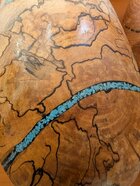
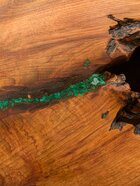
I like to use turquoise chips inlay on many of my pieces. I frequently use man-made turquoise, which can be either synthetic rock or a resin. My current batch is from Tuckers Turnings and is resin based, and the color is much closer to blue than green. Recently I picked up some (unlabeled) stone chips at a club auction that were much more green than blue. I really like the green tint and am looking to find some more. If any of you have a lead for more greenish turquoise, I would appreciate it. As I look at it, I wonder if it is not turquoise at all but something like malachite. I have attached photos of the blue and green varieties. PXL_20260314_161927040.jpgPXL_20260314_161849294.jpg
 
Seen lots of different grades on Etsy, from powders to coarse sand to chips,
Does it sand flat pretty easy? Am trying to get up the nerve to try something like that, not really on a turning to start but on a table top.
 
Seen lots of different grades on Etsy, from powders to coarse sand to chips,
Does it sand flat pretty easy? Am trying to get up the nerve to try something like that, not really on a turning to start but on a table top.
sanding, nah not really, so I go for very fine powder and CA glue. But then I am only using it on turnings and in small amounts compared to a table top etc.
 
Years ago, a member of our club who sold work in hoity toity galleries gave a demo on inlaying turquoise. This was well before it became commonplace. He said when he wintered in Arizona he would go to flea markets and buy strands of small pieces for less than $10, and they were very easy to lay into a cut groove and then level. 10 years or so ago, not being a snowbird, I bought some strands of turquoise like he described at a local bead store. When I went to level them, I discovered that they were all white inside, and not turquoise at all. Caveat emptor.
 
sanding, nah not really, so I go for very fine powder and CA glue. But then I am only using it on turnings and in small amounts compared to a table top etc.
Hughie, I tried some powder as an alternative for the same reason. Turns out that we have so much static electricity here in the desert that the stuff would leap off of my spatula, finger, or even the turning itself and plaster on to something else. I alternately laughed and cursed my way through that first tuquoise powder experiment. I think that I'm going to try something just a bit coarser next.
 
Last edited:
I like to use turquoise chips inlay on many of my pieces. I frequently use man-made turquoise, which can be either synthetic rock or a resin. My current batch is from Tuckers Turnings and is resin based, and the color is much closer to blue than green. Recently I picked up some (unlabeled) stone chips at a club auction that were much more green than blue. I really like the green tint and am looking to find some more. If any of you have a lead for more greenish turquoise, I would appreciate it. As I look at it, I wonder if it is not turquoise at all but something like malachite. I have attached photos of the blue and green varieties. View attachment 86134View attachment 86135

Turquoise has gotten expensive lately. I crush my own chips on a steel plate with the back of a cold chisel. Green tuquoise is hard to find. IndianJewelrySupplies.com and AllTribes.com (same company) has some nice tuquoise but their chips will need a little more crushing to be usable for inlay. Do not get howlite turquoise because it is not turquoise and often times white inside. I have a pound of natural New Mexico turquoise stones that has some greens in it that I’d be willing to part with for $100 plus shipping. I can send pics if interested.
 
I'm not going to be any great help here but years ago I used to buy big paper bags of floor sweepings of Turquoise. Colbaugh Processing in Kingman, Arizona and Kingman Turquoise is the one I may have dealt with years ago. All you have to do is make a smasher to break them down into the size you want.
 
I like to use turquoise chips inlay on many of my pieces. I frequently use man-made turquoise, which can be either synthetic rock or a resin. My current batch is from Tuckers Turnings and is resin based, and the color is much closer to blue than green. Recently I picked up some (unlabeled) stone chips at a club auction that were much more green than blue. I really like the green tint and am looking to find some more. If any of you have a lead for more greenish turquoise, I would appreciate it. As I look at it, I wonder if it is not turquoise at all but something like malachite. I have attached photos of the blue and green varieties. View attachment 86134View attachment 86135
Mike, how do you set the material? Clear resin?
 
I understand the value and draw of REAL turquoise chips, and I love it too! :D It has become harder to find, especially the slightly greenish variety, and very expensive now.

I thought I'd toss this out there, as a potential alternative. I picked up some tubs of this stuff years ago, forgot about it, and found them recently. This stuff is not real turquoise, but has a good hue, slightly greener (and there are other colors as well). The big thing about it...it turns SUPER-EASY. The stuff is soft...maybe middle of the ground relative to the range of wood harness, but much softer than real stone. Maybe just something for the back pocket. Looks pretty good. Lacks some nuances of the details and colors of real turquoise, but it produces a nice result nevertheless:

 
bought this twice, once in 2020 and again in 2022. still have some. good stuff. Crushed Turquoise Stone Inlay, Medium, 1/2 ounce
i have wanted to add some turquoise to my segmented pieces. I've thought about buying something like this, embedding it in urethane or epoxy resin, and cutting segments from that. What happens when you try to turn it. Do normal wood turning tools work or ??
 
I really like the green tint and am looking to find some more.

I can't answer the turquoise source question. Just wondering - for green, could liquid resin be colored green, hardened, and crushed?

What about inlaying with something else, like brass? Can look great on dark wood.

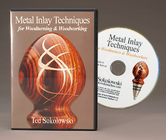
For those interested in inlays in wood in general, Ted Sokolowski made an excellent DVD, "Metal Inlay Techniques for Woodturning & Woodworking". I bought it over a decade ago and did some brass and aluminum powder inlays on turnings. I don't remember the details but I remember the info was useful and the process was not difficult. Should work as well with rock as well as metals.

Fine detail is easy. The example on the front of the DVD is quite small, on a bottle stopper. The wood can be carved or laser engraved. This thread is getting me interested again - might be time to watch the video again, clean off a workbench, set up the laser engraver.
1777253948726.png
Based on the current price of the DVD on Amazon, they must expect people to be inlaying with gold but I see some used copies are available. Maybe ebay too but I didn't check.

, I tried some powder as an alternative for the same reason. Turns out that we have so much static electricity here in the desert that the stuff would leap off of my spatula, finger, or even the turning itself

I wonder if you could work inside a small "tent" made of plastic and increase the humidity inside - shouldn't take much to increase the humidity with a small humidifier, spray bottle, damp sponges, etc. Could make an enclosure sort of like a glovebox with holes for arms and tape on a clear plastic window. Or get a small sandblasting or paint spraying enclosure.
www.amazon.com/Gyfent-Painting-Portable-Turntable-Furniture/dp/B0D1489N8M
Some larger spray paint tents are big enough to work inside. If made of fabric it might need to be treated to maintain the humidity level.
Just some brainstorming...

JKJ

 
Back
Top