I assume that you want to round off bowl blanks with a band saw as much as possible before turning, correct?
Getting the blank round before starting and as well balanced as possible can be a real help, especially for a lighter-weight lathe or one without an excess of power. Bandsaw, chainsaw, axe, trained termites, etc. But note that some blanks may have denser areas and be out of balance even if perfectly round - a hard knot opposite a void may always be out of balance and may need to have the speed reduced. A large and very heavy lathe is a bit more forgiving.
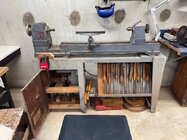
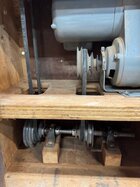
A friend of mine had a very similar lathe, perhaps the same model, and turned lots of large bowls on it outboard. He had a portable tool rest. To keep the lathe from walking across the floor he used long pipe clamps to fasten it to the studs on the inside of his mother's garage! Some people add a shelf underneath (if there's room) and load it up with sandbags and such. Many newer lathes have brackets built into the legs to hold a shelf or box for weight. Some have even fastened the legs to the floor, but even then turning out-of-balance can stress the lathe.
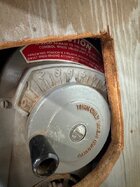
BTW, if you want to know the speed you can get an optical tachometer - stick a piece of reflective tape on the lathe spindle and point the thing and press a button. I have this one in my case of diagnostic instruments - I've used it for various things (but not woodturning):
But as mentioned, once you turn a while you never pay any attention to speed. A common question at demos is "what speed are you using?" and that answer is "Oh, I'll check." You learn to adjust the speed by sound, by feel, and the cut.
I like to turn as fast as safe and practical for the blank in question. It's all a judgement call. Smaller things can be turned at high speed. For example, I often turn thin and relatively thin spindles wide open - about 3000 rpm on my lathes. A bowl or platter blank or questionable piece of wood that could smash you if it came apart?- not so much!! Once common technique is turn up the speed until you feel vibration then back off until it goes away. (Sometimes you can actually increase the speed and "go through" the imbalance but not recommended without experience.) As the piece is turned round and the mass reduced and the balance improved, the speed can be increased.
Regardless, wear appropriate face protection!
JKJ