• December 2025 Turning Challenge: Single Tree! (click here for details)
  • Congratulations to Bob Henrickson, People's Choice in the November 2025 Turning Challenge (click here for details)
  • Congratulations to Guillaume Fontaine for "Old Tea Pot" being selected as Turning of the Week for December 15, 2025 (click here for details)
  • Welcome new registering member. Your username must be your real First and Last name (for example: John Doe). "Screen names" and "handles" are not allowed and your registration will be deleted if you don't use your real name. Also, do not use all caps nor all lower case.

Turned wood boxes inside finish?

Joined
Apr 23, 2022
Messages
11
Likes
1
Location
Lombard, IL
Hi

Wondering what the experts here have to say about the inside finish for small turned boxes which might be used for food, eg things like salt and spices, etc?
Just leave it natural? Using; cherry, walnut and maple for these little gift boxes.

Note that the inset tops of these boxes will be small disks of splated maple, but that surface won’t be touching the inside of the lid.

Thank you,

‘Markl
 
I would use beeswax or a similar food safe oil finish such as Tried and True Original Wood Finish or Mahoney's Utility Finish. I put links to both down below. Just make sure to let it cure before letting food touch the surface.


Wondering what the experts here have to say about the inside finish for small turned boxes which might be used for food, eg things like salt and spices, etc?

Hey Mark.
If the inside is smooth I like to use shellac. Shellac is safe around food.

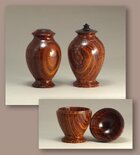
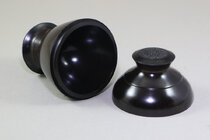
I usually don't go for gloss, but I like the looks of it when I make lidded boxes that are sort of "egg shaped" inside.
1765667932082.jpeg 1765668050599.jpeg

JKJ
 
Burnished wax. Both carnauba and beeswax are used on food. I never met a M&M I didn’t like and they are coated with carnauba wax. The box will be ready for immediate use and won’t impart any off flavors.
 
Last edited:
I agree- non-solvent finishes.

I'd leave the inside naked, and any of the Tried and True versions, or shellac, on the outside only. If you have pure tung oil on hand, that would work great on the outside, too.

I think I'd stick with one or two very light coats of oil, no surface flooding. T&T directions instruct "VERY LIGHT COATS" (yeah, capitalized and everything). I'd treat tung oil the same way.

I made a thin cherry bowl one time that had the oil pass through from one surface to the other as I applied it, showing speckled oily spots on the side I hadn't yet finished. I'll assume your containers will be fairly thin and light, so yes, very light coats.
 
OK, for those who advocate no finish (and I'm not disagreeing, just curious), what about aromatic woods? Wouldn't the wood impact the flavor of the salt or spices?

2. Friction polish is shellac and wax, and would fit some poster's suggestions. It's fast and easy inside boxes.
 
I use Parfix 3408, wiped off, not glossy. Its a ca glue with “long” open time, ~40 sec I think. Seals the wood, dries quickly, wiped off it cant flake off. Leave the lid off for a day, no smell.
 
I took a box making class with Bonnie Klein years ago, and she used Bull's Eye Spray lacquer. It dries in seconds, and there is no after smell. There are a lot of oils which can do the same thing, and have no VOCs in them. Osmo, Rubio Monocote, and others. I did catch one by EN Curtis on You Tube yesterday, and he was making a tapered wood stave trash barrel, and he was using a polymerized tung oil to finish the barrel with, but I couldn't find the video or remember where the product was from, it was made in USA though. Walnut oil would work, and I think the newer "LED" hard wax oils would work and they cure instantly under UV lights. No VOCs in them either.

robo hippy
 
A slightly tangential thought: many of our woodworking and woodturning waxes (e.g. "the stuff in a can") contain a solvent to facilitate spreadability. But these same waxes are usually available in solid, solvent-free block form from your local art supply store. E.g. beeswax, microcrystalline wax (ala Renaissance Wax), and more. For the purposes of this discussion it seems that an on-lathe friction application with a pad would work swimmingly. I'm assuming this is far from a novel thought – have any of you tried this? If so, any application tips?

Bonus: my recollection is that these solid wax blocks are usually much cheaper than their in-the-can counterparts.
 
OK, for those who advocate no finish (and I'm not disagreeing, just curious), what about aromatic woods? Wouldn't the wood impact the flavor of the salt or spices?

2. Friction polish is shellac and wax, and would fit some poster's suggestions. It's fast and easy inside boxes.
Well, Dean, you bring up a good point. Oaks, cedars, and probably any number of others. For that matter, could aromatic herbs and spices off-gas it into the wood?

Pure curing oils- no VOC. Solid waxes- no VOC. Shellac mixed with ethyl alcohol (not denatured), such as the highest proof Everclear- no VOC after complete evaporation of the alcohol. Isopropyl up in the +90% zone should be fine, too, it's medical grade. Shellac (mix at home) would be my vote for an interior finish. Shellac and carnuba wax are used for candymaking (the shiny outer shell) and to make grocery store apples shiny, too. Shellac is used in fire rehab construction to seal smoked surfaces, such as framing lumber, it effectively seals any smoke odors.
 
Some spices can be expensive. And probably should be sealed in somewhat air tight containers.

Turn a box that will contain the spice container as it comes from the store. The store supplied lid could be glued onto the underside of the wood lid. Carve the spice's name on the wood box

Much as it's satisfying to make something useful on your expensive turning equipment, but wood is not ideal for spice containers IMHO.

On edit, just took a look at the spices in out cupboard. Having see-though containers is a very big plus to give an instant reading of when to buy more. Plus that, the store containers seem to be consistent in size so they fit the inexpensive spice racks.
 
Last edited:
Burnished wax. Both carnauba and beeswax are used on food. I never met a M&M I didn’t like and they are coated with carnauba wax. The box will be ready for immediate use and won’t impart any off flavors.
Nope, M&Ms use a sugar/corn syrup coating that's polished to look shiny. While many other hard-coated candies (like some jelly beans or Whoppers) use shellac (confectioner's glaze from lac bugs), M&M's achieve their smooth finish through layers of sugar syrup and buffing.
 
Nope, M&Ms use a sugar/corn syrup coating that's polished to look shiny. While many other hard-coated candies (like some jelly beans or Whoppers) use shellac (confectioner's glaze from lac bugs), M&M's achieve their smooth finish through layers of sugar syrup and buffing.
Better not bet the farm.
 

Attachments

  • IMG_2730.png
    IMG_2730.png
    1.1 MB · Views: 24
For the M&M obsessed, like me, there's a Wikipedia article.

Interesting. "Sugar coating" and "candy coating" is the closest they get for full disclosure of the shell. I don't doubt it.

My favorite flavor- equal amounts (more or less) of regular M&Ms and Planter's or Fisher's dry roasted peanuts (salted, naturally) mixed in a food storage tub. A great sweet/salty TV snack. And MUCH better than peanut M&Ms.
 
Back
Top