• The forum upgrades have been completed. These were moderate security fixes from our software vendor and it looks like everything is working well. If you see any problems please post in the Forum Technical Support forum or email us at forum_moderator (at) aawforum.org. Thank you
  • Congratulations to David Bartell, People's Choice in the March 2026 Turning Challenge (click here for details)
  • Congratulations to Steve Gray for "White Oak Handled Bowl" being selected as Turning of the Week for April 6, 2026 (click here for details)
  • Welcome new registering member. Your username must be your real First and Last name (for example: John Doe). "Screen names" and "handles" are not allowed and your registration will be deleted if you don't use your real name. Also, do not use all caps nor all lower case.

Turning a Stool Seat

Joined
May 21, 2020
Messages
47
Likes
17
Location
Arlington, VA
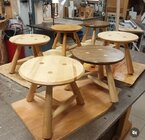
I'm making a stool and am thinking of ways in which I can turn the seat on the lathe. I'd rather not bore a mortise and instead leave the top and bottom of the seat flat. Picture below is similar to my plan.

Would appreciate your feedback on this technique. the blank will already be flat from a planer.
-I'd mark the center of the blank on the top and bottom and CA glue a 1-1/2 x 1-1/2 x 1/4 sacrificial wood block at the center.
-Mount the blank between centers using a spur drive and live center, making sure that the blank is perpendicular to the turning axis.
-Turn the blank round, and bevel the top and bottom.
-Remove the blank, and saw/chisel/block plane/sand off the sacrificial blocks.

I've thought about gluing a tenon to the bottom of the blank and remove it when finished, but it'd have to be ~3" dia and 3/8 thick. More difficult to remove.

Any better ideas?
 

Attachments

  • IMG_7917.jpeg
    IMG_7917.jpeg
    80.5 KB · Views: 21
Double faced tape to a faceplate may do the trick. I have also heard of gluing a removable glue block with a piece of a paper bag glued between the glue block and the work to help separate the glue block afterwards.
 
I'd just simply screw a faceplate to the bottom side of the seat, since it is already planed flat, and turn the seat to completion in one step. That's the primary purpose of a faceplate. Screws with 1/2" to 3/4" penetration are sufficient, you aren't hollowing a bowl blank so your cuts will be relatively lighter. Use the fattest sheet metal screws or wood screws that fit thru the faceplate holes, no drywall screws- too brittle. A single screw screwchuck, with 1/2" screw penetration, will be sufficient, too, see Richard Raffan for this. (He actually has a turned stool project on youtube, if I recall.) Sand the bottom to your desired smoothness before mounting the faceplate, and that area is done. (If you would rather not see the screw holes afterward, fill them with wood pegs afterward.)

If you are turning oak or other woods with tanins, use stainless steel screws, and line the face of the faceplate with masking tape or packaging tape, to lessen staining of the wood from the tanins and steel reacting to each other.

I know lots of people have success making joints for turning processes with CA glue, but I simply don't trust it here to resist the shearing loads of the turning process. It has no give to shock, it just simply breaks, not what you want happening with something like a catch of rhe cutting tool.

I've made a couple footstools like you show- fun projects. Mine are short like those, with relatively thick tops (1-1/4" to 1-1/2" thick) so the leg mortice gives a lot of structural support, so I did not need rungs between the legs. And I also slotted the top of the leg tenons for wedges, which add a lot of strength to that joint.

If you would like to add a cushioned/upholstered top for comfort as a footstool, Amazon has lots of affordable bar stool cushion tops that have simple elastic "cuffs" to keep them in place on the stool top. They are made for a few different diameter stool tops. Enjoy!
 
I atrach a wasteblock to the front using CA with accerator. Then I turn the bottom and cut a mortis for my chuck. Then I turn details or texture into the bottom of the mortis. Then I use a chisel to break the bond of the CA. Its not the wedging action that breaks the bond its the impact so fit it hard. Then I mount it on my chuck and turn the topside of the stool
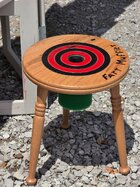
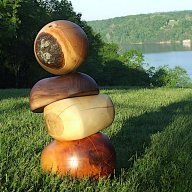
Its fun to use an air brush to add flowers ir other details to your stools. Sometimes of course you get a little whacky.
 

Attachments

  • 20250509_124423.jpg
    20250509_124423.jpg
    536.2 KB · Views: 12
You’ll find a stool project as part of the 4 way challenges from Raffan, Tomasic, Peace, and Angelo. The different perspectives may help you with your decision.

I liked the design of Tomasic’s stool. I would turn a tenon like he did, then use a flush cut handsaw to remove and sand the bottom smooth.
 
Last edited:
On a similar project I “permanently” screwed a face plate to a round piece of melamine coated plywood. Since the surface is flat it attaches easily to the workpiece with double sided tape. I’ve used that many times in situations such as yours.
 
A vacuum chuck system is by far the best method. I even use it to drill and ream leg mortises on the lathe. If I didn't have the vacuum system, I would use double sided tape, or hot melt glue.
IMG_2612.jpgIMG_2616.jpg
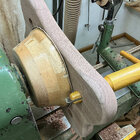
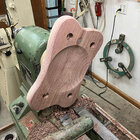
Shop made vacuum chuck.
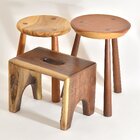
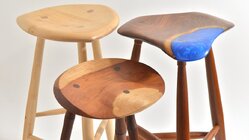
larry-copas-stools-2023.JPGlarry-copas-stools-2023 (2).JPG
All of these stools, except for the live edge one, were started on the lathe using my vacuum chuck. Some received additional carving after the initial turning. I also turn table tops, some as large as 3' diameter, on the outboard side using a vacuum.
 
Well, for me, to turn the top side and profile it, I would drill a recess into the bottom and turn it that way, then fill the recess after you are done. You could turn a waste block as well, NOT PLYWOOD! Legs will not be easy. I prefer a fairly even taper. Some of those legs just look too bottom heavy. Drilling the stretcher holes will be the difficult part. I did make a one legged stool once. Supposedly a good thing for some one who is autistic. It helps them to sit still. Also called a "milking stool".

Larry, half blind dove tails on the little step stool?

robo hippy
 
Back
Top