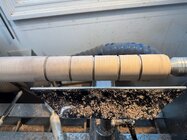
! need to turn several 2" diameter dowels. longest one is 36". Is there a simple jig I can make to be consistent?

Sorry, I can't answer you question about a jig. I've always just turned that size with a skew.! need to turn several 2" diameter dowels. longest one is 36". Is there a simple jig I can make to be consistent?
What lathe are you using and as asked earlier what is the tolerance?! need to turn several 2" diameter dowels. longest one is 36". Is there a simple jig I can make to be consistent?
I use those for spindles for the Windsor chairs I make. I wouldn't use this approach for something 2" in diameter.Or... a shave horse and a combination of drawknive and spokeshaves.
View: https://youtu.be/FB0tdqfg0xQ?si=74U5xrWmg1tnq2Wr
But, you could...I use those for spindles for the Windsor chairs I make. I wouldn't use this approach for something 2" in diameter.

Perhaps one could, but I definitely wouldn't. Holding something 2" in diameter and 36" long is not something I'd want to try on a shavehorse. I did shave a continuous arm for a settee. That was 86" long (yes 86") but only 1" in diameter. That was interesting but went fairly quickly. That was after I had made a number of chairs whose arm piece was shorter.But, you could...
In all seriousness, for your chair spindles, what is your acceptable tolerance of "round" off the shave horse? I've never done the process myself, with time and practice are you able to achive near-lathe-like roundness?

Curt, the answer to your question is Yes. You will find a post by me that addresses the issue in the Tips and Tutorials Forum. It is called "An Engineer's Look at Turning Slender Wood Spindles" Published July 31 2016.Question... Has anyone here ever attempted to do a very long thin dowel shape with a "pull" from the tail stock instead of the usual "push" from the tailstock? I envision a chuck at the headstock and a small chuck or a screw chuck situation at the tailstock. Of course, this would mean a drawbar at the tailstock into the morse taper or a set screw something or other to keep the project from pulling out as it is stretched between "centers". Would this lessen the likelihood of the spindle whipping like is easy to do on long thin spindles under compression?