• The forum upgrades have been completed. These were moderate security fixes from our software vendor and it looks like everything is working well. If you see any problems please post in the Forum Technical Support forum or email us at forum_moderator (at) aawforum.org. Thank you
  • Congratulations to David Wyke, People's Choice in the April 2026 Turning Challenge (click here for details)
  • Congratulations to Roberto Ferrer and Carol Hall for "Waking Dream - Danza Pagana" being selected as Turning of the Week for May 4, 2026 (click here for details)
  • Welcome new registering member. Your username must be your real First and Last name (for example: John Doe). "Screen names" and "handles" are not allowed and your registration will be deleted if you don't use your real name. Also, do not use all caps nor all lower case.

Turning wet vs turning dry

Joined
Aug 14, 2007
Messages
6,828
Likes
3,965
Location
Eugene, OR
Well, if you know me, you know I prefer sloppy wet wood, and the more it warps, the more I like it. So, yesterday, I cut up a nice blank of big leaf maple, which I really don't like to turn because it seems to never cut cleanly, no matter what I do. Well, the cleanest surfaces I could get on it was with a NRS. Now, I do use a NRS across the bottom of a bowl frequently since the grain is fairly straight so there is minimal uphill/downhill. I NEVER go up the sides. I tried shear scraping with mixed results. My gouge skills are okay, but not excellent. I did try a NRS and it seemed to leave the best surface. This is puzzling to me. Now, I do follow Tomislav, and like his methods, and he pretty much always turns dry wood, and his finish cut, most of the time is with a 50 degree scraper. I did ask him once if there was much of a difference when turning wet wood and he replied, not much. I am starting to wonder. With the fresh green wood I turn, with the exception of madrone, I won't use any kind of scraper because it leaves a lot of tear out in the transition and up the sides of the bowl. I do have 5 more of them to turn, and will experiment some more. Still, I do wonder if there is a lot more to green/dry wood than I expected.

Side note, In sanding the big leaf maple, I found the 80 grit cubitron discs to be VERY aggressive, and ended up starting with 120 grit, then 220, then 400. I think the solid surface 80 grit cubitron cuts more like 60 grit. Still, I got 4 bowls sanded in the time it normally takes me to sand 2.

robo hippy

 
Not sure if there's a question here, but the general topic of wet maple makes me think of what I've been learning about Siri Robinson's approach to spalted maple, apparently a very steep bottom feeder at low lathe speed. A mentor at our club has had multiple discussions with her and used the technique.
 
This also raises the question as to whether big leaf maple behaves differently than silver and sugar/rock maple. Our local maples are all landscape trees, many planted 100 years ago. Turned green, there is little difficulty getting clean cuts, unless is highly figured, or on undercut rims.

Reed, since you love scrapers, have you considered trying Richard Raffan's big scraper technique, where he's actually angling the scraper up as he draws it back from bottom through the transition zone? It's probably a shear scrape, though it's hard to see how the edge is applied on the available videos.
 
This also raises the question as to whether big leaf maple behaves differently than silver and sugar/rock maple. Our local maples are all landscape trees, many planted 100 years ago. Turned green, there is little difficulty getting clean cuts, unless is highly figured, or on undercut rims.

Reed, since you love scrapers, have you considered trying Richard Raffan's big scraper technique, where he's actually angling the scraper up as he draws it back from bottom through the transition zone? It's probably a shear scrape, though it's hard to see how the edge is applied on the available videos.
Dean- you got my curiosity up. Need to check that video. Have subscribed to RR among others.
 
Okay, accidentally double posted this one.... The soft maples, of which silver maple is one, just don't cut very clean. I do use shear scraping on pretty much all of my bowls as the final pass. As for "big" scrapers, I never use one more than 1 inch wide. To me, it is just a waste of metal.... I do use a pointed shear scraper on the outside of the bowl and a round nose or ) shape nose with a 70 degree bevel for the insides of the bowl since a spear point would be dangerous on the inside. I am thinking there is a major difference between turning dry wood compared to my once turned warped bowls. To be able to get a clean surface with a NRS on the walls of the bowl just makes no sense otherwise. There has to be a "structural" difference.

Dean, you are describing the shear scrape. I did one video dedicated to that.

robo hippy
 
I don't know if this is true for a lot of turners or mostly just me, but getting freshly cut wood is a complicated issue for me. Availability, getting the wood before it has time to split after a tree is downed, the mess from turning wet wood, the whole uncertain drying process after the rough turning, etc. make turning wet wood, for me at least, more complicated than dry. Since I don't turn hundreds of bowls in a year and I have quite a stock of drier chunks that are sealed and sound (for the most part), it's just easier to turn dry wood.

The times I've turned wood that isn't completely dried, the whole process seems more complicated with the rough turning/drying process and I just don't need the frustration of turning something that ends of having cracks or some other problem even though I'm careful how I dry it.

Anyway I believe, from some limited experience, that turning wet versus turning dry definitely presents both cutting and drying differences, but that could just be because most of my experience is with dry wood.
 
I've turned hundreds of "once turned" green wood bowls and almost always have gotten reasonably clean cuts with 40, 50, and 70 degree bowl gouges, but shear scraping green wood has never left as good a surface for me. However, turned 14 or 15 green once turned salad mixing bowls from a maple log that blew down in high winds a couple weeks ago, on Ohio farmland. On bowls from this particular tree there always is some fuzzy surface, gouge cut or shear scraper. Don't know what type of maple.
 
I prefer wet to dry, and I do feel like a NRS can rip it up sometimes. My bowl gouge skills aren't great either sometimes. I don't know if it's species, moisture content, or what, but I will try to test a spot with the NRS before going too far with it.

Last fall, I had a woman call me because a branch broke off her maple tree and she wanted a bowl from it. I drove there to find out that I should've brought my truck and my big saw. It was a huge branch. Even though it was very fresh, there was no spray off it and it cut really cleanly. I was really puzzled that a recently leafy branch turned more like dry wood. (wishing I had gotten the rest of it)
 
I've turned hundreds of "once turned" green wood bowls and almost always have gotten reasonably clean cuts with 40, 50, and 70 degree bowl gouges, but shear scraping green wood has never left as good a surface for me. However, turned 14 or 15 green once turned salad mixing bowls from a maple log that blew down in high winds a couple weeks ago, on Ohio farmland. On bowls from this particular tree there always is some fuzzy surface, gouge cut or shear scraper. Don't know what type of maple.
Don, don’t you think that this kind of fuzziness can occur on dry wood as well?
 
Idon't experience similar fuzziness when turning stair spindles, stool legs, and other items from dry wood. Doesn't mean it is not possible, just that I have not eperienced fuzzy surfaces when turning dry wood.
 
I do find it far easier to get clean cuts on spindles than I do on bowls. The problem is the uphill/downhill/uphill/downhill orientation of side grain. For 1/4 turn you are cutting with the grain, then 1/4 against, 1/4 with, 1/4 against. When ever you are going against the grain you get tear out due to unsupported fiber. With spindles, as long as the grain is pretty straight, it isn't too difficult figuring how to cut with the grain. This includes boxes and hollow forms, which, most of the time are end grain. It was just with this big leaf maple that I was able to get the best surface by using a NRS. On my once turned bowls, I do use a NRS on the bottom of the bowl, but NEVER come through the transition or up the walls of the bowl. I am trying to figure out why....

robo hippy
 
I do use a NRS on the bottom of the bowl, but NEVER come through the transition or up the walls of the bowl. I am trying to figure out why....

robo hippy
I turn mainly dry wood for finished bowls. One thing I do is use the NR as I proceed down the bowl if needed. When turning the inside of the bowl I have three sharp gouges and the NR ready to go.
I proceed down the bowl 1” to 2” at a time after the Final Cut with the fresh sharp gouge I check for any lines, tear out, or rough patch on the end grain and use the NR to clean that up. I do this all the way down the inside of the bowl at least 3/4 of the depth. I make a rough cut with one gouge to remove material, second gouge make one or two cuts, Final Cut is usually a 1/2” gouge followed by the NR.
I don’t usually have any problems blending the cuts but if needed I’ll keep my hand on the outside of the bowl with a paper towel and blend the last cut with the previous.
Once I finish the bottom of the bowl through the transition I’ll finish the bottom with a NR if needed.
My bowls are usually 1/4” +/- so flexing would be a issue if I used the NR at the end of the process, that why I us the NR as part of the process which may work for green turning if you us it as you advance down the side of the bowl. As I’m sure green wood will flex more than dry at 1/4”………just a thought.
 
With my sloppy wet wood, a shear scrape seems to leave the most even/cleanest surface. With the dry wood, at least with this batch of big leaf maple, the best surface I could get was with the NRS. If I use the NRS on sloppy wet wood, it tends to tear more up the sides and in the transition where a shear scrape gives me the best surface. The engineer side of me is trying to figure out why.

robo hippy
 
This also raises the question as to whether big leaf maple behaves differently than silver and sugar/rock maple. Our local maples are all landscape trees, many planted 100 years ago. Turned green, there is little difficulty getting clean cuts, unless is highly figured, or on undercut rims.
This comment makes me wonder about some downed trees I worked with last year. HUGE maples, crotches 4'+, trunks ~3' but definitely not big leaf maple - wood was very white. Bark was different and I never saw the leaves. Silver maple? We got quite a bit of stock for Intro classes out of the smaller trees but not the big ones - wayyy too many nails! :-(
 
Well, the silver maple tend to grow very big very fast, and then they fall apart. They can have 1/2 inch or larger growth rings. I figure that is why they fall apart since they are not native here. The wood does have a shine to it that dulls very quickly turning wise, like a month or less if it sits. I figure it is the sugar in it which is prime food for all those things that like to turn wood into compost. For sure, all of the soft maples turn a lot differently than the hard maples, and dry wood does turn differently than wet wood.

robo hippy
 
Well, the silver maple tend to grow very big very fast, and then they fall apart. They can have 1/2 inch or larger growth rings. I figure that is why they fall apart since they are not native here. The wood does have a shine to it that dulls very quickly turning wise, like a month or less if it sits. I figure it is the sugar in it which is prime food for all those things that like to turn wood into compost. For sure, all of the soft maples turn a lot differently than the hard maples, and dry wood does turn differently than wet wood.

robo hippy
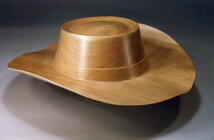
The silver maple Minneapolis/St. Paul metro area do grow fast and large but I don't know that they fall apart. The hat pictured was made as part of a demo for the MN woodturners Association if the fall after seeing Joannes Mickelson's demo at the SUNY Purchase symposium. The fresh cut wood was supplied by anther member and turned on a Delta 12" lathe that I had added 2" height blocks to make it a 16" lathe. The hat is still holding together and is a prized possession of my son.HatSoftMaple.jpg
 
Back
Top