• The forum upgrades have been completed. These were moderate security fixes from our software vendor and it looks like everything is working well. If you see any problems please post in the Forum Technical Support forum or email us at forum_moderator (at) aawforum.org. Thank you
  • Congratulations to Bernie Hyrtzak, People's Choice in the January 2026 Turning Challenge (click here for details)
  • Congratulations to David Croxton for "Geri's Basket Illusion" being selected as Turning of the Week for February 2, 2026 (click here for details)
  • AAW Symposium demonstrators announced - If the 2026 AAW International Woodturning Symposium is not on your calendar, now is the time to register. And there are discounts available if you sign up early, by Feb. 28. Early Bird pricing gives you the best rate for our 40th Anniversary Symposium in Raleigh, North Carolina, June 4–7, 2026. (There are discounts for AAW chapter members too) For more information vist the discussion thread here or the AAW registration page
  • Welcome new registering member. Your username must be your real First and Last name (for example: John Doe). "Screen names" and "handles" are not allowed and your registration will be deleted if you don't use your real name. Also, do not use all caps nor all lower case.

What is this wood species?

Joined
Nov 22, 2023
Messages
829
Likes
5,802
Location
Morganton, NC
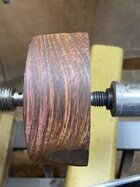
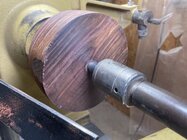
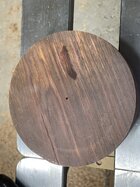
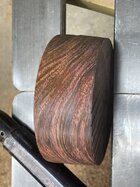
First time I have ever had to ask this question. I purchased several exotic blanks from someone several years ago. This is the only one left and was thinking of using it for the top on a lidded piece.
I am allergic to Morado which is a Bolivian Rosewood and this looks like it could be in the rosewood family. I turned just enough to get the wax off of it and expose the grain. It is dense, heavy for its size, and fairly hard. Size is 5-11/16” x 2-1/8” and weighs 2.2 pounds.
The oil in rosewood sends me to the doctor to get shots so I’m not turning anymore rosewood. This is the only wood I seem to have a reaction too and I’ve turned several exotic woods.
I’m a little hesitant to turn this so there’s a chance someone is going to get a free piece of wood😁

1770499399561.jpeg

1770499346013.jpeg
 
Could be Etimoe? Which is also known as African Rosewood. The blanks I have gotten have less black and more tans in them but it sure looks similar.

I am far from an expert.

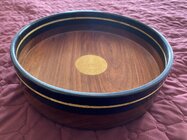
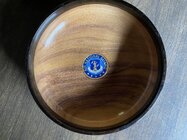
These are a few bowls I have done using Etimoe Blanks.

Bob

IMG_1137.jpeg

IMG_1439.jpeg
 
Looks like Cocobolo to me.

It would have a pretty distinctive sweet smell (sweet to me anyway).

I’d be happy to pay shipping if you want to send it my way! Send me a PM if you want to get rid of it!
Now it could be cocobolo, it did have the sweet smell. It’s been a couple years since I turned cocobolo but it didn’t have the streaks and was mostly black.
If it is coco I’ll have to rethink what I want to use it for!
 
FWIW, African Blackwood is in the rosewood family, as well. Back in the day when regular people could afford to buy these woods, the word on rosewoods was, "It's not whether you'll become allergic to rosewoods, it's when." If you're allergic to one, you probably should assume you're allergic to all of the genus Dalbergia. Some of us can be OK if we use maximum respiratory protection, but not everyone. Really a pity, given how wonderful they family is to work and how attractive.
 
Interestingly Morado is not in the Rosewood family, although anyone can be sensitive to “just about any” wood species. There’s plenty of folks sensitized to Walnut among other species. Yes, the Rosewoods , and many other exotics, can be more problematic than the domestic varieties we use more regularly like Cherry, Maple, etc.

I do know an inordinate amount of folks who mention Cocobolo as a “super-sensitive”species in the Rosewood family. There’s people that can’t be in the same room where the dust is without sneezing and getting itchy.
 
It looks much like Cocobolo to me too, at least looks much like some I have. HOWEVER, the end grain pores look large to me and too open. I usually turn it in spindle orientation (boxes, etc) so I don't have much experience with cutting across the end grain. Under the microscope many pores are often packed with a transparent resin that often looks orange. Maybe read the Identifiction section on this page:

But as with many species, there is much variation (and lots of look-alikes).

One thing very distinctive to me is the smell of Cocobolo when sanding a patch, bandsawing, or turning. Once smelled, it's hard to forget!
Maybe take it to a club meeting and ask others.

Another good website for seeing the color, grain, and figure of different species is Hobbithouseinc.

Note that a US citizen can send a sample of wood to a US laboratory for professional identification. I did this once to verify a species when learning to ID.

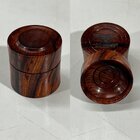
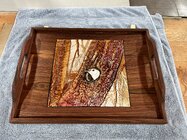
Some things I've turned from Cocobolo (I LOVE the way it turns).
1770516986687.jpeg
1770517034804.jpeg
1770517058073.jpeg
One of these (from 2008) is Cocobolo - the one on the left.
1770518624978.jpeg

Some people are highly allergic to Cocobolo (and other rosewoods). One guy refused to turn on any lathe that had ever had Cocobolo on it. A friend got so sensitive to it and some other species he gave up woodturning.

I've have a fairly large stash acquired almost by accident and have turned a bunch over almost two decades. (The seller had it labeled as Claro Walnut from California and I didn't know any better at the time. I bought it all since it looked nice, felt dense, and was inexpensive!) Although I have lots of respiratories sensitivities and can get asthma almost from looking at some things (hay, pollen, grasses, animal dander, etc) I've not yet been affected by Cocobolo.

One non-respiratory test for wood sensitivity: put a little dust on the skin (the inside of your forearm, for example) and cover with a bandaid. If sensitive, after a while it will start to itch or show a mild rash. I found out I was mildly affected by eastern red cedar by getting some fine dust under a wrist watch.

JKJ
 
Interestingly Morado is not in the Rosewood family, although anyone can be sensitive to “just about any” wood species. There’s plenty of folks sensitized to Walnut among other species. Yes, the Rosewoods , and many other exotics, can be more problematic than the domestic varieties we use more regularly like Cherry, Maple, etc.

I do know an inordinate amount of folks who mention Cocobolo as a “super-sensitive”species in the Rosewood family. There’s people that can’t be in the same room where the dust is without sneezing and getting itchy.
I also read that Morado was not a true rosewood but had similar characteristics. The oils in Morado gave me an itchy rash that lasted several days as well as a slight respiratory issue. It makes me wonder if the cocobolo would do the same now. I’m don’t think I’ll risk it and just donate this to our club raffle we have each month.
 
One non-respiratory test for wood sensitivity: put a little dust on the skin (the inside of your forearm, for example) and cover with a bandaid. If sensitive, after a while it will start to itch or show a mild rash. I found out I was mildly affected by eastern red cedar by getting some fine dust under a wrist watch.

JKJ
This is how I had my first reaction to the Morado. I was turning some wine stoppers and had dust under my watch and. I broke out in a small rash but also had a bug bite in the same location. I went to the doctor to see if it was a spider bite, decided it wasn’t, gave me a cream to apply and it went away.
Next reaction was when I turned a small bowl with it, heavy itchy rash on neck and arms the next morning. I also woke up in the middle of the night thinking I was coming down with bronchitis. I immediately knew it was the Morado and had to get shots the next day.
I have turn cocobolo in the past with not issue but when I put this piece on the lathe yesterday as soon as I saw the shavings my first thought was Morado but it didn’t look anything like Morado.
My head is telling me to resist turning it so I’ll donate this and my last piece of Morado to the club raffle this weekend.
 
This is how I had my first reaction to the Morado. I was turning some wine stoppers and had dust under my watch and. I broke out in a small rash but also had a bug bite in the same location. I went to the doctor to see if it was a spider bite, decided it wasn’t, gave me a cream to apply and it went away.
Next reaction was when I turned a small bowl with it, heavy itchy rash on neck and arms the next morning. I also woke up in the middle of the night thinking I was coming down with bronchitis. I immediately knew it was the Morado and had to get shots the next day.
I have turn cocobolo in the past with not issue but when I put this piece on the lathe yesterday as soon as I saw the shavings my first thought was Morado but it didn’t look anything like Morado.
My head is telling me to resist turning it so I’ll donate this and my last piece of Morado to the club raffle this weekend.
I too had a small reaction to rosewood. Not near as bad as yours but I avoid it now. Just got slight rash and itching. Camphor now is another story, that causes some respiratory issues.
 
My first reaction was small and second was large. You’re smart to avoid it, I was a little hardheaded but now avoid it!
Good decision. We had a long-time charter member of one of my clubs who had an extreme reaction to Cocobolo. His doctor told him that another incidence would most likely kill him. For all events/activities at his shop, and even at the club's meeting venue, Cocobolo was banned from the premises. I'm not sure if people who have a reaction to rosewoods would be OK with a "finished" piece - or, only have a problem with the raw wood and/or dust. I guess everyone is different.
 
This is how I had my first reaction to the Morado. I was turning some wine stoppers and had dust under my watch and. I broke out in a small rash but also had a bug bite in the same location. I went to the doctor to see if it was a spider bite, decided it wasn’t, gave me a cream to apply and it went away.
Next reaction was when I turned a small bowl with it, heavy itchy rash on neck and arms the next morning. I also woke up in the middle of the night thinking I was coming down with bronchitis. I immediately knew it was the Morado and had to get shots the next day.
I have turn cocobolo in the past with not issue but when I put this piece on the lathe yesterday as soon as I saw the shavings my first thought was Morado but it didn’t look anything like Morado.
My head is telling me to resist turning it so I’ll donate this and my last piece of Morado to the club raffle this weekend.
A contact reaction is a different category of response from a respiratory or generalized allergic reaction. JKJ's suggestion mimics typical contact sensitivity testing (but the doctor's office also has a crash cart on hand). You might also get an irritant reaction to the dust, with runny nose, sneezing, maybe throat irritation, if you have a contact sensitivity. Hives, swelling of face, hands, feet, or difficulty breathing (chest tightness, air hunger, difficulty breathing out) would be indications of a generalized reaction.

If the question is important enough to you, you could see an allergist and get it settled. Contact reactions are the domain of dermatologists, but a rash is not your biggest worry.

BTW, people often don't react to something on the first exposure. That, or subsequent exposures, just sensitizes your immune system, so you react when you experience it later.
 
A contact reaction is a different category of response from a respiratory or generalized allergic reaction. JKJ's suggestion mimics typical contact sensitivity testing (but the doctor's office also has a crash cart on hand). You might also get an irritant reaction to the dust, with runny nose, sneezing, maybe throat irritation, if you have a contact sensitivity. Hives, swelling of face, hands, feet, or difficulty breathing (chest tightness, air hunger, difficulty breathing out) would be indications of a generalized reaction.

If the question is important enough to you, you could see an allergist and get it settled. Contact reactions are the domain of dermatologists, but a rash is not your biggest worry.

BTW, people often don't react to something on the first exposure. That, or subsequent exposures, just sensitizes your immune system, so you react when you experience it later.
I had both contact and respiratory reaction on the second turning, so I’ll just stay away from it. Lots of other species to turn. I’ve not found a domestic or Australian species yet that I’ve had the slightest reaction to…yet😁
 
A contact reaction is a different category of response from a respiratory or generalized allergic reaction.
I was told a positive indication on a simple contact test could be a warning of more serious systemic or respiratory reaction in the future if you don't change your ways.

I've had serious asthma since a teen. I keep albuterol inhalers everywhere for a variety of allergens: pollen, dust, trees, grass, and especially hay. Wear a mask when mowing, working with hay. All of those give me skin reactions but without the inhalers a simple mild breathing discomfort would quickly turn in full asthma. (For years I've also used what's proven to be a life-saver for breathing - Breo Ellipta powder - it's amazing, not only as a treatment but as a daily preventative. (Maybe it's inhibiting wood respiratory reactions too, who knows.) Works when the albuterol won't. But so far I have to breathing issues from wood. Knock on Bubinga.

Breo Ellipta is expensive but after a short battle my insurance pays 100%. (We seem to have these battles often - one of my son's medications was going to cost me about $90,000/year until a medical insurance specialist talked sense into them and got it down to zero!)

JKJ
 
Last edited:
Once sensitized, there is a possibility of anaphylaxis. Albuterol may be helpful with shortness of breath as suggested but a full blown allergic reaction, epi would be a first line treatment.

If you were my patient I would suggest you discuss this with your medical provider and get their professional recommendation.
 
Once sensitized, there is a possibility of anaphylaxis. Albuterol may be helpful with shortness of breath as suggested but a full blown allergic reaction, epi would be a first line treatment.
If you were my patient I would suggest you discuss this with your medical provider and get their professional recommendation.

Don't worry - I'm long ahead of the game. All this has been well discussed with my GP and specialists. I keep epipens on hand for just in case - the drs were concerned since I keep hives and have had swelling reactions, never to honeybee stings, but to yellow jackets (wasps). Epipens are not cheap but insurance pays. So far with almost 25 years at the farm I've never needed to use one - and I've been stung plenty.

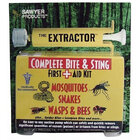
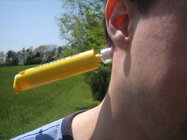
What I use instead for stings is something called "The Extractor" - inexpensive. It's like a reverse syringe - pressing the plunger creates a strong suction which pulls venom from sting. It comes with a set of different sized and shaped cups. Forget the stuff you put on skin to ease the discomfort - instead just quickly remove whatever's just been injected!

These are amazing. A yellow jacket sting on the back of my hand once caused my hand to swell like a balloon animal while the swelling slowly moved all the way up my arm to my shoulder - if it went past my shoulder I would have gone to the ER. The next times got yellowjacket stings I had discovered The Extractors and immediately applied one and got no swelling, just a red mark about the size of a nickle. Works for everything from mosquitoes to venomous snakes. Available from Amazon or in the camping section at Walmart:

1770695138614.jpeg

A friend was stung by a wasp or hornet (I didn't see it), The Extractor fixed it. Instantly took away the pain, no swelling.

1770695281314.jpeg

My wife once was stung on the deck by what looked like a bumblebee - terrible pain she said. I ran it house for the Extractor - used it on her hand and she said the pain was gone instantly.

I now keep one on the tractor, with the bee kit, two in the house, in the barn and shop, in the saddlebag when riding horses, in each car, with the chainsaw, one in my little side-by-side Kubota, always have one on vacations. I've bought some to give to friends with kids. I've bought and tried similar suction things but in my experience this is the absolute best.

Little tip about "bees" - foraging honeybees never sting unless you pinch them - you can pick one up and cup it in a closed hand all they'll do is buzz. But mess with the hive - get ready to run! The common carpenter bees can be intimidating - some swoop and buzz all around. However, these are males chasing other males away. The males can't sting. The females can sting but don't - they go quietly about their business - not the least aggressive. (BTW, I've developed a way guaranteed to get rid of carpenter bees.) With honeybees the females are also the only ones with stingers and the ones who do all the work and protect the hives. The males (drones) have no stingers, are lazy and worthless and can't even feed themselves. The males have one purpose in life and die immediately afterwards. And the females kick the remaining males out of the hive after breeding season.

All this, of course, has nothing to do with wood allergies and Cocobolo...

JKJ
 
Back
Top