
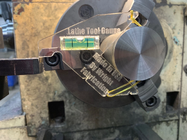
Seems like it would help? Put it on your round stock or tenon and double check tool rest height and where the tool is cutting when rested on the tool rest.

I was thinking more along line of setting the tool on top of the tool rest and making sure it's cutting on line or slightly above.Because it’s not that important, and often the rest needs to be other than on-center.
A metal lathe is a different story for different reasoning.
Tim

Are you serious? My scrapers cut without a burr. They cut at the joint of two flats and cutting occurs when the sharp end touches the wood in the right position like Steve says above. Wood is different than steel. In over 30 years of machining steel I never had to worry about tool presentation. The only worry was an interrupted cut that was mostly taken care of by grinding off the chip breaker on the carbide insert that usually made it across the 50 plus 1 1/4" holes. For over 90% of my time at GE I turned parts for the motorized wheels, you know those wheels that took those 15 foot tires for deep truck mines.When you use a scraper, the burr is doing the job, not the flat of the steel. I was taught to keep the handle higher than the burr to prevent the scraper from self feeding and getting a catch.





Might be useful, but only for something round.So, forget about tool rest height and imagine you just want a quick way to have the exact centerline of a piece. Still not worth the $7.00 it cost?
Dead serious. I cant believe that you didn’t set up your tool to be somewhat on center cutting steel. You must have never cut threads, or at least eyeballed that the tool was close to center. Never is a very bold statement! I’ve taught way too many classes where someone gets a catch with a scraper. When they get deeper into a bowl, they have no feeling for where center is and a crash results. This usually happens a couple inches up the side. Unless you use a stone to flatten your steel after every time you sharpen, there is a burr there from the grinding process. I am highly aware that wood and steel are different. I worked in a model shop at Caterpillar and turned steel for over a 15 years and have turned wood for over 38 years with personal time turning with John Jordan. I haven’t seen it all, but I’ve seen a hell of a lot over the decadesAre you serious? My scrapers cut without a burr. They cut at the joint of two flats and cutting occurs when the sharp end touches the wood in the right position like Steve says above. Wood is different than steel. In over 30 years of machining steel I never had to worry about tool presentation. The only worry was an interrupted cut that was mostly taken care of by grinding off the chip breaker on the carbide insert that usually made it across the 50 plus 1 1/4" holes. For over 90% of my time at GE I turned parts for the motorized wheels, you know those wheels that took those 15 foot tires for deep truck mines.
Thanks for the kudos, Bill.When I started I worked on a vertical boring mill with a 15 foot table using spring tools with cuts that took up to 28 hours. At GE those holes I cut across were on a 6ft diameter and the machines were all Bullards. I've had a catch or two with gouges but I've never had a catch with a scraper. I agree there will be a burr there for awhile but I use that scraper for a long time after that burr is gone and it does me just as good as when first sharpened. No matter how good the finish is off the tool the piece is still going to see some sandpaper. I highly suggest that Steve Tiedman's first paragraph as there is a lot of good knowledge in that short paragraph.

dangerous habits...... That's part of the reason I don't watch raffan videos. Early on I thought to myself he does some unsafe stuff. Seems like a lot of "older,experienced" aren't setting good examples.Completely unnecessary. With time and practice, and honestly, verbally repeating to yourself the laws of cutting tool presentation before you present the tool to the wood, micro-adjustments of the tool rest and the constant fluid movement of the tool on that rest to achieve your cut will become so second nature that you could do them in your sleep.
Just please keep your fingers out of the smashing path of the loose tool rest in case you touch the loose rest to the wood while the wood is spinning. Such adjustment is commonplace among seasoned turners (watch utoob for examples), but it is a dangerous habit. Adjust the rest only when the wood is not spinning.

Can you be more specific on what safety risks you perceive?dangerous habits...... That's part of the reason I don't watch raffan videos. Early on I thought to myself he does some unsafe stuff. Seems like a lot of "older,experienced" aren't setting good examples.

Woodturning is dangerous by its nature, and as an instructor of rank beginners (well over 200 so far) I intensely emphasize safety. But I'll guess that there isn't one veteran production turner around who turns off the lathe EVERY single time they move the tool rest. The key is to know what your level of risk is (e.g., a natural edge bowl vs. clean spindle or bowl, or how close to the wood you're planning to set the rest. Students are watched carefully that they they follow the "rule" to turn off the lathe, and fear instilled, but no expectation that after dozens of hours of experience they will stick to it 100%. I sure don't.dangerous habits...... That's part of the reason I don't watch raffan videos. Early on I thought to myself he does some unsafe stuff. Seems like a lot of "older,experienced" aren't setting good examples.
That's part of the reason I don't watch raffan videos. Early on I thought to myself he does some unsafe stuff. Seems like a lot of "older,experienced" aren't setting good examples.
Can you be more specific on what safety risks you perceive?
What kind of turning do you do?Tool rest height can change as one turns a piece of wood and the tool used.
Its common to have the rest high when using a skew chisel, which may change as the diameter is reduced.What kind of turning do you do?
I'd be interested in your more detailed reasoning with this concept....
Note that the centerline of the spindle's distance to the bedways are the same in either case.
I'll also state here that this isn't a "gotcha".....just interested in your thoughts here in more detail.....
=o=
I defer to Ross's answer.