Is Kingspors Green wood sealer a good choice for sealing fresh cut wood?

-
January 2026 Turning Challenge: Turned and Bent! (click here for details) -
Congratulations to Phil Hamel, People's Choice in the December 2025 Turning Challenge (click here for details) -
Congratulations to Larry Copas for "Magnetic Yarn Spinner" being selected as Turning of the Week for January 12, 2026 (click here for details) -
Welcome new registering member. Your username must be your real First and Last name (for example: John Doe). "Screen names" and "handles" are not allowed and your registration will be deleted if you don't use your real name. Also, do not use all caps nor all lower case.
You are using an out of date browser. It may not display this or other websites correctly.
You should upgrade or use an alternative browser.
You should upgrade or use an alternative browser.
wood sealers
- Thread starter Ed Jarvis
- Start date

I really like the PVA emulsion sold by Craft Suppies.
That's the only sealer I've used too. It didn't work very well at first when I tried bushing it on. Now I pour it into a shallow cake pan and dip the end grain in it. If I'm sealing bowl blanks I roll the edge in it. When I'm done I just use a cheap funnel and pour what's left back into the jug. I gave up on wasting sealer to seal larger lot ends. They seem to crack no matter what you do. I process my wood into blanks and them seal them.I really like the PVA emulsion sold by Craft Suppies.
Is Kingspors Green wood sealer a good choice for sealing fresh cut wood?
I wish I had experience with that. Do you know what's in it? From the instruction to not let it freeze, sounds like it might be an emulsification like Anchorseal (wax, water, and surfactant) but it looks darker through the bottle. Maybe it has color added.
For sealing, some use PVA glue and variations, some dip the blank or the ends in hot paraffin, some paint the ends (best to use oil-based, not latex paint). Aluminum paint is supposed to work well too.
I stick to Anchorseal which has worked extremely well for me. (Bought a 55gal drum once, down to the last few gallons).
However, for me Anchorseal is too thin. I process a LOT of green wood into blanks for drying and I've learned to like a thicker coat of wax. Since it has water in it a 2nd coat won't stick well to a dry 1st coat.
I thicken it first: pour about an inch or so into a plastic coffee can and leave the lid off for days. Some of the water evaporates. I stir it some, and apply with a 2" wide cheap throw-away brush from the big box store. This goes on and dries thicker and protects the wood better IMO. I've cut up log sections into 1000s of blanks over the years for drying and have very few failures.
A frame from my bandsaw video, sealing with thickened Anchorseal.
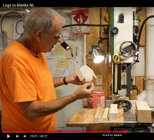
I never clean the brush, just stick it in the can and close the lid. (If the brush handle is too long I'll cut off a bit.) I use the same brush and can for years.
If coating the ends of logs at the sawmill I use a wider brush.
BTW, the late great John Jordan, the famous one who only turned green wood, told me he never sealed the ends of logs. He bought a long log and stored it off the ground out of the sun. When ready to turn one of his hollow forms, he cut about off 6" the end of the log, threw it away, then cut a blank to take to the lathe and turn immediately.
JKJ
The Klingspor green wood sealer is just rebottled Anchorseal2 according to its information sheet.
I like to use it on log ends if I can’t process them right away. I prefer pva glue for the rough turned bowls since it is a little cheaper and not waxy.
I like to use it on log ends if I can’t process them right away. I prefer pva glue for the rough turned bowls since it is a little cheaper and not waxy.
I have a sawmill and use end sealer on my good grade logs. I've used both Klingspor and Anchorseal. They are similar but not the same consistency. Both work well, but either one really needs two coats. I would buy whichever one I could get the best price on.
I have used paraffin wax to seal wood turning blanks along with gunstock blanks. I kept maybe 10 pounds in a old electric roaster that I would fire up to melt the paraffin. The paraffin was the very best.
I have used paraffin wax to seal wood turning blanks along with gunstock blanks. I kept maybe 10 pounds in a old electric roaster that I would fire up to melt the paraffin. The paraffin was the very best.