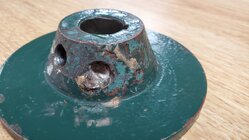
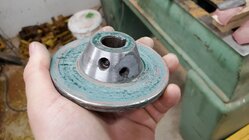
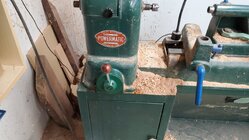
I surmise from the very small slot in shaft at the working side that I should stick the same Allen wrench in there to hold it and then unturn the handle?
I haven't seen that lathe.
A few pictures of your tailstock might be helpful. Also, an internet search of your lathe with model number might turn up a parts diagram which should show what should be there. If you happen to have a manual, it may have a parts diagram.
Tailstocks usually have four main parts - 1) the steel or cast iron body, 2) the steel quill with the slots and a morse taper on the end which slides in and out, 3) the steel left-hand threaded lead screw, and 4) has the handwheel fastened securely to the unthreaded end end of the lead screw. Plus various levers and screws. The handwheel turns the lead screw and the threads on the left end of the lead screw drive the quill in and out.
***First of all, does the handle turn and will the quill slide in and out properly? Does the handwheel turn at all, even a little bit? If so, can you see anything else happening?
Note that the hand wheel
often has two, sometimes three set screws holding it on the shaft. If only one is visible, look behind and under to see if there is another.
Most quills have one square-bottomed slot down the length of the back side. Some have a second slot on the front side.
I have never seen a tailstock with an empty hole that allows something like an allen wrench to be inserted until it touches the slot.
One of these grooves usually has a guide setscrew, short threaded rod with a locking nut, or the quill locking lever riding in the slot to keep the quill from turning when adjusted. The tailstock casting usually has a threaded hole to hold one of these. If the quill doesn't advance in and out check to see if whatever is there to keep it from rotating is not too tight. Larger lathes often have a separate lever to lock the tailstock. All should be adjusted so the tailstock slides freely.
If the hand wheel turns and the quill doesn't move in and out, loosen and remove all locking/guide screws. If the handwheel still doesn't turn and advance the quill something may be rusted, bent, or locked up inside. If you do get the handwheel off and everything else loosened, the guide screw and quill can often be gently/carefully driven out of the tailstock from the rear. A brass hammer is good for this since iit won't deform the machined end of the guide screw. If stuck, soak in something first.
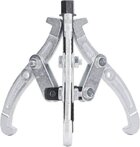
I've adjusted and repaired several tailstocks for others. Some had rusted or got gummed up inside and the quill wouldn't slide. One had been abused and the quill was bent and stuck. I fixed them all. I've never had any problem removing the handwheel. If the set screws are remove and the wheel still doesn't slide off the end, I'd try dousing the end with penetrating lubricant, and after waiting a bit lock the quill and try to either twist the handwheel or use a thin wedge like a putty knife encourage it to slide backwards. If the set screws in the handwheel have been overtightend, they may have deformed the metal and the wheel may need extra encouragement.
Are you a member of a woodturning club or have experienced turners nearby? Often having someone else look at the problem can immediately see the problem while others have to make long-distance guesses and assumptions.
JKJ