
This is true. Can get a MUCH cleaner end surface with a facing cut with the long point of a sharp skew but it does take a bit of practice to avoid catches. (Or use my invention, the "catchless skew". They laughed when I described it but it works. Limited to just a single purpose, though.)the parting tool leaves a very rough, torn-out surface.

Or a trained termite? BTW, have a fine blade saw.I'll attack those nubbins any number of ways, in no particular order:
-Parting tool to clean cut one end, then remove the other by way of...
-this small flush cut trim saw, and I bought a replacement blade for it as well. https://www.leevalley.com/en-us/shop/tools/hand-tools/saws/japanese/101323-japanese-kugihiki-saw
-a very sharp carving knife to pare away the waste wood.
-sandpaper.
-and usually any combination of the methods above.
I've tried training termites, and wood eating wasps, but just about the time we are in sync with each other, they die off.Or a trained termite? BTW, have a fine blade saw.
Says who?? I'd never call them that.Richard, that's the correct nomenclature. Very slow cutting on the bandsaw.
I used to keep a very sharp knife near the lathe just for this. Then one day I realized my skews were as sharp or sharper.-a very sharp carving knife to pare away the waste wood.
I've used the skew for this countless times, but for me, a carving knife (which I keep, and is easy to maintain, surgically sharp) if more controllable, since the design of the knife would include carving off spindle nubbins in its intended uses. Here is what I use.I used to keep a very sharp knife near the lathe just for this. Then one day I realized my skews were as sharp or sharper.
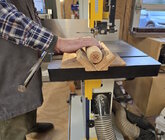
I just want to point out that to remove those small nubs on a bandsaw you do not actually have to turn the machine on. With the saw unplugged, set up for the cut (I'd use a miter guage), then open the cabinet and spin the top wheel by hand. Much safer. Although, I'd probably just use a small pull saw.Very slow cutting on the bandsaw.
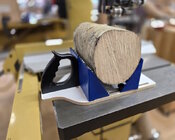
If you use a V-shaped cradle guided by a bar riding in the table's slot you can cut round stock quite safely. Will take a photo today and post.I just want to point out that to remove those small nubs on a bandsaw you do not actually have to turn the machine on. With the saw unplugged, set up for the cut (I'd use a miter guage), then open the cabinet and spin the top wheel by hand. Much safer. Although, I'd probably just use a small pull saw.
Yes! That's the best way.If you use a V-shaped cradle guided by a bar riding in the table's slot you can cut round stock quite safely. Will take a photo today and post.
I've used the skew for this countless times, but for me, a carving knife (which I keep, and is easy to maintain, surgically sharp) if more controllable, since the design of the knife would include carving off spindle nubbins in its intended uses.
Good idea, hadn't thunk o' that one.I have one of those for carving, keep with my chip carving knives.
I forgot to mention my favorite way these days - a hand scraper with a gentle curve on the end and a well-formed burnished burr. Not only removes nubs gracefully but can leave a beautifully smooth and flat surface, even on end grain.
This is true. Can get a MUCH cleaner end surface with a facing cut with the long point of a sharp skew but it does take a bit of practice to avoid catches. (Or use my invention, the "catchless skew". They laughed when I described it but it works. Limited to just a single purpose, though.)
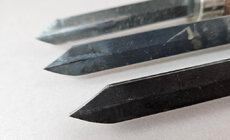
But if using a parting tool, I grind like the one at the bottom of this pic. Lets me basically do a peeling cut, cleaner than the typical rough scraping cut with the parting tool.
View attachment 85877
JKJ
Tenons.Says who?? I'd never call them that.
Tim
With a “diamond” parting tool (my favorite type) sharpened that way and honed to a razor edge, with the cutting edge at the widest part of the tool and when presented properly I find the peeling action is much like a skew and the cut clean.. The difference is in the width of the cut. If pealing a narrow groove the diamond shape does provides some side clearance but I still usually make two cuts, one a slight distance away from the finial cut to provide a bit of clearance.I'm guessing that even a peeling cut with a skew is better than using a parting tool. Will test that today. Peeling cuts are pretty easy.
Correct, as Richard said. Not bumps. And again, a router is a sure-fire way to remove even quite large ones.Tenons.
If you use a V-shaped cradle guided by a bar riding in the table's slot you can cut round stock quite safely. Will take a photo today and post.