• The forum upgrades have been completed. These were moderate security fixes from our software vendor and it looks like everything is working well. If you see any problems please post in the Forum Technical Support forum or email us at forum_moderator (at) aawforum.org. Thank you
  • March 2026 Turning Challenge: Olla! (click here for details)
  • Congratulations to David Wyke, People's Choice in the February 2026 Turning Challenge (click here for details)
  • Congratulations to Dave Bell for "Torus Teapot" being selected as Turning of the Week for March 9, 2026 (click here for details)
  • Welcome new registering member. Your username must be your real First and Last name (for example: John Doe). "Screen names" and "handles" are not allowed and your registration will be deleted if you don't use your real name. Also, do not use all caps nor all lower case.

Dealing with end bumps?

Joined
Jan 24, 2010
Messages
3,277
Likes
1,006
Location
Cleveland, Tennessee
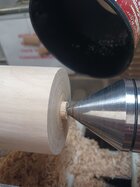
I'm working on turning some crosses for the upcoming Easter season. Got everything started with a live center and a spur drive, squared off with a 1/4 inch parting tool. Now...I'm looking at the ends with the bumps. How do you deal with them? Photos enclosed.
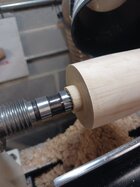
20260307_113917.jpg20260307_113928.jpg
 
First of all, I would use a smaller spur drive, such as a half-inch drive or a ring center (see link below). If you use the Steb-type drive shown in the photo for safety's sake, the ring center provides the same level of safety and drive capabilities without leaving big marks or needing to leave nubs at either end. I suspect, also, using this set-up would save sanding time - the parting tool leaves a very rough, torn-out surface. If the stock was originally cut clean at the ends (miter saw, table saw, good bandsaw blade), the ring marks and teeny-tiny hole from the ring set from Axminster (or others?) would be easy to sand out.

If you prefer the drive and live centers you have, try leaving longer nubs, bevel the nubs down ward toward the project until there's a very small amount of wood left, face off the ends with a sharp skew rather than a parting tool and proceed to 4emove the nubs
 
Last edited:
I turn small then cut with a saw, finish by hand with a skew.

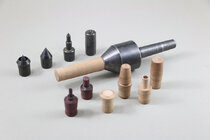
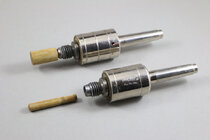
But another easy way is to make wooden pressure tips for live centers. You can cut them away completely without damaging the tool edge.

Below the Nova live center in this pic are some I've made for various things. Knocking the included steel centers out of the live center reveals a short #2Morse Taper - I just turn short MTs to fit and make what I need at the time.
1772913205262.jpeg

You can do something similar with the common Oneway live center and clones - knock out the center tip and the turn a short #0 Morse Taper with the wooden extension or attachment desired.

1772913451806.jpeg

BTW, I use these types of custom wooden centers a LOT. Just the thing to, for example, support the end of a longish thin spindle such with a hole drilled in the end, or the end of a conductors baton without a hole - in this case I drill a small hole in the live center extension to fit.

JKJ
 
the parting tool leaves a very rough, torn-out surface.
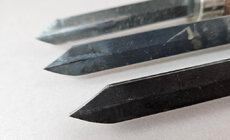
This is true. Can get a MUCH cleaner end surface with a facing cut with the long point of a sharp skew but it does take a bit of practice to avoid catches. (Or use my invention, the "catchless skew". They laughed when I described it but it works. Limited to just a single purpose, though.)

But if using a parting tool, I grind like the one at the bottom of this pic. Lets me basically do a peeling cut, cleaner than the typical rough scraping cut with the parting tool.

1772914118031.jpeg

JKJ
 
Knocked off the headstock end with the bandsaw and finished with the belt sander. Other end was cut on the bandsaw and a light tough on the disk sander.
 
I'll attack those nubbins any number of ways, in no particular order:
-Parting tool to clean cut one end, then remove the other by way of...
-this small flush cut trim saw, and I bought a replacement blade for it as well. https://www.leevalley.com/en-us/shop/tools/hand-tools/saws/japanese/101323-japanese-kugihiki-saw
-a very sharp carving knife to pare away the waste wood.
-sandpaper.
-and usually any combination of the methods above.
Or a trained termite? BTW, have a fine blade saw.
 
Or a trained termite? BTW, have a fine blade saw.
I've tried training termites, and wood eating wasps, but just about the time we are in sync with each other, they die off.
 
I used to keep a very sharp knife near the lathe just for this. Then one day I realized my skews were as sharp or sharper.
I've used the skew for this countless times, but for me, a carving knife (which I keep, and is easy to maintain, surgically sharp) if more controllable, since the design of the knife would include carving off spindle nubbins in its intended uses. Here is what I use.
 
Very slow cutting on the bandsaw.
I just want to point out that to remove those small nubs on a bandsaw you do not actually have to turn the machine on. With the saw unplugged, set up for the cut (I'd use a miter guage), then open the cabinet and spin the top wheel by hand. Much safer. Although, I'd probably just use a small pull saw.
 
I just want to point out that to remove those small nubs on a bandsaw you do not actually have to turn the machine on. With the saw unplugged, set up for the cut (I'd use a miter guage), then open the cabinet and spin the top wheel by hand. Much safer. Although, I'd probably just use a small pull saw.
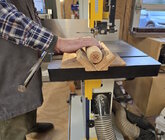
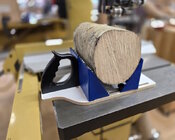
If you use a V-shaped cradle guided by a bar riding in the table's slot you can cut round stock quite safely. Will take a photo today and post.
 
I've used the skew for this countless times, but for me, a carving knife (which I keep, and is easy to maintain, surgically sharp) if more controllable, since the design of the knife would include carving off spindle nubbins in its intended uses.

I have one of those for carving, keep with my chip carving knives.

I forgot to mention my favorite way these days - a hand scraper with a gentle curve on the end and a well-formed burnished burr. Not only removes nubs gracefully but can leave a beautifully smooth and flat surface, even on end grain.
 
I have one of those for carving, keep with my chip carving knives.

I forgot to mention my favorite way these days - a hand scraper with a gentle curve on the end and a well-formed burnished burr. Not only removes nubs gracefully but can leave a beautifully smooth and flat surface, even on end grain.
Good idea, hadn't thunk o' that one.
 
I have a Dremel with a sanding drum. That should get the big pieces then sand the piece.
 
This is true. Can get a MUCH cleaner end surface with a facing cut with the long point of a sharp skew but it does take a bit of practice to avoid catches. (Or use my invention, the "catchless skew". They laughed when I described it but it works. Limited to just a single purpose, though.)

But if using a parting tool, I grind like the one at the bottom of this pic. Lets me basically do a peeling cut, cleaner than the typical rough scraping cut with the parting tool.

View attachment 85877

JKJ

I'm guessing that even a peeling cut with a skew is better than using a parting tool. Will test that today. Peeling cuts are pretty easy.
 
There are multiple options. I will usually turn that stub down to maybe 1/8 inch diameter and then remove from the lathe. Any smaller than that and you run the risk of it breaking off, and it ALWAYS will leave a divot/hole where the end grain tears out. Most of the time I will use a spindle detail gouge which is more pointed than rounded. It is great for getting in close to the work. A skew chisel works, depending on what your skill level with the skew is. The surface you show is a bit rough and will require 80 grit. You can watch Richard Raffen and Tomislav use that end grain cut and try to learn that one. Mostly it will save a LOT of sanding. There is also a Cindy Dorzda/Stuart Batty/Allan Batty tool that they call a "Vortex" tool. This is half round bar stock, and Doug Thompson has "fluteless gouges" which is what these are made from, and it is much more pointy than most spindle detail gouges. The main idea is to get better and most importantly cleaner cuts prior to nibbling down the bump at the end of a spindle turning. I guess you could leave more tenon on the end so you have more room to get other tools in to get cleaner cuts. 10,000 more times!

robo hippy
 
Simplest answer is to have slightly longer waste material. Then it's easy to manage with your usual tools by cutting it tapered down toward the base of the cross. As Robo mentioned, leave 1/8-1/4" of diameter, depending on the wood, then off the lathe, cut or saw off and sand the little remaining nub. A disc or belt sander makes quick work of it, but it's not hard to do by hand. You can do bigger diameter nubs on the band or disc sander, but it tends to scorch the wood. ( I have skew coaching sessions at my tiny shop periodically and you're welcome to stop by when you're in the neighborhood, Gramps. Hey, everybody gets to Yellowstone, some day)
 
I'm guessing that even a peeling cut with a skew is better than using a parting tool. Will test that today. Peeling cuts are pretty easy.
With a “diamond” parting tool (my favorite type) sharpened that way and honed to a razor edge, with the cutting edge at the widest part of the tool and when presented properly I find the peeling action is much like a skew and the cut clean.. The difference is in the width of the cut. If pealing a narrow groove the diamond shape does provides some side clearance but I still usually make two cuts, one a slight distance away from the finial cut to provide a bit of clearance.

With a parting too ground the "normal" way, the surface is not nearly as clean.

Another way to flatten the end of a cylinder is put in in a v-block perpendicular to a 10" disk sander and twist gently.

But if one end of the piece is held firmly in a chuck, I often just clean up the cut end with a good NRS. Quicker than a hand scraper and with good control will make in incredibly flat smooth surface. But if further turning to make a box or something, the only value for this is the practice.

JKJ
 
I have several flush cut hand saws that remove them very well (think cutting dowels flush in flat ww). For the TS end, a spindle gouge can get it very small by rotating the lower edge into the side of the nub, lathe turning, let of most of the quill force. Knife or chisel to remove the rest, sand. HS end, after thinning the TS end with a SG, stop lathe, use flush cut saw while still mounted, rotate by hand around and around as cut deepens, keeps surface flat.
 
If you use a V-shaped cradle guided by a bar riding in the table's slot you can cut round stock quite safely. Will take a photo today and post.

Finally got some photos. The small one is shop-made, lined with sandpaper to keep stock from spinning. The large blue one is a Carter. The Carter has teeth to prevent spinning, and the front part is adjustable. I've cross-cut log pieces as large as 12" diameter, maybe more (yes, I usually use a chainsaw). Always shim the stock if it wants to rock laterally (right to left).
V cradle small Edx.jpg
V cradle Carter Edx.jpg
 
Back
Top